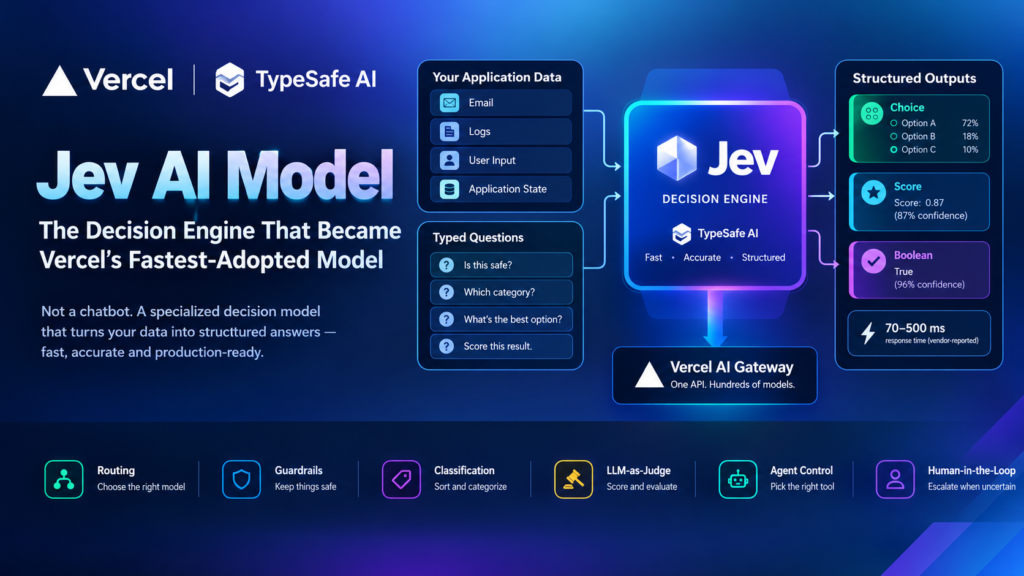
The Jev AI model is a specialized decision model from TypeSafe AI. It takes your application’s data plus a list of typed questions and returns choices, scores, or true/false answers with probabilities, never prose. Within 24 hours of launching on AI Gateway, it reached more than twice as many paid teams as any previous model launch. vercel
Every other AI launch this year promised a smarter conversationalist, and the one that won the adoption race cannot write a sentence. This guide explains what the Jev AI model is, how it works, why developers adopted it so quickly, and where the hype needs a reality check.
A note on sourcing: adoption figures come from Vercel’s own announcement. Speed and cost multipliers come from TypeSafe AI’s internal evaluations, not independent benchmarks.
Key Takeaways
- What it is: The Jev AI model is a decision model, not a chatbot. State goes in, and typed Choice, Score, or Boolean answers come out with probabilities attached. aiweekly
- Adoption: By hour 24, nearly 13% of Vercel’s paid teams were using it, roughly 2x the GPT-5.6 family and over 6x Fable 5.1. vercel
- Speed and price: TypeSafe AI cites response times of 70–500 ms and prices input at $0.042 per million tokens with free output. ai-market-watch
- Best fit: Routing, guardrails, classification, and LLM-as-judge checks.
- Caveat: Early adoption is not the same as lasting adoption, and Vercel said so itself.
What Is the Jev AI Model?
Definition
The Jev AI model is a probabilistic decision model built for making structured decisions inside software. Jev was introduced on September 15 and evaluates its questions in parallel. It returns answers that code can use directly. vercel
A decision model is a model whose job is to choose, not to compose. Instead of generating a paragraph that a developer must then parse, validate, and guardrail, it hands back a value the program can branch on: yes or no, option A through D, or a score from 0 to 1. That makes it unusually easy to slot into routing, moderation, and evaluation workflows. sacra
How Is It Different from a Chatbot?
A chatbot is optimized for human conversation. The Jev AI model is optimized for machine consumption. You give it data plus typed questions, and it returns decisions, not text. gitconnected
The difference shows up in three places:
- Output format: structured values rather than free text.
- Confidence: every answer carries a probability, so your code can decide when to trust it.
- Latency profile: it is built for many small, fast decisions rather than long generations.
How Does the Jev AI Model Work?
Short answer: The Jev AI model reads application state, evaluates typed questions in parallel, and returns structured answers with calibrated probabilities. The company has not disclosed the underlying architecture.
What Goes In and What Comes Out
You provide the data (an email, a command, a log line, a user message) and one or more questions with a declared answer type. Jev’s answers can be used to verify model outputs, enforce guardrails, or send uncertain cases for human review. The probability is what makes the last use practical. If the model is 97% sure a command is safe, run it. If it is 55% sure, escalate. vercel
What Is a “System One” Model?
TypeSafe AI calls Jev a System One model. The phrase borrows from psychology’s fast, intuitive mode of thinking, as opposed to slow, deliberate reasoning. TypeSafe AI says the name itself honors the economist William Stanley Jevons. The idea is that most production AI work is quick judgment, not extended reasoning, and a model built only for judgment should be faster and cheaper than a general one. aiweekly
How Was It Trained?
Jev was trained entirely on synthetic data, which founder Diogo Almeida has called one of his best bets. TypeSafe AI describes its method as Reinforcement Learning for Calibrated Decisions. The architecture itself remains a secret. Almeida stayed tight-lipped about it, and outside observers suspect an open-weight language model underneath, TechCrunch reported. Treat that as speculation until TypeSafe AI says otherwise. Member-only story +2
Who Is Behind It?
TypeSafe AI, founded by ex-OpenAI researcher Diogo Almeida, opened early access to Jev on September 15, 2026, after two years in stealth and a $40 million seed round led by DCVC. Almeida worked on training methods that later formed the basis of ChatGPT. ai-market-watchdev
His pitch is a critique of the field. Four years of work on conversational models produced systems that are superb at talking to people, he told TechCrunch. His answer is a model that does not talk at all. thenextweb
How Fast Was the Jev AI Model Adopted?
Short answer: Nearly 13% of Vercel’s paid AI Gateway teams used it within 24 hours, the fastest adoption in the gateway’s history.
The Numbers
Jev passed every other comparison model in its first twelve hours and kept widening its lead. It reached a tenth of teams within 18 hours, while every other recent launch stayed below 7% after a full day. vercel
The ecosystem moved just as quickly. Vercel, Cloudflare, LangChain, and Langfuse all integrated it within three days. gitconnected
Context Behind the Headline
The adoption figure for the Jev AI model deserves context before anyone treats it as a quality ranking.
First, the metric measures teams that tried it, not volume or retention. Vercel itself noted that the next test is whether early adoption lasts. vercel
Second, price may have helped. Vercel was reportedly giving Jev away on its gateway until 25 September. Free access lowers the barrier to experimentation and likely inflated first-day trial numbers. thenextweb
Third, AI Gateway sits in live developer traffic, so teams were swapping Jev into existing production model menus almost immediately. That is a meaningful signal, but it also reflects how easy the gateway makes switching. sacra
Jev AI Model vs. General-Purpose LLMs
The table below summarizes where each approach fits. Jev figures reflect vendor claims.
| Dimension | Jev | General-purpose LLM |
|---|---|---|
| Primary output | Typed Choice, Score, or Boolean | Free-form text |
| Confidence signal | Probability attached to every answer | Usually none, or inferred indirectly |
| Typical latency | 70–500 ms (vendor-reported) | Often seconds for full responses |
| Input pricing | $0.042 per million tokens, output free | Varies widely, output usually billed |
| Best for | Routing, guardrails, classification, judging | Writing, reasoning, coding, conversation |
| Parsing needed | None | Often required, plus validation |
| Can write or chat | No | Yes |
The Jev AI model wins when the task is narrow, repetitive, and well-defined. A general LLM wins when you need generation, open-ended reasoning, or flexible handling of tasks no one anticipated. Most production stacks will use both.
Where the Jev AI Model Fits in Production
Jev targets the unglamorous majority of production AI: routers, guardrails, classifiers, and LLM-as-judge checks. These are the jobs where developers were already paying frontier-model prices for a yes-or-no answer. gitconnected
Typical use cases:
- Model routing: decide which model a request needs before spending money on it.
- Safety and guardrails: check whether an input or output is allowed.
- Classification: sort emails, tickets, or documents into categories.
- LLM-as-judge: score another model’s output against a rubric.
- Agent control: pick which tool to call or whether to act at all.
- Human-in-the-loop triage: escalate low-confidence cases for review.
Real-World Example: Vercel’s Command Safety Check
Vercel engineer Pranit Sharma swapped the OpenAI model behind a command-safety classifier for Jev and got results 5 to 18 times faster, with better accuracy. The task checks whether a command is safe to execute, which is a pure decision problem. gitconnected
Real-World Example: Sorting at Bryo AI
Bryo AI CTO Nikhil Mudholkar had Jev sort worksheets. The general pattern is that agents make many small decisions in a row, and calling a large model for each one can be too slow and expensive. devdev
What Does the Jev AI Model Cost?
Short answer: Input is priced at $0.042 per million tokens, with free output. ai-market-watch
That structure is unusual. Because the model returns short typed values, output tokens are tiny anyway, so making them free mostly removes a line item from the bill.
TypeSafe AI’s headline efficiency claims are large. In its own workflow evaluations, it reports Jev was up to 194 times faster and 445 times cheaper than language models. These are peak, in-house numbers on workflows chosen by the vendor. Run your own evaluation on your own data before budgeting around them. vercel
How to Start Using the Jev AI Model
Short answer: Call it through its API, official SDKs, a Vercel AI SDK provider, or the AI Gateway.
You can call it through an API using the model name jev-latest, with official JavaScript and Python SDKs. A practical rollout looks like this: gitconnected
- Pick one decision. Choose a narrow, high-frequency task such as spam triage or a safety check.
- Build a labeled test set. Gather a few hundred examples with known correct answers.
- Run Jev beside your current model. Compare accuracy, latency, and cost on the same inputs.
- Set confidence thresholds. Use the returned probabilities to decide when to auto-act and when to escalate.
- Ship behind a gateway. Keep failover to your existing model so you can switch back quickly.
What is the Vercel AI Gateway? It is a service through which developers can connect hundreds of AI models to their applications through a single API, without integrating each provider separately. That is why a specialized model can spread so fast there: trying one more model is a configuration change. dev
Limitations of the Jev AI Model
No tool fits every job, and the Jev AI model is explicit about what it gives up.
- It cannot generate text. If you need an answer, summary, or draft, you need another model.
- Benchmarks are self-reported. The big speed and cost multipliers are TypeSafe AI’s own numbers.
- The architecture is undisclosed. That limits how well outsiders can assess failure modes.
- Calibration must be verified. A probability is only useful if “90%” really means right nine times in ten on your data. Test it.
- Adoption data is early. Retention and production incident rates are not yet public.
It also helps to keep the underlying reliability issue in view. A model that does a job 95% of the time sounds good until the job runs millions of times. Calibrated confidence and human-review paths matter more than a headline accuracy number. thenextweb
What the Jev AI Model Signals for the Market
The broader lesson is about specialization. General LLMs may handle open-ended generation while specialized models take over narrow, high-frequency software decisions. That would mean a more fragmented model market, with different models for different jobs rather than one model for everything. sacra
Cost pressure points the same direction. TNW reported that AI model costs were already pushing startups toward cheaper open weights. Routing is a natural first target because predicting which model a job needs is useful, but using a language model to do it is expensive. thenextweb
Expect competition. Developer Armin Ronacher told TechCrunch he expects competitors now that the model’s utility is apparent. If decision models become a standard layer in AI stacks, the interesting questions will shift to calibration quality, evaluation tooling, and integration depth. thenextweb
Frequently Asked Questions
Is the Jev AI model a chatbot?
No. It does not generate text. It returns typed decisions with probabilities.
Who made it, and when did it launch?
TypeSafe AI launched it on September 15, 2026. The company was founded by ex-OpenAI researcher Diogo Almeida.
Why was it adopted so fast on Vercel?
It solves a narrow, expensive problem, returns code-ready output, and slots into an existing gateway with minimal changes. Free access during the launch window likely helped too.
Is the Jev AI model open source?
There is no indication that it is. The architecture is undisclosed, and access is through TypeSafe AI’s API and partner platforms.
Can it replace GPT-style models?
No. It complements them. Use it for decisions and a general model for generation.
Are the speed and cost claims independent?
No. They come from TypeSafe AI’s own workflow evaluations, so test them on your workloads.
The Bottom Line
The Jev AI model shows that “smaller and narrower” can beat “bigger and smarter” when the job is a decision. Its adoption record on the Vercel AI Gateway is real, and the use case is well chosen. The open questions are durability, independent validation, and how well its probabilities hold up in your domain. If you run routers, classifiers, or guardrails on a frontier model today, a side-by-side test of Jev is worth an afternoon.