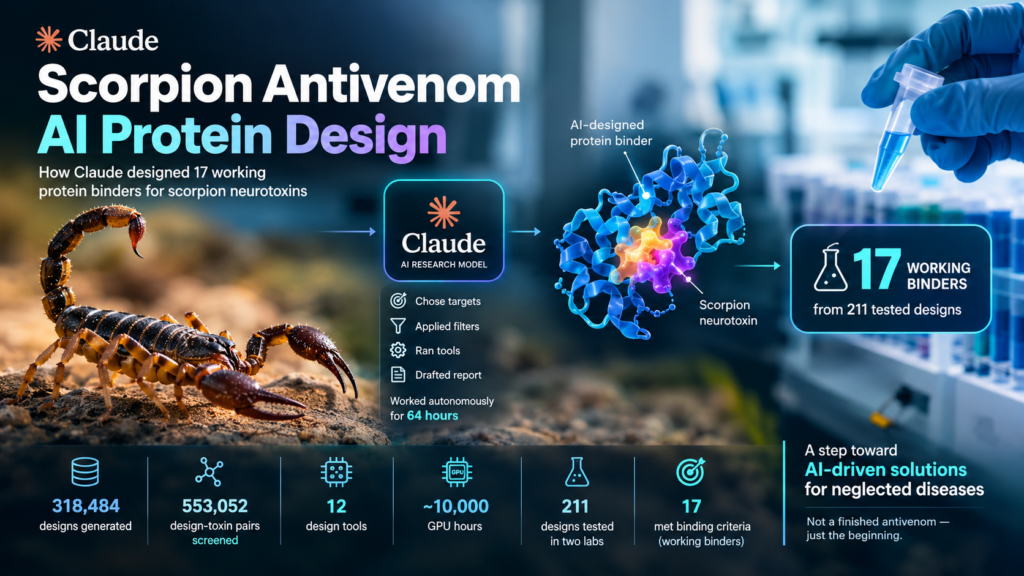
Claude did not create a finished antivenom, but it did design 17 protein binders that stuck to scorpion neurotoxins in lab tests. An internal research model worked mostly autonomously for 64 hours, generated 318,484 designs, and two outside labs tested 211 of them for binding. That is the honest summary of the Claude scorpion antivenom story. anthropic
The result matters because scorpion stings are a neglected health problem, and the project tests a bigger question. Can a small team of non-specialists use AI to start real drug discovery? This guide covers what happened, how it worked, what the numbers mean, and what still has to happen before any binder becomes a medicine.
What Did the Claude Scorpion Antivenom Experiment Actually Prove?
The experiment proved that an AI research model can design novel proteins that bind dangerous scorpion toxins, and that lab tests can confirm this within weeks. It did not prove that those proteins neutralize venom or protect any living animal.
Key takeaways:
- Scale: Claude produced 318,484 designs, screened 553,052 design-toxin pairs, and used 12 design tools over about 10,000 GPU hours. anthropic
- Hit rate: Of 211 designs tested, 17 met Anthropic’s strict criteria for a binder. anthropic
- Best performers: The two strongest binders, Cn2-B1 and Cn2-B2, bound the Mexican scorpion toxin Cn2 with single-digit nanomolar affinity. anthropic
- Biggest caveat: Anthropic says it has not confirmed neutralization in cells, so it does not claim to have produced an antivenom. anthropic
- Open data: All 211 designs and their experimental data were released for other researchers. anthropic
Anyone summarizing the Claude scorpion antivenom work should keep the first four points together. The headline number is real, and so is the limitation.
What Is the Claude Scorpion Antivenom Project?
Definition: The Claude scorpion antivenom project is an Anthropic research effort in which an internal Claude research model designed minibinders against scorpion neurotoxins. A minibinder is a small protein that attaches tightly to a specific target, and the hope is that such proteins could one day become the basis of an antivenom.
Expansion: The model worked inside Claude Science from one starting prompt and four follow-ups, developed in collaboration with the investment research firm Citrini Research. The goal was a first, measurable step: show that designed proteins can grip toxins that harm people. anthropic
Who Was Involved?
Four groups played distinct roles:
- Anthropic’s life sciences team framed the problem and supervised the work.
- Claude chose structures, set quality thresholds, ran the tools, and drafted the report. Under supervision, it analyzed the data, generated the figures, and wrote the final report. anthropic
- Citrini Research posed the original question and helped shape the prompt.
- Adaptyv Bio and Twist Bioscience are contract research organizations that made and tested the proteins.
Why Did Citrini Research Get Involved?
Citrini Research asked whether Claude, and AI drug discovery generally, could let a group of motivated non-experts tackle a genuine human-health problem. The firm is an investment research group, and its interest began as an investment question: how far has AI drug development really come? Scorpion toxins were a target where its team could see the gap between need and investment. anthropic36kr
Why Do Scorpion Stings Need New Treatments?
Short answer: Scorpion stings are common, sometimes lethal, and underserved by drug developers. Scorpions sting at least 1.2 million people a year, causing more than 3,250 deaths, mostly among children in regions with limited medical access. Because treatments are costly to make and rarely earn back development costs, scorpion envenomation has been described as a neglected tropical disease. anthropic
What Does Scorpion Venom Do to the Body?
The neurotoxins most dangerous to humans attach to sodium channels in nerve cell membranes, which makes nerves fire at the wrong times. That can release large amounts of stress chemicals such as adrenaline, and in severe cases it can cause heart failure and fluid in the lungs. anthropic
How Is Antivenom Made Today?
Traditional antivenoms usually come from immunized animals. Venom is milked from thousands of scorpions and injected into horses, and the resulting antibodies are purified from the horses’ blood. The process can take months. These products can work when given early, but they generally cover only a small number of neurotoxins, and in many regions they are expensive or in short supply. anthropicanthropic
What Is the Promise of De Novo Design?
De novo design means generating proteins from scratch against a chosen target. These binders are designed computationally and can be optimized for properties like potency and stability, which could make them easier to supply where stings are most common. That is the logic behind any Claude scorpion antivenom effort: replace a slow, animal-dependent pipeline with a computational one, if the proteins also prove safe and effective. anthropic
How Did Claude Design the Scorpion Toxin Binders?
Claude chose its own targets, filters, and strategies inside rules set by the researchers. The campaign had three moving parts: the toxins, the autonomous workflow, and the human follow-ups.
Which Toxins Did Claude Target?
The team chose five neurotoxins from four regions, and aimed each design at the toxin’s sodium-channel-binding site. anthropic
| Toxin | Region | Toxin family |
|---|---|---|
| Cn2 | Mexico | β |
| Ts1 | Brazil | β |
| AaH I | North Africa | α |
| AaH II | North Africa | α |
| LqhIII | Middle East | α |
The five share one overall fold, but any two are only 26% to 62% identical in amino acid sequence, which made them a hard test for designs meant to hit several toxins at once. Claude searched the Protein Data Bank and the AlphaFold database for toxin structures, then picked five hotspots on each toxin for its binders to latch onto. anthropicanthropic
What Did Claude Do Autonomously?
The initial prompt defined the targets, the design and folding tools, and the rules for novelty, scoring, and filtering. Claude then:
- Set the quality thresholds a design had to clear
- Decided how heavily to rely on each available tool
- Developed strategies for multitoxin binders
- Filtered out designs resembling a known toxin or protein
- Co-folded each design with its toxin to predict the complex
After 64 hours it delivered a final list of 180 designs. The team then added 31 more with Claude’s help, bringing the total to 211. anthropic
How Much Did Humans Steer the Process?
Claude worked on its own for the first 24 hours. The team then used follow-up prompts, mostly to push for a multitoxin binder, and Claude selected most of the 180 designs, including the strongest binder, only after the third follow-up. Humans also chose the indication and targets, defined the tools and selection rules, and prompted four times. The honest description is a supervised agent rather than a fully independent scientist. anthropickingy
At the team’s request, Claude even emailed the protein sequences to Twist Bioscience, with the emails labeled as written by Claude. anthropic
What Did the 211 Designs Cover?
The set included 60 single-toxin designs (12 per toxin), 30 aimed at the two β toxins, 30 aimed at the three α toxins, and 91 aimed at all five toxins. anthropic
How Were Claude’s Designs Tested in the Lab?
Two independent labs measured binding, using complementary methods, and a design had to pass at both. This is what makes the Claude scorpion antivenom results more credible than a computer prediction alone.
What Methods Did the Labs Use?
- Adaptyv Bio expressed designs in a cell-free system that uses protein-making machinery extracted from bacteria. anthropic
- Twist Bioscience expressed them in human kidney cells as fusions to an antibody stem called Fc. anthropic
- Both labs measured binding by surface plasmon resonance (SPR), which tracks in real time how a toxin attaches to and detaches from a design. The result is a dissociation constant (KD), and a lower KD means tighter binding. anthropic
What Counted as a Binder?
A design had to be a hit at both labs, showing binding in every replicate with every KD at 1 µM or tighter. It also had to show no signal against CLEC12A, an unrelated human protein used to detect off-target “stickiness.” (LqhIII was assessed only by Adaptyv Bio.) anthropic
Results of the Claude Scorpion Antivenom Campaign
Seventeen of the 211 designs met the criteria, and each was a binder against a single toxin. anthropic
| Toxin | Binders found |
|---|---|
| Cn2 | 7 |
| AaH II | 4 |
| AaH I | 4 |
| LqhIII | 2 |
| Ts1 | 0 |
Among the 60 single-toxin designs, 11 were binders (18%), a rate consistent with typical protein design campaigns, including Anthropic’s earlier work. The hit rate is respectable and unremarkable, which is itself informative: the novelty is the speed and autonomy, not an unusually high success rate. anthropic
What Made Cn2-B1 and Cn2-B2 Stand Out?
Both bound Cn2 tightly at both labs, with single-digit nanomolar affinity. Competition experiments suggest they attach on or near the same site as an antibody called LR, which has been reported to neutralize Cn2 in mice. That makes neutralization plausible, but plausible is not proven. anthropicanthropic
Why Did the Multitoxin Designs Fail?
None of the designs made against multiple toxins met the criteria for more than one toxin. Anthropic lists several possible reasons, including Claude’s current capabilities, the prompting, limits of the available tools, and the biology itself. A universal cocktail of few molecules would be the cheapest route, so this remains an open goal. anthropic
What the Claude Scorpion Antivenom Work Does Not Prove
Binding is necessary for an antivenom but nowhere near sufficient. Three gaps stand out:
- No neutralization data. Neither in vitro tests in lab-grown cells nor in vivo tests in animals were done. anthropic
- Recombinant toxins only. The binding results use toxins grown from their genes, not toxin purified from venom. anthropic
- No drug-development work. A therapy must also be safe, stable, affordable, and available where stings happen.
Anthropic’s own next steps for Cn2-B1 would be confirming binding to venom-purified toxin, running patch-clamp recordings to see whether it blocks the toxin’s action on sodium channels, and then testing protection in mice. Treat any headline calling this a finished Claude scorpion antivenom as overstated. anthropic
Claude Scorpion Antivenom Candidates vs. Traditional Antivenom
| Factor | Traditional antivenom | AI-designed binders (current status) |
|---|---|---|
| Source | Antibodies from immunized horses | Computationally designed proteins |
| Development time | Months for production | Designs in days, lab binding in weeks |
| Toxin coverage | Usually a small number of toxins | Binding shown for four toxins, one design per toxin |
| Cost and supply | Often expensive or scarce | Unproven; design could allow cheaper manufacturing |
| Neutralization evidence | Established when given early | Not yet tested |
| Animal dependence | Yes | No for the design step |
The right column shows promise, but it is largely hypothetical. Advantages such as consistent production, stability, or lower cost are reasons to do the work, but this study did not establish them for these binders. kingy
What Does This Mean for AI Protein Design?
Both outside experts described the work as a promising first step. Susana Vázquez Torres of CNIO in Madrid said designing a binder against almost any target no longer seems unrealistic, and that binding itself is no longer the main bottleneck. The real impact will come from the parts of the therapeutic pipeline beyond binding. Timothy P. Jenkins of the Technical University of Denmark called designing credible binders against five toxins in parallel, in days, a strong showcase of the AI-driven shift in therapeutic discovery, especially for neglected diseases. anthropicanthropic
Can Non-Experts Now Do AI Protein Design?
Partly. Reporting on the collaboration describes a five-person investment team, a budget of $200,000, and three months of work. Citrini’s estimates put compute alone at nearly $50,000. That is far below a traditional program but not casual spending. Anthropic also acknowledges that this much compute is more than most researchers can access, and notes a simplified single-agent, single-GPU prompt reached comparable in silico scores over 24 hours. eu.36kr.com +2
Why Does the Data Release Matter?
Because outside groups can verify and extend the work. Anthropic published all 211 designs with predicted structures, scores, and experimental data, plus a technical report. Neglected-disease research benefits when negative results and raw data are public, not just the 17 successes. anthropic
Frequently Asked Questions
Did Claude create a scorpion antivenom?
No. Claude designed proteins that bind scorpion neurotoxins in lab tests. Anthropic says it has not confirmed that they neutralize venom in cells, so the Claude scorpion antivenom work is a binder-design milestone, not a treatment.
How many designs worked?
Seventeen of 211 tested designs met the binder criteria: seven against Cn2, four each against AaH I and AaH II, and two against LqhIII.
How long did Claude take?
Sixty-four hours from the initial prompt to the final list of 180 designs, with four human follow-ups along the way.
Who tested the designs?
Adaptyv Bio and Twist Bioscience, two contract research organizations, tested the designs independently using surface plasmon resonance.
Why scorpions?
Citrini wanted a newer, less noticed target after earlier AI protein design work on snake venom. Scorpion envenomation is also medically serious and commercially neglected. 36kr
What happens next?
The logical sequence is venom-purified toxin binding, cell-based neutralization tests, then mouse protection studies, followed by safety, stability, and cost work. None of that has been reported yet.
Is the Claude scorpion antivenom data public?
Yes. Anthropic released all 211 designs and their experimental data on Hugging Face so other labs can build on them.
Bottom Line
The Claude scorpion antivenom experiment shows that AI protein design can move from a prompt to lab-verified binders against hard toxin targets in days. It does not show a working antivenom. The distance between those two claims is exactly where the next experiments, and the next headlines, will land. For now, the Claude scorpion antivenom story is best read as a credible proof of concept for neglected-disease drug discovery, one that stays unproven until neutralization data exists.
The most important next step is determining whether the strongest candidates, Cn2-B1 and Cn2-B2, can do more than attach to the Mexican scorpion toxin Cn2. Researchers need to test whether these proteins can block the toxin’s biological activity, first in controlled cellular experiments and eventually in animal studies. They must also establish whether the binders remain effective when exposed to toxins purified directly from scorpion venom rather than laboratory-produced versions.
These tests will help determine whether AI-designed proteins can become practical therapeutic candidates. Even successful neutralization would not immediately translate into a treatment. Scientists would still need to investigate safety, stability, manufacturing costs, dosage, and how quickly a potential medicine could reach patients after a sting. Affordability and reliable distribution will be particularly important in regions where scorpion envenomation causes serious illness and access to medical care is limited.
Another important outcome is the release of all 211 tested designs and their experimental data. By making these results available, Anthropic gives independent researchers an opportunity to examine successful binders, learn from unsuccessful candidates, and develop improved designs. This openness could help accelerate future research into scorpion toxins and other neglected diseases.
Ultimately, the breakthrough is not that Claude has solved scorpion envenomation. It is that an AI research model helped generate testable protein candidates against difficult biological targets within a short period. If future experiments demonstrate genuine toxin neutralization and safety, this approach could become a valuable part of drug discovery. Until then, the results represent an encouraging scientific milestone, not a replacement for established antivenom treatment.