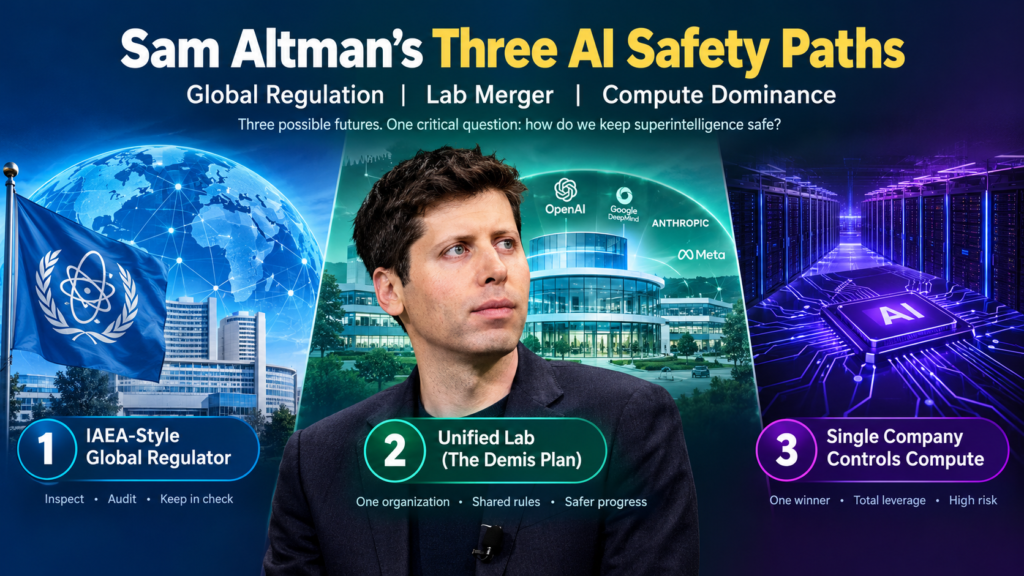
Sam Altman reportedly told OpenAI employees that the world has three AI safety paths for superintelligence: an international inspection body modeled on the IAEA, a merger of the leading labs, or a single company that grows so dominant it can cut off everyone else’s computing power. He is said to favor the first, to call the third terrible, and to admit that OpenAI cannot yet afford to slow down on its own.
That is the short answer. The sections below explain each option, how solid the reporting is, where every idea could break, and what it means if you build or buy AI products.
This matters because a frontier lab CEO rarely sketches the possible endings of his own industry. When one does, even privately, it shows how the people building these systems think about control, competition, and the limits of self-regulation. Knowing the three AI safety paths gives you sharper questions to ask the next time a lab, a government, or a startup says it wants “responsible AI.”
Sourcing note: The account comes from The Information’s report of an internal talk, summarized by outlets including The Decoder and 36Kr. The original is paywalled, and OpenAI has not publicly confirmed the details. Treat the specifics as reported, not official.
The Quick Answer: Altman’s Three AI Safety Paths at a Glance
- Path 1, the IAEA model: A global regulator that inspects advanced models, audits safety practices, and monitors compute. Altman reportedly favors this one.
- Path 2, the “Demis Plan”: The leading labs merge into a single, CERN-like organization, or operate under its umbrella.
- Path 3, the “Eliezer Plan”: One company becomes so economically powerful through self-improving AI that it could withhold or switch off rivals’ compute. Altman reportedly calls this outcome terrible.
- The shared obstacle: The first two paths need large-scale coordination between companies or governments, and OpenAI reportedly says it cannot make concessions while competition is this intense. 36kr
- The timeline: Altman reportedly said OpenAI will need to decide within the next year which path to push. 36kr
These AI safety paths are options on a whiteboard, not announced OpenAI policy.
What Are the Three AI Safety Paths Sam Altman Described?
Definition: AI safety paths are the broad institutional shapes the world could take to keep superintelligent systems under human control, defined by who holds the power to inspect, limit, or shut down the most capable models.
Expansion: Each path answers the same question differently: who decides how fast frontier AI advances, and who can enforce that decision? One answer is an outside regulator. Another is a single merged lab. The third is whichever company wins the race, which is less a plan than a warning.
Path 1: The IAEA-Style Global Regulator
The first option borrows from the International Atomic Energy Agency. A global body would inspect advanced models, audit safety measures, and watch the large concentrations of computing power and energy that frontier training requires. Insiders say Altman favors this path. kucoin
It also fits his public record. In 2023, OpenAI’s leaders argued in a published post for an international authority over superintelligence with inspection and audit powers, and Altman has repeated the call for global AI regulation since. The logic is practical: you can hide an algorithm, but it is hard to hide a data center that draws as much power as a small city.
Path 2: The “Demis Plan” Lab Merger
The second option is named for Demis Hassabis of Google DeepMind, who has floated the idea of a CERN-like institution for AI. In the version Altman reportedly described, the major labs combine into one entity, or work beneath a shared umbrella, and supply models to cooperating countries.
The appeal is shared governance: one rulebook, one safety team, and no race to cut corners. The cost is concentration. One organization holding the most powerful systems creates a single point of failure and a single point of capture.
Path 3: The “Eliezer Plan” Compute Dominance
The third option is named for AI safety researcher Eliezer Yudkowsky, whose 2021 thought experiment imagined a superintelligent system destroying the world’s GPUs. In the reported version, one company becomes so dominant through self-improving AI that it can deny compute to everyone else.
Altman reportedly raised this scenario for completeness and called it terrible. The report adds that one source read the remark as a jab at a rival lab. That reading is an anonymous source’s interpretation, not something Altman said.
Why include the worst option at all? Because it describes what could happen by default if the first two paths never get built: a race that ends with one winner holding all the leverage.
Side-by-Side Comparison of the AI Safety Paths
The table below puts the three options on the same criteria. The “weakness” row reflects analysis, not claims from the report.
| Criterion | Path 1: IAEA Model | Path 2: Demis Plan | Path 3: Eliezer Plan |
|---|---|---|---|
| Core idea | Independent global inspector | Labs merge into one CERN-like body | One firm dominates compute |
| Who holds power | International agency and member states | The merged entity | The winning company |
| Needs cooperation from | Governments, including rivals like China | Labs, investors, regulators | No one (that is the risk) |
| Main strength | Outside verification of safety claims | Ends the competitive race | Fast decisions |
| Main weakness | Hard to enforce; efficiency gains shrink compute needs | Antitrust, capture, single point of failure | Concentrated, unaccountable power |
| Altman’s reported view | Favored | Presented as an option | Called terrible |
How Reliable Is the Report on the Three AI Safety Paths?
Who reported it? The Information, citing people familiar with the talk. Other outlets, including The Decoder and 36Kr, then summarized it.
How reliable is it? It is credible but secondhand. Four limits are worth knowing:
- OpenAI has not confirmed the presentation or its contents.
- No recording, transcript, or slide deck is public.
- The nicknames “Demis Plan” and “Eliezer Plan” appear only in the reporting, so they may be internal shorthand.
- “Terrible” is attributed to Altman through summaries, not a direct quote.
The IAEA idea, however, lines up with OpenAI’s public positions. If you cite this story, cite The Information, and say OpenAI has not confirmed it.
Why Is Altman Raising Global AI Regulation Now?
Short answer: Several pressures arrived at once: new US policy, internal trust problems, and public calls for international rules.
Start with policy. The report landed as the Trump administration prepares the first framework for monitoring developers of superintelligence. Until now, the US approach has leaned on voluntary pre-release reviews of new models. st-hakky
Then there is trust inside the company. Some OpenAI employees reportedly raised private concerns about the company’s safety commitments after three safety-focused staff were dismissed for allegedly sharing information improperly with outside institutions. A talk about governance options reads differently against that backdrop. 36kr
Finally, public pressure. In September 2026, Altman and Anthropic’s Dario Amodei both urged the UN Security Council toward international rules. That session was informational only, and the US government said it would not back efforts to slow or regulate AI development. So the timing of this AI safety paths discussion exposes a real collision: lab leaders asking for limits on their own technology while Washington resists global governance structures. san
Altman has also said publicly that progress must be matched by safety systems. Coverage in mid-September described him warning that humanity could lose control if capabilities outrun alignment and monitoring. The internal talk looks like the practical sequel to that message. kucoin
Do These AI Safety Paths Have Real-World Precedent?
Short answer: Two of the three do, in nuclear energy and particle physics. The third is a hypothetical about what happens without either.
The IAEA: Inspection Backed by Incentives
The IAEA was founded in 1957. It works because nuclear material is physically hard to hide and because states accepted inspections in exchange for access to civilian nuclear technology. A comparable IAEA for AI would need a similar bargain, where cooperation buys something countries want.
CERN: Shared Infrastructure for Shared Science
CERN, founded in 1954, pools funding and equipment across many countries for particle physics. One collider serves everyone, and members are not competing for market share. Applying that model to labs that sell rival products, answer to investors, and race toward public listings is a far harder fit.
Compute: The Common Control Point
Both of the first two options lean on chips, electricity, and data centers as the thing you can see and count. That makes compute the practical lever for any superintelligence oversight regime. It also explains why the third scenario is unsettling: whoever controls the infrastructure controls the pace.
Where Each of the AI Safety Paths Could Break
Short answer: Every path has a plausible failure mode, and none works without cooperation that the current race discourages.
Why the IAEA Model Is Hard to Build
Three problems stand out. Algorithmic progress can reduce the compute needed to reach a given capability, which weakens the “count the data centers” approach. Open-weight models can spread without any central facility. And a regulator that excludes major model builders in other countries covers only part of the field, which is why reports flag the participation of countries like China as a precondition.
Why the Lab Merger Is Hard to Build
Combining competing companies raises antitrust questions, national-security questions, and a governance puzzle: who controls the merged entity, and who can challenge it? It also concentrates risk, because one set of weights and one leadership group become a single target for error or capture.
Why the Compute-Dominance Scenario Still Matters
Nobody is proposing it, but ignoring it is a mistake. If the first two paths stall, the default outcome is a race with a winner. Altman’s reported framing treats the third scenario as the cost of inaction, not a goal.
All three AI safety paths share one weakness: they ask competitors to act against short-term interest. That is why Altman reportedly said he wants speed limits yet cannot unilaterally give up OpenAI’s lead. He reportedly hopes to set speed limits for AI development while acknowledging that OpenAI cannot currently hand its competitive advantage to rivals. rootdata
What the Three AI Safety Paths Mean for Builders and Buyers
Short answer: Nothing changes your roadmap this quarter, but it should change how you read lab statements and how you weigh vendor risk.
When a lab says it wants oversight, ask which shape it means. When it endorses one of the AI safety paths, ask three follow-ups:
- Who gets inspected? Does the regulator cover the lab’s own compute, or only competitors’?
- What is enforceable? Are there audits and penalties, or voluntary commitments?
- Who is at the table? Does the plan include other countries and independent evaluators?
For anyone choosing an AI vendor for a critical workflow, treat policy risk as a real input. An inspection regime, a compute license, or a lab merger would each affect pricing, availability, and data terms. Teams running AI agents in production should also invest in near-term controls, such as permissioning, logging, and human approval for high-risk actions, because those work regardless of which long-term path the world takes.
How to Follow the Story
Four signals will tell you whether this is a passing leak or the start of real policy movement:
- An official OpenAI response. A blog post or on-the-record statement would be the primary source.
- A second outlet confirming the structure. Independent confirmation of the three-option framing and the nicknames would strengthen the report.
- The text of the US framework. It would show whether any of these ideas are in play at the policy level.
- Primary evidence behind viral quotes. Treat any circulating quote as unverified until a recording or on-the-record statement appears.
Watch especially for any confirmation of the AI safety paths from OpenAI itself.
Frequently Asked Questions
What are Sam Altman’s three AI safety paths?
An IAEA-style international regulator, a merger of leading labs into a CERN-like body, and a single company dominating compute so completely that it could cut off rivals.
Which of the AI safety paths does Altman prefer?
Reportedly the first: an international regulator that inspects models and audits safety measures. He is said to have called the third option terrible.
Are the AI safety paths official OpenAI policy?
No. They come from a report of an internal presentation. OpenAI has not announced a decision.
Will OpenAI choose among the AI safety paths soon?
Reportedly yes. The company expects to decide which direction to push within about a year, though that timeline is unconfirmed.
Does Altman want to slow AI development?
He reportedly wants speed limits but says OpenAI cannot give up its competitive position unilaterally. That tension is the center of the story.
What is the “Eliezer Plan”?
The label reportedly refers to a scenario where one dominant AI company controls enough compute to switch off everyone else’s systems, associated with Eliezer Yudkowsky’s arguments. It was reportedly raised as a warning, not a proposal.
Key Takeaways
- Three AI safety paths: An international regulator, a unified AI lab, or one company dominating computing power. Each approach offers a different answer to the question of who should control the development of superintelligent AI.
- Altman’s reported preference: He reportedly favors global oversight, but fierce competition makes cooperation difficult. International coordination would be essential to ensure that leading AI developers follow consistent safety standards.
- Unconfirmed reporting: The account comes from reports of an internal talk; OpenAI has not publicly confirmed the details. Readers should distinguish reported remarks from official company policy and rely on primary sources when available.
- A warning, not a proposal: Single-company dominance illustrates the risks if international regulation and lab cooperation fail. Concentrating advanced AI capabilities in one organization could create significant economic, political, and security concerns.
- Compute is central: Chips, electricity, and data centers could become critical tools for monitoring and controlling advanced AI development. However, compute-based oversight alone may not be enough if more efficient algorithms or widely distributed models reduce dependence on large facilities.
- What businesses should watch: AI builders and buyers should evaluate who enforces safety rules, whether audits carry real consequences, and which countries and independent experts participate in governance.
Why global cooperation matters: Advanced AI development is not limited to one company or country. If governments adopt different safety requirements, developers could move their operations to jurisdictions with weaker oversight. An effective international framework would need shared standards, credible inspections, and incentives for countries and companies to participate without sacrificing legitimate scientific research.
The challenge of balancing innovation and safety: Stronger regulation could reduce the likelihood of reckless deployment, but poorly designed restrictions might increase compliance costs, slow beneficial research, or give established technology companies an advantage over smaller competitors. Policymakers must therefore distinguish between routine AI applications and frontier systems that could introduce substantially greater risks.
What the three paths mean for businesses: Companies that depend on AI tools should avoid building critical operations around assumptions of unlimited model access or permanently stable pricing. Changes in computing regulations, licensing requirements, or industry consolidation could affect vendor availability and product costs. Maintaining alternative providers, monitoring policy developments, and implementing human approval for high-impact automated decisions can improve resilience.
The bottom line: None of the three AI safety paths offers a guaranteed solution. An international regulator could provide independent oversight, a unified laboratory could coordinate research, and compute dominance could concentrate control in ways that create serious risks. The central question is whether governments and AI developers can establish enforceable safeguards before competition makes cooperation even harder. Until the reported discussion is independently confirmed, these scenarios should be understood as a framework for examining possible futures rather than an official OpenAI roadmap.