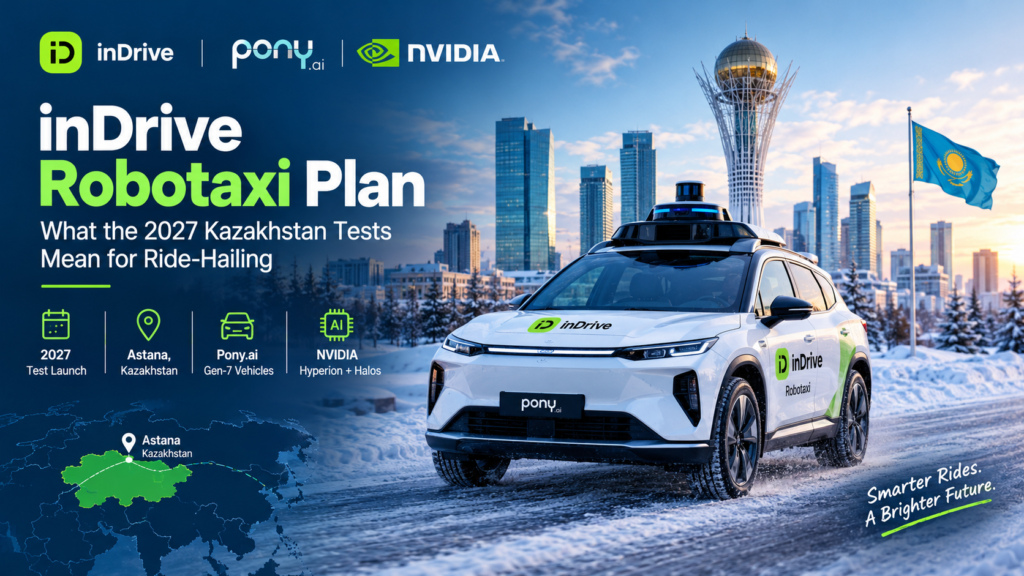
The inDrive robotaxi initiative is a planned set of supervised self-driving tests in Astana, Kazakhstan, due to begin in the first half of 2027 with Pony.ai and Nvidia as partners. It is a test program, not a commercial launch: a safety operator rides along at first, and fully driverless rides are the eventual goal. TechCrunchTechCrunch
Ride-hailing’s next proving ground may not be San Francisco or Shenzhen. It may be a cold, snowy capital in Central Asia. This guide covers who is involved, what each partner contributes, why Astana was chosen, how the plan compares with Uber’s robotaxi push, and what to watch as 2027 approaches.
Key Facts at a Glance
- What: A memorandum of understanding (MoU) between inDrive, Pony.ai, and Nvidia to explore bringing Pony.ai’s robotaxis to inDrive’s platform TechCrunch
- Where: Astana, the capital of Kazakhstan
- When: First half of 2027
- How it starts: With a safety operator on board
- End goal: Fully driverless rides
- Vehicles: Pony.ai’s Gen-7 robotaxis TechCrunch
- AI stack: Nvidia’s Hyperion platform and Halos safety system TechCrunch
- Announced: Friday, October 23, 2026, per TechCrunch’s reporting TechCrunch
What Is the inDrive Robotaxi Plan?
Definition
The inDrive robotaxi plan is a proposed collaboration in which three companies split the work of a self-driving taxi service. Pony.ai would provide the vehicles, inDrive would offer them through its ride-hailing app and operate the service in Kazakhstan, and Nvidia would supply the AI technology. TechCrunch
Expansion: What “Exploring” Really Means
The companies signed a memorandum of understanding to explore the idea. That wording matters. An MoU signals shared intent and a target window. It does not confirm fares, fleet size, service area, or a public launch date. Coverage of the announcement points out that the partners still have to assess technical, commercial, and regulatory requirements before any wider rollout. The sensible reading is that this is an important planned trial, not proof that driverless ride-hailing is about to spread across Central Asia. analyticsinsight
About inDrive
inDrive is a ride-hailing company known for letting passengers and drivers negotiate fares. It operates in more than 1,200 cities across 47 countries and has expanded into delivery, intercity transportation, and financial services. That footprint explains the appeal of autonomous vehicles. A company with a presence in many emerging markets can pilot robotaxis wherever the rules and the economics line up. TechCrunch
Who Does What in the inDrive Robotaxi Partnership?
In the inDrive robotaxi model, each company handles the layer it knows best. The table below summarizes the division of labor.
| Partner | Role | Contribution |
|---|---|---|
| inDrive | Platform and local operator | Offers rides in its app and runs operations in Kazakhstan |
| Pony.ai | Vehicle and driving-technology provider | Supplies Gen-7 robotaxis |
| Nvidia | AI and safety technology provider | Hyperion sensor and compute platform, Halos safety system, Alpamayo model, and simulation and testing tools |
This split fits how inDrive describes its strategy. CTO Yuri Misnik said the approach is “capital-light by design,” meaning the company works with partners in different markets instead of building everything itself. TechCrunch
inDrive: Platform and Local Operations
inDrive brings the riders and the local operating know-how. It would integrate the robotaxis into its app and handle operations in Kazakhstan. Owning the customer relationship and the local logistics, without owning the whole technology stack, is the core of a capital-light model. TechCrunch
Pony.ai: Gen-7 Robotaxis
Pony.ai is the vehicle and autonomy partner. It debuted its Gen-7 autonomous driving system at the Shanghai Auto Show in April 2025, then began public road testing of seventh-generation robotaxis in China. The company has been pushing beyond its home market. It aims to have more than 3,500 robotaxis in over 20 cities worldwide by the end of 2026, up from 1,975 vehicles at the end of June. Kazakhstan would add a cold-climate, Central Asian market to that list. aapTechCrunch
Nvidia: Hyperion, Halos, and Alpamayo
Nvidia works under the hood. Its Hyperion platform gives companies a ready-made base of sensors and computing hardware, so they don’t have to design and integrate everything themselves. Nvidia also offers its Alpamayo model and tools for generating synthetic data and testing driving systems across many scenarios. TechCrunch
Nvidia’s pitch is about cost. Ali Kani, the company’s vice president of automotive, argued that those savings matter most in emerging markets, where ride-hailing is already fairly cheap and autonomous services must compete on price. That makes inDrive robotaxi economics central to whether the project can ever scale. TechCrunch
Why Astana? Winter, Regulation, and Market Fit
The Kazakhstan robotaxi tests rest on three things: a hard environment, a supportive rulebook, and a market where affordability decides who wins.
Winter as a Stress Test
Astana is a deliberately difficult location. The city has about 1.7 million residents and faces months of snow and ice, which are tough conditions for self-driving systems. inDrive founder and CEO Arsen Tomsky framed this as an advantage, saying the launch would give the partners a chance to evaluate the technology in challenging winter conditions, with lessons that could apply to other places facing similar weather. TechCrunchTechCrunch
For the inDrive robotaxi tests, this matters more than it might seem. Autonomous driving demos are easy in sunshine. Snow-covered lane markings, icy surfaces, and low visibility are where systems struggle. A program that works in Astana’s winters would be a stronger proof point than one tested only in mild climates.
Regulation: A Supportive Framework
Last month, Kazakhstan announced plans to launch autonomous taxi services in 2027, with initial trials in Astana and two other cities. It has also introduced rules allowing autonomous vehicles to be tested on certain public roads. Misnik was direct about why this matters, saying that a favorable and collaborative regulatory environment is one of the main requirements for a successful launch. TechCrunchTechCrunch
Market Fit: Affordability First
inDrive built its brand on affordable rides. The company wants to bring a similar focus on affordability to autonomous ride-hailing. That is a harder problem than it sounds, because removing the driver does not by itself guarantee a cheaper fare. Vehicle costs, sensors, remote support, and fleet maintenance all stay in the equation. TechCrunch
Questions and Direct Answers
When will the inDrive robotaxi tests begin?
In the first half of 2027. inDrive CTO Yuri Misnik told TechCrunch that testing will begin in Astana in that window. TechCrunch
Will the first rides be driverless?
No. The tests will initially involve a safety operator, and fully driverless rides are the eventual goal. No date has been given for removing the operator. TechCrunch
Which robotaxis will inDrive use?
Pony.ai’s Gen-7 robotaxis. These are Pony.ai’s seventh-generation vehicles and driving system, designed to work across multiple vehicle models and be mass-produced. TechCrunch
Is the inDrive robotaxi service available to the public today?
No. The announcement is an MoU to explore testing, with trials still months away. There is no public service, fare schedule, or fleet-size commitment yet.
What does Nvidia contribute?
Nvidia supplies the AI and safety layer: the Hyperion platform and the Halos safety system. In plain terms, it provides pre-integrated sensors and computing, plus tools for testing and simulation, so partners can build robotaxi services faster and more cheaply. TechCrunch
Does Kazakhstan allow robotaxi testing?
Yes, in limited form. The country has introduced rules for testing autonomous vehicles on certain public roads and plans to launch autonomous taxi services in 2027, starting with trials in Astana and two other cities. TechCrunch
Is Kazakhstan inDrive’s only robotaxi market?
No. In December, inDrive signed a separate agreement with Saudi Arabia’s AI Driver to explore deploying vehicles powered by Chinese self-driving company WeRide, starting in Riyadh. That pilot was targeted for the first half of 2026, but it remains unclear whether testing has begun. Misnik added that the company is looking at other markets for future deployments. TechCrunchTechCrunch
How the inDrive Robotaxi Strategy Compares With Uber’s
The inDrive robotaxi plan arrives as ride-hailing leaders race to add autonomy. Earlier this month, Uber announced plans to test Pony.ai’s robotaxis in London, where it has also started offering supervised autonomous rides with British startup Wayve. Uber is working with multiple robotaxi companies in other markets, including the Middle East. TechCrunch
| Dimension | inDrive | Uber |
|---|---|---|
| Robotaxi partners named in coverage | Pony.ai and Nvidia (Kazakhstan); AI Driver and WeRide (Riyadh MoU) | Pony.ai (London tests); Wayve (London supervised rides); others in several markets |
| Stated approach | Capital-light, partner-driven | Multiple robotaxi partners across markets |
| Current stage in the headline market | MoU signed; supervised tests planned for Astana in H1 2027 | Supervised autonomous rides already offered in London with Wayve |
| Positioning | Affordability and emerging markets | Multi-partner expansion, including the Middle East |
| Footprint | 1,200+ cities in 47 countries | Not covered in the source report |
Two points stand out. First, both companies lean on Pony.ai, so the technology supplier is not the differentiator. The market choice and the cost discipline are. Second, Uber is further along in at least one market, since supervised rides are already running in London. inDrive’s bet is that emerging markets with price-sensitive riders, and a lean operating model, can be won on cost.
Risks and Open Questions
The inDrive robotaxi plan has real promise, but several risks sit between an MoU and a working service:
- Cost competitiveness: Robotaxis must beat or match already cheap ride-hailing fares. Nvidia’s own executive acknowledged this pressure in emerging markets.
- Winter performance: Astana’s snow and ice are an opportunity to prove the technology, and also a chance for it to fall short.
- Regulatory pace: Kazakhstan’s framework is supportive for now, but it covers testing on certain roads. Wider commercial service would need more.
- MoU-to-deployment gap: An MoU is the start of the process. Technical, commercial, and regulatory assessments come before any rollout.
- Track record on other pilots: The Riyadh pilot was targeted for the first half of 2026, and it remains unclear whether testing has begun. That is a reminder that pilot timelines can slip.
- Fare model fit: inDrive is known for negotiated fares. The coverage reviewed doesn’t say how that model would work with a robotaxi, where there is no driver to haggle with. This is an open question, not a reported problem.
What the inDrive Robotaxi Plan Means for Riders, Drivers, and Rivals
For riders: The upside is potentially lower fares and a new way to travel, but only if the economics hold. For now, expect a supervised, limited pilot, not a citywide service.
For drivers: Nothing in the announcement points to near-term displacement. Tests begin small, with a safety operator aboard. The longer-term picture depends on how quickly the technology and regulation mature, which is uncertain.
For competitors: The announcement shows that robotaxi competition is spreading beyond the U.S. and China. As TechCrunch framed it, the deal reflects growing interest in self-driving technology beyond those two markets. Rivals operating in emerging markets will now have to decide whether to build, partner, or wait. TechCrunch
For Nvidia and Pony.ai: Each gets a new showcase. Nvidia can demonstrate that its Hyperion platform lowers the barrier for operators who don’t want to build a stack. Pony.ai adds another international market to its expansion plans. The announcement also coincided with Nvidia CEO Jensen Huang’s first visit to Kazakhstan. TechCrunch
What to Watch Through 2027
As the inDrive robotaxi program moves from announcement to road tests, these milestones will show whether it is working:
- Test start date: Does Astana testing begin within the first half of 2027?
- Disclosed details: Fleet size, service area, and whether riders can book through the app
- Winter results: Any performance data from snow and ice conditions
- Operator removal: A timeline for moving from safety-operator rides to driverless service
- Kazakhstan’s wider trials: Progress in the two other cities named in the national plan
- Riyadh status: Whether the WeRide-powered pilot starts, since it indicates how inDrive executes on its MoUs
- Pony.ai’s fleet growth: Progress toward its stated fleet and city targets
- Cost signals: Any early indication of what a robotaxi ride would cost versus a conventional one
Bottom Line
The inDrive robotaxi plan is a credible, early-stage step into autonomy for a company that built its name on affordable rides. It pairs Pony.ai’s Gen-7 vehicles with Nvidia’s Hyperion platform and Halos safety system, and it puts them in a market whose regulators have signaled support and whose winters will test the technology hard.
It is also just a plan. The inDrive robotaxi tests begin with a safety operator, in one city, in the first half of 2027. Whether this becomes a real driverless service will depend on cost, weather performance, and regulation. If it works in Astana, though, it could give inDrive a template for other cold-climate and emerging markets.
What Will Determine the Project’s Success?
One of the biggest challenges will be making autonomous rides affordable enough to appeal to everyday passengers. Removing the need for a human driver could eventually reduce some operating expenses, but robotaxi fleets still require expensive vehicles, sensors, computing systems, maintenance, charging or refueling, and remote operational support. The partners will need to demonstrate that these costs can be managed without making rides significantly more expensive than conventional alternatives.
Safety will be equally important. Astana’s winter conditions offer a demanding environment for evaluating how autonomous vehicles respond to snow-covered roads, icy surfaces, reduced visibility, and changing traffic conditions. The initial tests, conducted with a safety operator on board, should help the partners identify weaknesses before considering more advanced driverless operations. However, successful testing in one season or on selected routes would not automatically establish readiness for every road condition.
Why the Partnership Model Matters
The collaboration also highlights a practical approach to entering the autonomous mobility market. Rather than developing every component independently, inDrive can draw on Pony.ai’s self-driving technology and Nvidia’s computing, simulation, and safety capabilities. This division of responsibilities could reduce the resources required to begin testing, although the actual financial benefits remain to be demonstrated.
For Pony.ai, Kazakhstan could provide an opportunity to evaluate its Gen-7 robotaxis in a new operating environment. For Nvidia, the project offers another potential application for its autonomous driving technology. Meanwhile, inDrive can explore whether robotaxis fit its existing ride-hailing business without immediately committing to building an entire autonomous vehicle platform itself.
What Should Riders and Drivers Expect?
Passengers should not expect immediate access to fully driverless rides. The announcement describes a planned testing program, and the companies have not established a public launch date, confirmed fares, or disclosed a final fleet size. Any expansion will depend on technical results, regulatory approvals, and the commercial viability of the service.
Drivers should also distinguish between a limited pilot and large-scale automation. The planned tests do not establish a timeline for replacing conventional ride-hailing services. The longer-term impact on employment will depend on how quickly autonomous vehicles become reliable, affordable, and legally deployable at scale.
The Road Ahead for 2027
As the proposed launch window approaches, the most meaningful indicators will be whether testing begins on schedule, how the vehicles perform in winter, and whether the partners share measurable safety and operational results. Updates on service areas, fleet numbers, passenger access, and potential pricing will also help clarify the project’s direction.
Ultimately, the inDrive robotaxi plan is worth watching because it connects autonomous driving technology with a market where affordability is central to consumer choice. Astana could become a useful proving ground for robotaxis operating in challenging climates, but the real test will be turning a promising partnership into a safe, dependable, and economically sustainable service.