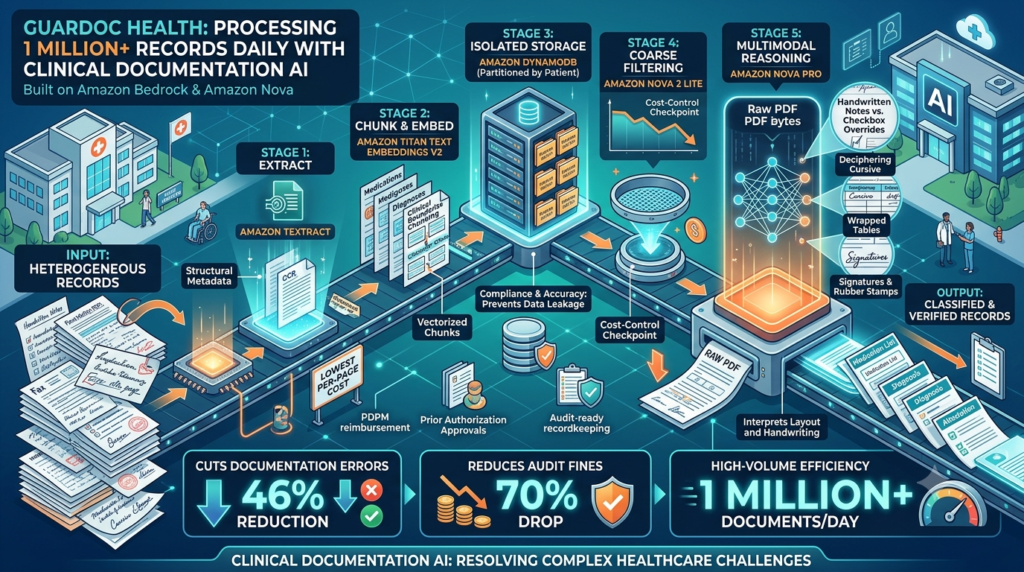
Clinical documentation AI now processes over one million clinical documents every single day at Guardoc Health, a long-term care documentation platform built on Amazon Bedrock. The company says this system has cut documentation errors by 46 percent and audit fines by 70 percent, numbers that matter because in long-term care, a missed handwritten note on a prior authorization form isn’t a minor clerical slip. It can mean a denied Medicare claim, a compliance audit, or a patient whose condition goes untreated a week too long.
This piece breaks down exactly how Guardoc’s clinical documentation AI pipeline works, why it was built the way it was, where it still struggles, and what the reported results actually tell us, and don’t.
What Is Clinical Documentation AI?
Clinical documentation AI refers to systems that use machine learning, typically a combination of optical character recognition (OCR), embedding models, and large language models, to read, classify, and extract meaning from medical records, charts, forms, and notes without requiring a human to manually review every page.
Unlike basic OCR, which only converts scanned text into machine-readable characters, modern clinical documentation AI has to interpret context: a checkbox that’s been overridden by a handwritten note, a medication dose buried in a paragraph of prose, or a symptom description that only appears once, in cursive, in the margin of an intake form. This is the layer where Guardoc Health’s system operates, and it’s the layer where most legacy healthcare software still fails.
In long-term care specifically, clinical documentation AI has to do more than digitize paper. It has to support real regulatory workflows , Patient-Driven Payment Model (PDPM) reimbursement categories, prior authorization approvals, and audit-ready recordkeeping, where a single misread field has downstream financial and clinical consequences.
Why Clinical Documentation AI Matters at Scale
The scale of the underlying problem is what makes this a genuinely hard engineering challenge rather than a routine automation project. <cite index=”1-1″>Research published in BMJ Quality and Safety estimates that around 12 million US outpatients are affected by diagnostic error each year, with information-handling failures cited as a contributing factor.</cite>
Guardoc’s documents don’t arrive in one clean format. <cite index=”1-1″>Its pipeline has to handle multi-page PDFs with handwritten physician annotations layered over printed text, prior authorization forms where a single checkbox state determines a coverage decision, medication lists that appear as clean tables in one chart and free text in the next, and patient intake forms mixing typed fields with rubber stamps and handwriting on the same page.</cite>
At Guardoc’s processing volume, even a small error rate compounds fast. <cite index=”1-1″>A one percent error rate in condition detection alone would generate thousands of incorrect records daily, each carrying its own patient safety or compliance consequence.</cite> That’s the risk calculation any clinical documentation AI system has to get right before it can be trusted with real patient charts.
The Financial Stakes Behind the Errors
Get clinical documentation AI wrong, and the fallout isn’t abstract. <cite index=”1-1″>Errors compound into denied Medicare claims under the Patient-Driven Payment Model, audit fines, litigation exposure, and in the worst cases, a missed condition that changes how a patient gets treated.</cite> Get it right, and <cite index=”1-1″>the payoff shows up in fewer corrections, fewer hospital transfers, and lower compliance costs.</cite> That’s the trade-off Guardoc built its architecture around.
Inside Guardoc Health’s Clinical Documentation AI Pipeline
Guardoc’s approach to clinical documentation AI is built as a retrieval-augmented generation (RAG) pipeline, meaning the system pulls specific evidence from a patient’s own records before reasoning across it, rather than asking one large model to read an entire chart cold. <cite index=”1-1″>The architecture runs condition classification through retrieval augmented generation, pulling evidence from a patient’s own documentation before reasoning across it to produce a final answer.</cite>
Step 1: OCR and Structural Extraction with Amazon Textract
<cite index=”1-1″>Amazon Textract extracts text and structural metadata from each incoming page first, at what the company treats as the lowest per-page cost point in the pipeline.</cite> This is the cheapest stage, so it’s positioned to do the widest sweep of raw processing. <cite index=”1-1″>That output gets chunked along clinical boundaries, so a medication list or a diagnosis section stays intact rather than getting split by arbitrary character count.</cite>
Step 2: Embedding and Patient-Isolated Storage
<cite index=”1-1″>Each chunk is embedded using Amazon Titan Text Embeddings V2 and stored in Amazon DynamoDB, partitioned by patient so retrieval never crosses patient boundaries.</cite> This partitioning matters as much for compliance as for accuracy, it structurally prevents one patient’s data from leaking into another patient’s classification results.
Step 3: Narrowing the Search with Nearest-Neighbor Retrieval
<cite index=”1-1″>A custom pre-filter narrows the candidate set by document type and recency before a k-nearest neighbour search retrieves the chunks most relevant to a given classification query, returning page references only at this stage to keep data transfer light.</cite>
Step 4: Coarse Filtering with Amazon Nova Lite
<cite index=”1-1″>Amazon Nova 2 Lite then runs a text-based pass to remove obvious non-matches.</cite> This is the cost-control checkpoint, a lightweight model discards the easy cases before anything reaches the expensive stage.
Step 5: Multimodal Reasoning with Amazon Nova Pro
<cite index=”1-1″>Only the pages that survive every prior filter reach Amazon Nova Pro, which receives the raw PDF bytes and reasons over layout, handwriting, signatures, and stamps to produce the classification that downstream systems act on.</cite> This final tier is where the system does the actual interpretive work, reading a document the way a human reviewer would, not just transcribing it.
The overarching logic ties the whole pipeline together: <cite index=”1-1″>cheap components handle high-volume work like embedding and coarse filtering, and the more computationally intensive multimodal reasoning gets reserved for the final stage where it’s actually required.</cite>
Clinical Documentation AI vs. Traditional OCR Workflows
The table below compares how legacy OCR-only systems handle clinical records against a modern clinical documentation AI pipeline like Guardoc’s.
| Capability | Traditional OCR Workflow | Guardoc’s Clinical Documentation AI |
|---|---|---|
| Printed text extraction | Yes, generally reliable | Yes, via Amazon Textract |
| Handwritten annotations | Frequently missed or misread | Interpreted via Amazon Nova Pro’s multimodal reasoning |
| Checkbox vs. handwritten override conflicts | Not resolved automatically | Explicitly resolved as a targeted use case |
| Patient data isolation | Depends on system design | Structurally partitioned in DynamoDB by patient |
| Cost structure | Flat per-page cost | Tiered, cheap filtering first, expensive reasoning last |
| Medication list extraction (mixed formats) | Struggles with free text and wrapped tables | Hybrid Textract + Nova Pro pass |
| Scale demonstrated | Varies widely by vendor | Reported 1M+ documents processed daily |
This comparison isn’t about OCR being obsolete, Textract is still doing foundational work in Guardoc’s pipeline. The difference is that clinical documentation AI treats OCR as one stage in a longer reasoning chain, not the entire solution.
The Hardest Cases for Clinical Documentation AI
Not every document type is equally difficult. According to Guardoc, a small set of recurring problems accounts for most of what earlier, less sophisticated pipelines missed:
- Physician attestation fields on prior authorization forms, <cite index=”1-1″>a handwritten note can override a printed checkbox</cite>, and missing that override changes the coverage decision entirely.
- Patient-reported symptom sections, <cite index=”1-1″>handwriting often carries information that doesn’t appear anywhere else in the record</cite>, meaning there’s no clean-text fallback if it’s misread.
- Medication extraction across inconsistent formats, <cite index=”1-1″>drug names, dosages, routes, and frequencies show up in structured tables, in prose buried inside physician notes, in handwritten additions to printed lists, and in scans that have been faxed through multiple hands.</cite>
- Wrapped table columns and non-standard layouts, cases where OCR alone can’t reliably reconstruct the original structure.
For medication data specifically, Guardoc runs a hybrid approach: <cite index=”1-1″>Amazon Textract first for clean printed tables, then passes both the original PDF and the Textract output to Amazon Nova Pro to resolve wrapped table columns, handwritten additions, and non-standard formats that OCR alone can’t parse correctly.</cite>
Why This Matters for PDPM Reimbursement Accuracy
Getting these edge cases right isn’t just an accuracy exercise, it directly affects PDPM reimbursement accuracy, since misclassified conditions or missed documentation can trigger incorrect payment categories, denied claims, or audit flags months later.
Reported Results, What the Numbers Show (and Don’t)
Guardoc has published a set of headline figures for its clinical documentation AI deployment:
- <cite index=”1-1″>A 46 percent reduction in documentation errors</cite>
- <cite index=”1-1″>A 70 percent drop in audit fines</cite>
- <cite index=”1-1″>More than $400,000 in annual ROI for a single facility</cite>
It’s worth noting directly: <cite index=”1-1″>Guardoc has not published the baseline period or methodology behind those calculations</cite>, so these figures should be read as company-reported outcomes rather than independently verified benchmarks.
In a more granular quarterly deployment across two facilities and 200 patients, <cite index=”1-1″>the company says its system drove 847 documentation corrections, flagged 86 issues tied to PDPM reimbursement accuracy, and was associated with a 74 percent reduction in hospital transfers per 100 admissions.</cite> A broader case study covering seven facilities and 1,618 residents reportedly identified 10,612 issues, according to the company.
Assaf Amiaz, Director of Product at Guardoc Health, framed the goal behind the system this way: <cite index=”1-1″>the Nova family is meant to help healthcare organisations detect high-risk cases earlier and act before issues become costly, automating workflows that once required manual oversight so teams can reduce compliance gaps, prevent errors, and focus more time on patient outcomes.</cite>
Frequently Asked Questions
What is clinical documentation AI used for in long-term care? Clinical documentation AI is used to extract, classify, and verify information from clinical records, including handwritten notes, prior authorization forms, and medication lists, to reduce manual review time and catch errors before they affect billing or patient care.
How does Guardoc Health’s clinical documentation AI handle handwriting? It uses Amazon Nova Pro to reason directly over raw PDF bytes at the final pipeline stage, allowing the model to interpret handwriting, signatures, and stamps in context rather than relying solely on OCR text output.
Why does the pipeline use multiple AI models instead of just one? Cost and accuracy trade-offs. Amazon Textract and Amazon Nova Lite handle cheaper, high-volume filtering first; only the documents that need deeper interpretation reach the more computationally expensive Amazon Nova Pro stage.
Are Guardoc’s reported results independently verified? No. The company has published the figures itself, and as of this writing has not disclosed the baseline period or full methodology behind the error-reduction and ROI numbers.
What role does Amazon Bedrock play in this system? Amazon Bedrock is the platform through which Guardoc accesses the Amazon Nova model family, allowing the company to run both the lightweight filtering model and the multimodal reasoning model within a single managed infrastructure.
Key Takeaways
Clinical documentation AI is moving past simple OCR toward multi-stage pipelines that combine cheap filtering with targeted, expensive reasoning only where it’s needed. Guardoc Health’s system, built on Amazon Textract, Titan embeddings, DynamoDB, and the Amazon Nova model family, illustrates what that looks like in a live, high-volume healthcare environment processing over a million documents daily. The reported results are notable, but as with any vendor-published figures, they’re worth treating as directional rather than independently audited. What’s clear is that the hardest problems in clinical documentation AI aren’t about reading text, they’re about resolving conflicts, like a handwritten override on a printed checkbox, that only show up at the edges of a document.