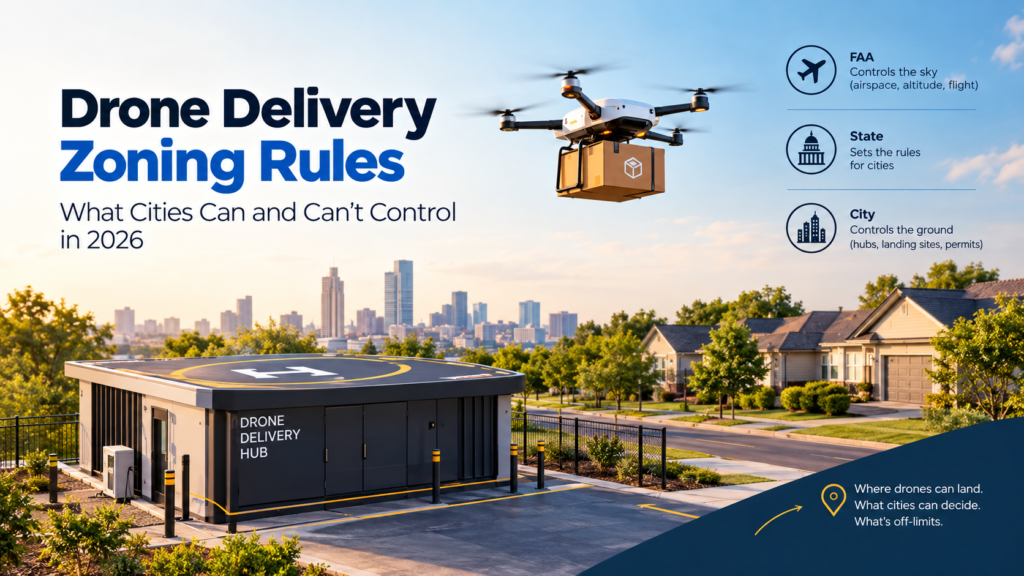
Drone delivery zoning rules determine where drone hubs, nests, and landing sites can be built, and cities and states write them, not the FAA. The FAA still owns the airspace, so a city generally cannot ban overflight, cap altitude, or impose a drone curfew. It can regulate the ground: land use, facility siting, and local nuisance impacts.
If you’re an operator planning a launch, a council member drafting an ordinance, or a resident wondering why a drone just crossed your street, this guide shows who controls what. It draws on 2026 developments in Arizona, Texas, Colorado, and California, and each section is written to answer one question on its own.
The short version:
- Sky: The FAA controls flight, altitude, and airspace.
- Ground: Cities control where hubs and landing sites go, unless a state law takes that power away.
- 2026 trend: Cities such as Plano, Northglenn, and Belvedere are writing hub rules, while Arizona now sharply limits what its cities can do.
- Biggest gap: A neighboring town’s hub can legally serve your address, whatever your own council decides.
What Are Drone Delivery Zoning Rules?
Drone delivery zoning rules are local land-use regulations that decide where drone delivery facilities may be located and under what conditions they can operate. They live inside a city’s zoning code, next to the rules for warehouses, gas stations, and retail parking lots.
In practice, these rules answer questions like these:
- Is a drone hub a permitted use in a commercial district, or does it need a special permit?
- How far must a landing site sit from homes?
- What noise, fire, and safety standards apply to the facility?
Until a city writes specific language, hubs get squeezed into existing categories. Round Rock, Texas, says its current zoning doesn’t specifically address drone delivery hubs. Fort Worth’s staff report notes that zoning regulations applicable to drones primarily address outdoor storage of equipment and similar issues. That gap is why so many cities are now drafting dedicated language. thedroneukxan
How Do Drone Delivery Zoning Rules Differ From Flight Rules?
Flight rules govern what happens in the air. Zoning governs what happens on the ground.
On the flight side, any company providing commercial drone delivery must first secure a Part 135 certificate, drones are typically limited to a maximum altitude of 400 feet, and flights near airports are restricted. Those are federal questions, decided in federal processes. kxankxan
Zoning covers the building, the pad, the parking-lot nest, the charging equipment, and the spot where a package touches down. Different layer, different decision-maker, different appeal path. Confusing the two is the most common mistake in public debates about drone delivery.
Who Regulates What? Federal, State, and Local Roles
Does the FAA or the City Control Drone Delivery?
Both do, at different layers: the FAA controls the sky, and local governments control the land beneath it, subject to state law. The table below compares the three layers.
| Layer | Who decides | What they control | Example |
|---|---|---|---|
| Federal | FAA | Operator certification, altitude, airspace, flight operations | Part 135 certification; 400-foot ceiling |
| State | Legislature | Whether and how cities may regulate delivery at all | Arizona’s June 2026 law |
| Local | City or county | Hub siting, landing sites, permits, nuisance rules | Plano’s new land-use category |
Local rules must also work within federal ones. Fort Worth’s report states that local rules must comply with FAA regulations, which is why smart ordinances stick to ground-level topics. kxan
Why Can’t Cities Set Altitudes or Curfews?
Because aviation is a federal domain, and courts have struck down local attempts to regulate flight itself. A federal court struck down Newton, Massachusetts’ overflight, altitude and registration rules in 2017. dronexl
DroneXL’s resident guides make the same point plainly: a city cannot ban overflight, set an altitude, or write a drone curfew. A city that tries invites litigation. A city that stays on the ground stands on much firmer legal footing. dronexl
What Do Drone Delivery Zoning Rules Usually Cover?
Most drone delivery zoning rules cover five things: how a hub is classified, where it can sit, how close it can be to homes, what noise and safety standards apply, and whether delivery onto private property needs consent. The list below frames each element.
- Land-use classification: Is a hub its own category, or an accessory use at a retail store?
- Location limits: Which districts allow hubs, and which prohibit them?
- Residential setbacks: Minimum distances between landing sites and homes.
- Noise and safety: Fire code, equipment storage, and nuisance standards.
- Delivery consent: Whether a package may be lowered onto someone’s private property.
DroneXL’s guides flag the same two ground questions for residents: zoning, meaning whether a hub is a permitted use and where, and consent for delivery onto private property. dronexl
How Do Setbacks Work in Drone Hub Zoning?
A setback is a minimum distance between a drone landing site and a protected use, usually homes. Arizona’s new statute makes this concrete. It leaves cities the land-use approval for a takeoff and landing site in or within 150 feet of residential zoning, which is the main exception to its otherwise broad ban on local regulation. Setbacks like this are the lever most cities reach for first, because they respond directly to the noise and safety worries residents raise. dronexl
What About Package Drop-Off on Private Property?
Delivery consent rules decide whether a drone may lower a package onto a yard or driveway without the owner’s agreement. This is local and ground-level, which is why DroneXL lists it as one of the questions a town can answer for itself. Consent rules matter most for residents because they’re the point where drone delivery touches a private lot.
State Law: Where Local Authority Expands or Disappears
State law decides whether a city gets to write drone delivery zoning rules at all. This is where the national picture gets fragmented. The table summarizes what current reporting shows.
| State | Local authority | What happened |
|---|---|---|
| Arizona | Sharply limited | A June 2026 law bars cities from regulating commercial drone delivery, with narrow exceptions such as sites near residential zoning |
| Florida | Limited | A county may not refuse a drone port over its location |
| Colorado | Open | SB26-024, which would have barred local drone rules, died in a Senate committee 5–2 on February 25, 2026 |
| California, Massachusetts, Washington, Nebraska, Missouri, Kansas | Open | No statute taking drone rules away from towns |
| Ohio | Unclear | A 2025 law lists two things cities may regulate and says nothing about delivery; its effect hasn’t been tested in court |
| South Carolina | Changing | A new drone law takes effect January 1, 2027 drone delivery town guides 20 new towns +4 |
Why Does State Preemption Matter for Drone Delivery Zoning Rules?
State preemption matters because it can void a city’s rules entirely, however carefully they were drafted. Arizona’s HB 2875 prohibits a local government from enacting any ordinance, policy or rule that relates to the ownership or operation of a commercial drone delivery system and voids those that violate the ban. The law also preserves limited city authority over zoning, fire, and safety rules for facilities within 2.5 miles of larger airports, provided those rules don’t govern flight paths or prohibit delivery, and the operator consults with the airport. azleg
Read the actual statute text before relying on any summary, including this one. Preemption language is dense, and the exceptions are where the real disputes will happen.
Where Can Cities Still Write Drone Delivery Ordinances?
Cities can write drone delivery ordinances in states without preemption, as long as the rules stay on the ground. In California, Massachusetts, Washington, Colorado, Nebraska, Missouri, and Kansas, towns can write ground rules of the kind Belvedere and Northglenn have drafted. That makes those states the active testing ground for how much local control courts will accept. dronexl
Four Communities Writing Drone Delivery Zoning Rules
The clearest way to understand drone delivery zoning rules is to watch how real towns are drafting them. Each of the four below takes a different approach.
Plano, Texas: A New Land-Use Category
Plano’s city council approved a change to the city’s zoning ordinance, regulating drone delivery hubs as a new land-use category. That gives operators a predictable path: a hub is a defined use with defined conditions, not an awkward fit under an old label. Plano’s move came as Walmart expanded drone delivery with Wing and Zipline across the Dallas–Fort Worth area, where one official described the regional response as “a mixed bag” of zoning approaches. dronelifedronelife
Round Rock, Texas: Launch First, Write Rules Second
Round Rock took the opposite sequence. Zipline launched in the Austin area, and the city says it plans to use that site to evaluate operations and write rules for future facilities. One drone-industry analyst called this the 2026 pattern: launch, a parallel FAA review, and city rules about the ground, not the sky. thedroneuthedroneu
Northglenn, Colorado: Writing the Code Before Operators Arrive
Northglenn, a city of 38,131 north of Denver, is about to become the first city in Colorado to write drone delivery hubs into its zoning code. This is proactive drafting. As DroneXL puts it, a town that writes its rules early has leverage over where hubs go and under what conditions. dronexl
Belvedere, California: A Drone Delivery Ordinance for Marin County
Belvedere is also writing rules before any operator arrives, and its City Council scheduled a final vote on Marin County’s first commercial drone delivery ordinance for October 12. Belvedere and Northglenn show the same strategy in two states: draft first, negotiate from a position of clarity. thedroneu
Why Your Town’s Drone Delivery Zoning Rules May Not Stop Drone Service
Local zoning stops hubs inside city limits, not deliveries that originate somewhere else. A drone can fly from a hub in one jurisdiction to a customer in another, so a town’s ground rules only bind facilities within its own borders.
DroneXL illustrates this with Northglenn: a Wing nest anywhere inside a ring covering Thornton, Federal Heights, Westminster, Broomfield or Commerce City could serve every Northglenn address under the FAA’s rules, whatever Northglenn decides. There’s no local hearing for that flight, because it’s an FAA matter. dronexl
This has two practical consequences:
- For residents: A strict local ordinance doesn’t guarantee drones never pass overhead.
- For officials: Regional coordination with neighboring jurisdictions may matter more than any single code amendment.
How to Prepare: Operators, Officials, and Residents
Preparation looks different depending on your role, but all three groups need to start with the same step: reading the state law. The lists below frame the next actions for each.
For Drone Delivery Operators
- Map the state and local framework in every target city before site selection, because drone delivery zoning rules can differ block to block.
- Check whether the state preempts local authority, as in Arizona, before engaging the city.
- Engage early where cities are drafting, since early input shapes definitions and setbacks.
- Plan for airport proximity, which can trigger additional rules near large hubs.
For City Officials
- Confirm what your state allows before drafting a drone delivery ordinance.
- Write drone delivery zoning rules around ground-level topics: classification, siting, setbacks, noise, and consent.
- Avoid altitude, curfew, and flight-path language, which invites the kind of challenge Newton lost in 2017.
- Coordinate with neighboring jurisdictions, since a nearby hub can serve your residents anyway.
For Residents
- Find out whether your city has a hub category and where it applies.
- Attend council hearings. Some towns, like Tracy, California, are hosting a town hall on Amazon drone delivery as the service arrives. dronexl
- Remember that complaints about flight paths go to federal, not local, channels.
Frequently Asked Questions About Drone Delivery Zoning
Can a city ban drone delivery?
Generally no. Cities cannot ban overflight, and in states like Arizona they are barred from regulating delivery operations at all. They can, however, regulate where ground facilities are located, in states that permit it.
Do drone delivery zoning rules apply to flight paths?
No. Drone delivery zoning rules apply to ground facilities, not flight paths. Flight paths, altitude, and airspace belong to the FAA. Even Arizona’s airport-adjacent exceptions specifically exclude rules that govern flight paths.
Are drone hubs allowed in residential areas?
It depends on the city and state. Many ordinances restrict hubs near homes through setbacks or district limits. In Arizona, cities keep land-use approval authority for takeoff and landing sites in or within 150 feet of residential zoning.
Who delivers by drone in the United States?
Three companies lead: Amazon, Wing, and Zipline. DroneXL describes them as rolling out home delivery at scale, with Walmart partnering with Wing and Zipline in the Dallas–Fort Worth area. dronexl
Will drone delivery zoning rules change soon?
Yes, and they’re already changing. South Carolina’s drone law takes effect January 1, 2027, Colorado’s preemption bill failed this year but could return, and more cities are drafting hub ordinances as operators expand. Check your state legislature and city planning department for current text.
Conclusion: Know the Layer, Know the Rule
Drone delivery zoning rules are the local half of a split system: the FAA decides what happens in the air, and states and cities decide what happens on the ground. Where a city has authority, it can classify hubs, set setbacks, and require consent for private-property drop-offs. Where a state has preempted, that authority shrinks fast.
The practical takeaway is to start with your state’s law, then read your city’s code, then look at your neighbors. Plano, Round Rock, Northglenn, and Belvedere each show a different way to write drone delivery zoning rules, and the right model depends on how much power your state leaves you.
What the Future Holds for Drone Delivery Zoning
As commercial drone delivery expands, zoning decisions are likely to become more important for city planners, delivery operators, property owners, and residents. Communities must find ways to accommodate new delivery infrastructure while addressing concerns about noise, safety, residential privacy, and land use. Clear zoning definitions can help cities avoid confusion when companies propose new drone hubs, charging facilities, or designated landing areas.
For operators, understanding local requirements before investing in a site can reduce delays, unexpected compliance costs, and disputes with planning authorities. A location that appears suitable from an operational perspective may still face restrictions because of its zoning classification, proximity to residential properties, or applicable state legislation. Early discussions with local planning departments can help identify these issues before a project moves forward.
City officials also need to distinguish between legitimate land-use concerns and regulations that attempt to control aircraft operations. Rules addressing facility placement, building requirements, fire safety, and other permitted ground-level impacts can provide a practical framework for managing drone infrastructure. However, restrictions that conflict with federal aviation authority or state preemption laws may be difficult to enforce. Reviewing existing statutes and seeking appropriate legal guidance can help municipalities develop more defensible ordinances.
Residents have an important role in this process as well. Attending public meetings, reviewing proposed zoning amendments, and submitting comments can help communities communicate concerns about proposed delivery hubs. Residents should also understand that preventing a hub from being built within city limits does not necessarily prevent drones operated from neighboring jurisdictions from flying overhead. Recognizing this distinction helps set realistic expectations about what local regulations can accomplish.
A Practical Checklist Before Making a Decision
Whether you are planning a drone delivery facility or evaluating a proposed ordinance, consider these essential steps:
- Check state law first: Determine whether the state allows local governments to regulate commercial drone delivery facilities.
- Review the zoning code: Identify permitted land uses, special-use permit requirements, and any applicable residential setbacks.
- Understand federal limits: Keep local land-use rules separate from FAA-controlled flight operations and airspace.
- Assess neighboring jurisdictions: Consider whether facilities outside city boundaries could serve local customers.
- Monitor legal changes: Revisit relevant statutes, ordinances, and regulatory guidance as drone delivery services expand.
Ultimately, effective drone delivery zoning requires coordination rather than treating every issue as a local one. State legislatures establish the boundaries of municipal authority, the FAA governs aviation, and local governments manage land use where the law permits. Operators need to understand all three layers, while residents and policymakers need realistic expectations about each layer’s reach.
The bottom line: Before approving a drone hub, challenging a proposed facility, or drafting a new ordinance, identify who has legal authority over the specific issue. Understanding that division is the most reliable starting point for navigating drone delivery zoning rules in 2026 and beyond.