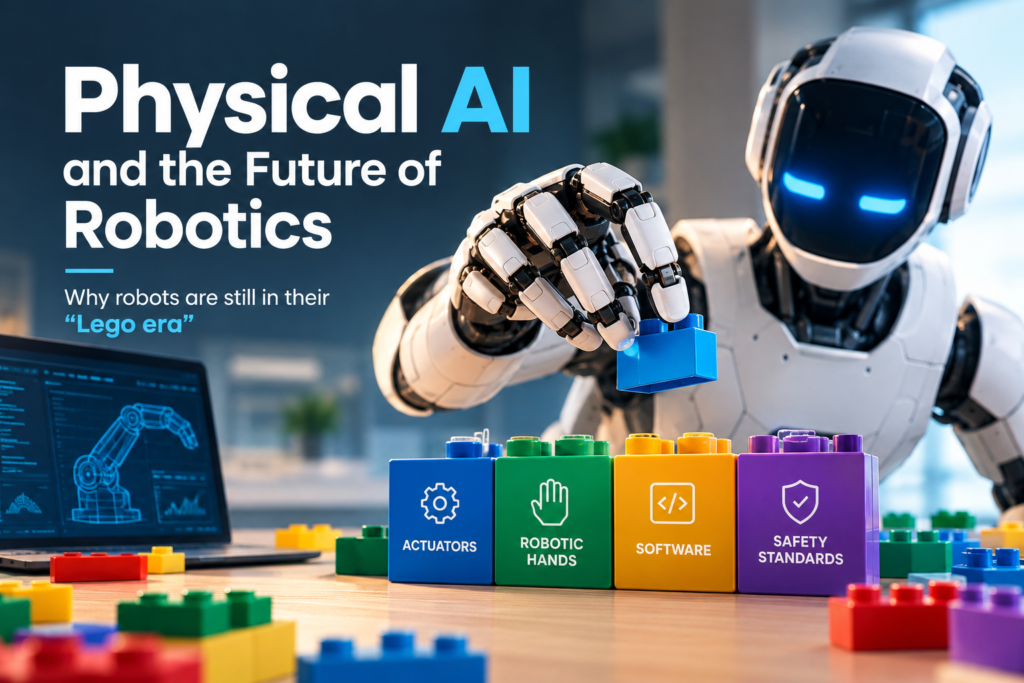
Physical AI is artificial intelligence that senses, reasons, and acts in the real world, and former Nvidia executive Amulya Vishwanath argues it is far bigger than robots and still in its “Lego era.” In plain terms, the basic building blocks of robotics (actuators, robotic hands, software, and safety standards) are still being rebuilt, so a single “ChatGPT moment” is further away than the hype suggests.
Everyone in tech seems to be waiting for the day one general-purpose model makes robots as capable as chatbots became in late 2022. Vishwanath spent seven years leading product marketing for NVIDIA’s robotics platforms, and she thinks that is the wrong thing to wait for. This guide unpacks her argument, defines the term, looks at where the money is going, and explains what it means if you build or fund companies in this space. winzheng
Key Takeaways
- Physical AI is broader than robots. Vishwanath’s definition includes molecules, materials, and medicines, not only machines on a factory line.
- The “Lego era” is about components. Actuators, hands, software, and safety standards still need work before general-purpose robots can scale.
- Capital is surging, but totals depend on who is counting. Trackers disagree on how much money has gone into physical AI this year, largely because they define the category differently.
- Own one brick. The strongest startups usually dominate one layer of the stack instead of claiming the whole thing.
What Is Physical AI?
Physical AI is AI that perceives the physical world through sensors, decides what to do, and then changes something made of real matter: a robot arm, a vehicle, a lab instrument, or a surgical tool. The defining feature is that the output is not text or an image. It is a physical outcome.
Vishwanath frames it even more broadly. She defines it as more than robots, naming “a molecule, a material, a medicine,” or a machine on a factory line. That is why the category stretches from warehouse automation to materials discovery to life sciences, the same three areas her firm invests in. winzheng
Is Physical AI the Same as Robotics?
No. Robotics is one major branch of physical AI, but the term also covers AI-driven work in materials science and life sciences, where the “robot” might be an automated lab rather than a humanoid on two legs.
How Is It Different From Generative AI?
Generative AI produces digital outputs and can be wrong cheaply: a weak paragraph is easy to edit. Physical AI has to contend with friction, weight, latency, wear, and safety, so mistakes can break hardware or hurt people. That higher cost of error is one reason progress feels slower here than it did with chatbots. (This is explanatory context rather than a claim from the interview.)
Who Is Amulya Vishwanath, and Why Does Her View Matter?
Vishwanath is the founder and managing partner of Techable VC and one of the first women executives to spin out of Nvidia and launch her own early-stage firm. Techable writes early checks and invests in physical AI across robotics, materials science, and life sciences. winzheng
Her vantage point is unusual. After years inside Nvidia’s robotics business, she sees which components are mature and which are not. She says that experience built the network she now uses for due diligence and customer introductions, and she wants founders to see their VC as their moat. podbay
She is not the only Nvidia alum building in this space. Business Insider reported that Nvidia’s robotics lab is turning into a founder factory, citing Sanja Fidler’s Veeda AI, which builds simulated worlds to train robots, and Joel Jang’s Dream Labs. She laid out her thesis on TechCrunch’s Equity podcast on October 16, in conversation with host Dominic-Madori Davis. ecosistemastartupcryptopolitan
What Does the “Lego Era” Mean for Robotics?
The “Lego era” is the stage where an industry is still designing and rebuilding its basic bricks before anyone can snap them into finished products. Vishwanath says actuators, robotic hands, software, and safety standards are still being rebuilt. The metaphor is useful because it shifts attention from the flashy demo to the unglamorous parts that decide whether a robot works in a real facility. winzheng
Actuators
Actuators are the components that create motion. One summary of her view stresses that problems like actuator efficiency, power density, and manufacturing cost are engineering challenges AI alone cannot fix. A smarter model does not help if the joint is too weak, too hot, or too expensive to build at volume. techbuzz
Robotic Hands
Robotic hands are another critical building block in the development of Physical AI. While industrial robots can perform repetitive movements with impressive precision, handling objects of different shapes, sizes, weights, and textures remains a significant challenge. Picking up a fragile component, opening a package, turning a tool, or gripping an irregular object requires a combination of dexterity, tactile sensing, and precise control.
Human hands perform these tasks almost automatically, adjusting grip strength and finger position based on touch and visual feedback. Replicating this flexibility in machines requires sophisticated mechanical designs, reliable sensors, and software that can respond to changing conditions. Until robotic hands become more capable, many robots will remain limited to carefully structured environments where objects and tasks are predictable.
Software and Control Systems
Software connects a robot’s sensors, mechanical components, and decision-making systems. It enables machines to interpret their surroundings, plan movements, respond to unexpected obstacles, and coordinate complex actions. However, developing software that works reliably in a simulation is not the same as deploying it in a real factory, warehouse, or laboratory.
Physical environments introduce variables such as changing lighting, slippery surfaces, unexpected obstacles, and differences between individual objects. Robotics software must account for these variations while balancing speed, accuracy, and reliability. A capable AI model is valuable, but it must work alongside control systems that translate decisions into precise physical movements.
Safety Standards
Safety is equally important because robots interact with equipment, materials, and sometimes people. A system that performs well during a demonstration may still require extensive testing before it can operate independently in a commercial environment. Unexpected movements, sensor failures, or incorrect decisions can damage equipment, interrupt production, or create risks for nearby workers.
Clear safety procedures, dependable emergency stops, continuous monitoring, and appropriate testing help establish the trust required for wider adoption. Safety should therefore be considered during product development rather than added only when a robot is ready for deployment.
Together, these building blocks explain why robotics is still in its “Lego era.” Progress depends on improving several interconnected technologies rather than relying on a single breakthrough in artificial intelligence. As actuators become more efficient, robotic hands gain dexterity, software becomes more reliable, and safety systems mature, developers will have a stronger foundation for building practical robots that can work beyond controlled demonstrations.
Software
Software ties perception, planning, and control together. The risk, as one VC analysis put it, is that decks claim all of it. Most teams are genuinely strong at one layer, whether actuators, perception, or the software gluing them together. valueaddvc
Safety Standards
Safety standards decide where robots can operate near people and what insurers and regulators will accept. Without them, even a capable robot stays in a cage. Treating safety as a first-class building block, not a later compliance task, is one of the most practical implications of her framing.
Why Robotics Has Not Had Its ChatGPT Moment (Yet)
Will a general foundation model trigger robotics’ breakthrough? Vishwanath’s answer is “not until the building blocks mature.” Her view runs counter to those who believe a general foundation model will deliver robotics’ “ChatGPT moment,” the way the chatbot’s late-2022 launch did for language. General Intuition CEO Pim de Witte told Equity earlier this year that a single general model would make much of today’s specialized robotics work redundant. winzhengwinzheng
Here is how the two camps compare:
| Dimension | “ChatGPT moment” thesis | “Lego era” thesis |
|---|---|---|
| Representative voice | Pim de Witte, General Intuition | Amulya Vishwanath, Techable VC |
| Core belief | One general model unlocks robotics | Components must mature first |
| Where value accrues | The foundation model | Actuators, hands, software, safety |
| Pace of change | Sudden, step-change | Incremental, layer by layer |
| Startup implication | Specialized work may be displaced | Owning one brick can be defensible |
| Main risk | Hardware can’t keep up with the model | Slower than investors expect |
My read, as analysis rather than reporting: the two views are not fully exclusive. A strong general model still needs hands that can grip and joints that can bear load. The more useful question is which bottleneck binds first.
How Much Money Is Flowing Into Physical AI?
The short answer: a lot, and quickly, though sources disagree on the exact figure.
- Crunchbase: $47.4 billion across 521 physical AI deals in the first half of 2026, almost four times the previous half-year’s $12 billion. cryptopolitan
- PitchBook (via Business Insider): Physical AI companies raised $33.4 billion in the first half of 2026, more than the $28.7 billion raised in all of 2025. ecosistemastartup
The gap likely comes from what each tracker counts. Megadeals in autonomy and defense can swing totals, and “physical AI” has no standard definition. Whichever number you trust, the direction is unmistakable: funding has accelerated sharply. The takeaway for founders is that capital is available, but investors are sorting teams by which layer they truly own.
Where Does Physical AI Show Up Beyond Humanoid Robots?
The most interesting applications are rarely the dancing humanoid. Vishwanath focuses on real-world problems like labor shortages in family factories and surgeon burnout. Think of it as a map of use cases: pluang
- Family-run factories: Automation that helps small manufacturers keep lines running when workers are scarce.
- Surgery: Tools that reduce strain on surgeons, addressing burnout.
- Materials and molecules: AI-guided discovery of new materials and chemistry.
- Medicine: Life-sciences work where automation and AI meet lab practice.
- Warehouses: Gartner’s September research names physical AI agents among four trends reshaping warehouses. cryptopolitan
The episode also covers what she calls “conscious automation” and China’s role in the field, if you want to hear her full reasoning.
What Should Founders Building Physical AI Startups Do Now?
What should a robotics founder do if the market is in the Lego era? Pick a brick and become indispensable at it. One article on her thesis put the question this way: the question is not when the universal robot arrives, but which Lego brick you will be indispensable at. ecosistemastartup
A practical sequence:
- Choose the layer you can own. Actuators, perception, control software, or safety tooling. Be able to say which one in a sentence.
- Anchor to a painful, specific problem. Labor shortages and burnout are concrete; “general-purpose robots” is not.
- Build safety in early. Standards are still forming, so teams that treat compliance as a feature can earn trust sooner.
- Be honest about what AI can’t fix. Power density and manufacturing cost are engineering problems.
- Choose investors who add network. She argues a VC should be a moat, bringing diligence help and customer introductions.
The best physical AI startups in a Lego era will probably look less like moonshots and more like indispensable suppliers.
What Should Investors Watch?
For investors, her framing suggests a sharper diligence question. The question for any robotics deal is which layer of the stack a startup actually owns. A few cautions: valueaddvc
- Label breadth. “Physical AI” is broad enough to cover almost any hardware-adjacent AI startup, which makes it a useful fundraising label and a hard one to diligence against. valueaddvc
- Timeline risk. If components mature slowly, returns may arrive later than a foundation-model thesis implies.
- Concentration in megadeals. Large autonomy and defense rounds can make the category look healthier than the early-stage market is.
FAQ
What does physical AI mean?
It is AI that perceives and acts in the real world. Vishwanath extends it beyond robots to molecules, materials, and medicines.
What does “Lego era” mean in robotics?
It means the industry is still building and rebuilding its basic components: actuators, robotic hands, software, and safety standards.
Who is Amulya Vishwanath?
She is the founder and managing partner of Techable VC and spent seven years leading product marketing for Nvidia’s robotics platforms.
Is a ChatGPT moment for robotics coming?
Opinions differ. Pim de Witte argues a general foundation model could be that moment, while Vishwanath says the building blocks must mature first.
How much has been invested in the sector this year?
Reports range from $33.4 billion (PitchBook) to $47.4 billion (Crunchbase) for the first half of 2026, depending on definitions.
Conclusion
The most useful idea in Amulya Vishwanath’s argument is humility about sequence. Before robots can perform a wide range of tasks reliably, someone has to build better joints, hands, software, and safety systems. Physical AI will likely advance brick by brick, and the founders and investors who identify the right building blocks early may be best positioned when the pieces finally come together.
The industry’s biggest challenge is not simply making AI models smarter. It is connecting intelligence with physical systems that can operate safely, consistently, and economically in unpredictable real-world environments. A robot may understand what needs to be done, but that understanding is only valuable if its actuators can generate the required movement, its hands can manipulate objects, and its control software can respond to changing conditions. Until these capabilities mature together, even impressive demonstrations may struggle to translate into dependable commercial products.
This is why the “Lego era” offers a useful perspective for understanding the future of robotics. Instead of expecting one breakthrough to solve every problem, the industry must make progress across multiple interconnected layers. Better hardware, more capable perception systems, reliable control software, and practical safety standards will all contribute to the development of useful Physical AI applications. Improvements in one area can unlock opportunities in another, gradually making systems more capable and affordable.
For startups, this creates an opportunity to focus on a specific problem rather than attempting to build an entire robotics ecosystem from scratch. A company that develops efficient actuators, dexterous robotic hands, dependable perception software, or safety tools could become an essential supplier to many robotics businesses. The key is to identify a genuine bottleneck, demonstrate measurable value, and build expertise that competitors cannot easily replicate. Solving one difficult problem exceptionally well may prove more commercially valuable than promising a universal robot before the underlying technology is ready.
Investors should approach the sector with similar discipline. The growing attention and funding surrounding Physical AI indicate significant interest, but investment momentum alone does not guarantee sustainable businesses. Evaluating a startup requires understanding which part of the technology stack it controls, what problem it solves for customers, and whether its solution can scale beyond controlled demonstrations. Manufacturing costs, hardware reliability, deployment complexity, and safety requirements deserve as much attention as the sophistication of its AI models.
The opportunities also extend far beyond humanoid robots. Factory automation, warehouse operations, surgical assistance, automated laboratories, materials discovery, and life sciences all illustrate how AI can create outcomes in the physical world. These applications may develop at different speeds because their technical requirements, operating environments, and tolerance for failure vary considerably. As a result, the future of Physical AI is unlikely to follow a single timeline or depend on one category of robot.
Ultimately, the most important question is not simply when robotics will experience its own ChatGPT moment. It is which technological limitations must be overcome to make physical intelligence useful at scale. General-purpose models may accelerate progress, but they cannot eliminate every challenge associated with motors, materials, manufacturing, and safety.
Physical AI is still being assembled, and that is precisely where meaningful opportunities exist. The companies that understand the individual building blocks, solve real customer problems, and develop reliable technologies may help determine how the next generation of intelligent machines enters everyday life. The road ahead may be more incremental than the hype suggests, but each successful component brings the broader vision of practical, capable robotics one step closer to reality.