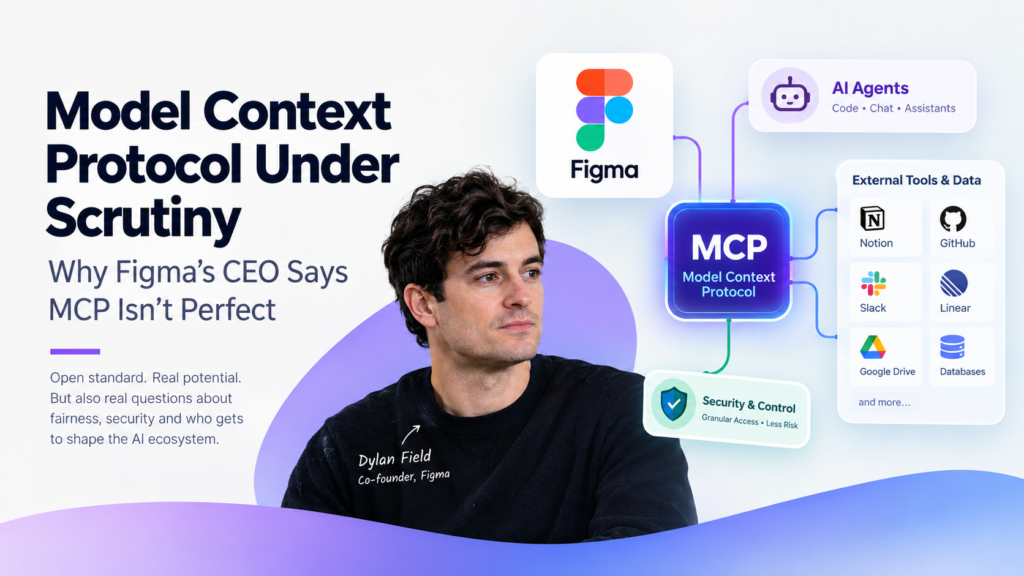
Quick answer: The Model Context Protocol is still the most widely adopted way to connect AI agents to outside tools and data. But Figma co-founder Dylan Field argues it favors the largest AI labs and has plenty of room to improve. Figma is expanding its support anyway, while deliberately limiting how much of its data it exposes.
It’s unusual for a company to deepen its commitment to a standard while its CEO publicly lists the standard’s flaws. That is what happened on October 20, 2026, when TechCrunch reported that Figma is broadening MCP support despite Field’s stated concerns. This analysis covers what Field said, why it matters to anyone building AI integrations, and what the dispute shows about who gets to shape the plumbing of the AI ecosystem. TechCrunch
What Is the Model Context Protocol?
Definition: The Model Context Protocol (MCP) is an open-source standard that defines how AI agents connect to external data sources and tools. It standardizes the connection between agents and the systems they need to read from or act on. TechCrunch
Expansion: Before a shared standard existed, every AI application needed a custom integration for every tool it wanted to touch. A coding assistant that wanted access to a design file, a ticketing system and a notes app needed three bespoke connectors. A common protocol replaces that matrix of one-off integrations with a single interface that both sides implement. That is why the Model Context Protocol has spread so quickly across AI products.
How the Model Context Protocol Works in Practice
A tool like Figma runs an MCP server that exposes some of its data and actions. An AI client, such as an agent inside a code editor or a chat product, connects to that server and requests context. In Figma’s case, partners use MCP to pull designs and design systems into their own AI tools. A developer can ask an agent to build a component, and the agent reads the relevant design context directly instead of relying on a screenshot or a pasted description. drweb
The important design question is what the server exposes and who gets it. That question is at the center of Field’s critique.
What Did Dylan Field Say About MCP?
Direct answer: Field said Figma wants to be open, but that MCP is “not a perfect protocol.” He made the remarks when TechCrunch asked him about the open-versus-closed debate at a media briefing. TechCrunch
Here is what he said, based on the reporting:
- He called MCP imperfect. He said it is “advantaged more to frontier labs” and has substantial room for improvement. daily
- He criticized Anthropic’s approach. In an earlier post on X, he noted that Anthropic, which created the standard, doesn’t expose artifacts or other cloud resources created via MCP. TechCrunch
- He reframed the debate. He argued that the conversation is framed as open versus closed, while issues of asymmetric context sharing get ignored. poweredbyai
- He defended limits on exposure. Figma doesn’t want to be fully open because exposing more data through MCP raises the chance of abuse. TechCrunch
- He supported developers. He said he understands people who simply want a protocol they can use with their Figma data, and that he wants them to use it. TechCrunch
Taken together, these are not the remarks of an opponent. They come from a major platform owner who is adopting the standard and trying to set its own terms.
Why Is Figma Expanding MCP Support Despite Field’s Doubts?
Direct answer: Because the Model Context Protocol is where AI developers already are, and being absent would cost Figma more than participating on its own terms. The company’s stated approach is to support as many standards as possible without exposing all of its data. pressbee
The 20-Partner Expansion
At its first Config conference in India, Figma announced 20 new MCP partners. The partners named in coverage include: poweredbyai
- Amp
- ClickUp
- Dia
- Junie by JetBrains
- Linear
- Meta Muse
- Mistral
- Notion
- OpenCode
- Sarvam Agents
The list mixes coding agents, project-management tools, browsers and model providers. That suggests Figma sees MCP as a way to put design context wherever people already work, not as a feature for one category of tool.
Why India, Why Now
The location of the announcement is worth noting. According to Figma figures reported by Dr. Web, India is the company’s second-largest market by daily active users, and the conference drew more than 30,000 registrations. Figma’s customer base is also moving beyond professional designers: roughly two-thirds of monthly active users are not designers, according to Dataquest. The more varied those users are, the more tools they bring with them, and the more Figma’s data has to travel through standards like MCP. drwebdrweb
What Is Asymmetric Context Sharing?
Definition: Asymmetric context sharing describes a situation where information flows into a platform through a shared protocol, but doesn’t flow back out in equal measure. One side gets rich context from the ecosystem, and the other side can’t get equivalent access to what the first side creates.
Expansion: This is my reading of Field’s argument, not a quote from him. Suppose an AI product uses the Model Context Protocol to read from many third-party tools. Users then generate artifacts inside that product, such as documents, designs or analyses. If those artifacts aren’t reachable through the same protocol, third-party tools can feed the product but can’t draw on what it produces. Context accumulates on one side.
That is the structure of the point Field raised about Anthropic. Because Anthropic created the standard, his comment is a pointed one. I haven’t seen a response from Anthropic in the coverage I reviewed, so treat this as one side of an ongoing discussion.
Why “Advantaged More to Frontier Labs” Matters
The frontier labs sit at the consuming end of most MCP connections. Their models are the clients, and the world’s tools are the servers. A protocol that makes it easy to serve context but doesn’t require reciprocity naturally benefits whoever sits at the consuming end. Field’s complaint, in essence, is that “open” isn’t a sufficient test of fairness. A standard can be open source and still tilt the economics.
Is the Model Context Protocol Secure? The Abuse-Risk Argument
Direct answer: Security is a real constraint, not an excuse, and it is the reason Figma gives for not exposing everything. Field’s position is that most users don’t intend to misuse MCP or Figma data, but the company still has to plan for the risks. mezha
This is the less glamorous half of the debate, and it deserves attention because MCP security is where integrations succeed or fail in practice. Any deployment of the Model Context Protocol widens the surface through which an automated agent can read, and sometimes change, valuable data. A few general risks apply to MCP-style integrations broadly. These are standard concerns in the field, not claims from the Figma coverage:
- Over-broad access. An agent granted wide permissions can retrieve far more than the task needs.
- Prompt injection. Content that an agent reads can contain instructions that try to redirect it.
- Scale effects. Automated clients can pull data far faster than a person clicking through an interface.
- Data leaving the trust boundary. Once context reaches a third-party model or tool, the data owner has less control over where it goes.
Seen this way, Field’s two criticisms pull in opposite directions. The asymmetry argument says the protocol should be more open and reciprocal. The abuse-risk argument says data owners need room to restrict. A mature standard has to support both: strong, granular controls for the party that owns the data, and fair access rules so those controls don’t become a tool for lock-in.
Open vs. Controlled Exposure: A Comparison
The table below summarizes the trade-off as I read it. The right-hand column reflects Figma’s stated approach, based on its public comments.
| Dimension | Fully open exposure | Selective exposure (Figma’s stated approach) |
|---|---|---|
| Developer convenience | Highest: everything is reachable | Good, but some data stays out of reach |
| Abuse and scraping risk | Higher: more data to misuse | Lower: smaller surface area |
| Ecosystem growth | Fast, with less friction | Steady, but gated by what the owner allows |
| Fairness across platforms | Depends on reciprocity from other parties | Owner decides, which can look like lock-in |
| Control for data owner | Weakest | Strongest |
| Best fit | Public or low-sensitivity data | Proprietary design files, customer data |
The takeaway is that neither column is automatically “right.” The Model Context Protocol exposure that suits a public documentation site is different from what suits a company’s unreleased product designs.
What the Pi Episode Reveals About Open Standards
The dispute has a concrete trigger. Days before the announcement, one of MCP’s co-creators complained that Figma didn’t support the open-source tool Pi. Field later added that Figma plans to support Pi. TechCrunchTechCrunch
That sequence shows two things. First, the debate is public and conducted partly on social media, so standards politics now plays out in real time. Second, it shows that the Model Context Protocol is not the only game in town. Figma’s stated aim of supporting many standards means developers should expect a multi-protocol landscape, where MCP is the most visible option but not the only one.
What Does the Model Context Protocol Mean for Developers?
Direct answer: Treat MCP as an interoperability layer, not as your whole trust model. Build the integration, but make your own decisions about permissions, logging and data scope.
If you are building on the Model Context Protocol, whether as a server provider or an agent developer, a few practical principles follow from this debate.
For Teams Exposing Data
- Start narrow. Expose the smallest useful slice of data and widen it based on real demand.
- Separate read from write. Reading context is a lower-risk operation than changing it.
- Log everything. Agent traffic behaves differently from human traffic, so you want an audit trail.
- Document what is and isn’t available. Surprise gaps cause frustration, as the Pi episode shows.
For Teams Consuming Data
- Ask about reciprocity. If your product creates valuable artifacts, consider whether users and partners can reach them through open interfaces.
- Request least privilege. Ask only for the access the task needs.
- Plan for multiple protocols. Don’t assume MCP will be the only integration standard you support.
How to Read the Disagreement
There are at least three honest interpretations of Field’s comments, and they aren’t mutually exclusive.
A principled critique. The asymmetry point is a real structural issue, and the security argument reflects genuine operational risk. On this reading, Field is doing what a platform operator should: adopting a standard while pushing for improvements.
Competitive positioning. Figma also has commercial interests. According to the German-language coverage, Figma sells seat-based licenses to teams that design software, so how much of its data flows freely to AI tools affects its business. Limiting exposure can protect users, and it can also protect strategic position. drweb
Ecosystem politics. A very visible dispute between a major design platform and the standard’s creators shapes how developers perceive the Model Context Protocol, whatever either party intended.
My view is that a healthy standard can absorb loud criticism from a significant adopter. A protocol that is quietly adopted but never questioned usually has problems nobody has stress-tested. The harder question is whether the stewards of MCP respond with concrete changes, such as better reciprocity norms or clearer permission models. Until they do, Field’s critique stays open.
Frequently Asked Questions
Does Figma support the Model Context Protocol?
Yes. Figma is expanding its support and announced 20 new MCP partners, even though its co-founder has voiced reservations about the standard’s design. daily
Is the Model Context Protocol open source?
Yes. Coverage describes it as an open standard that connects AI applications with external systems, data and tools. Open source doesn’t automatically mean balanced, which is the point Field is making. tokenpost
Who created MCP?
Anthropic created the standard, as Field’s comments and the TechCrunch reporting both note. Anthropic is also the maker of Claude, the assistant that wrote this analysis, so weigh my commentary on that dispute accordingly.
Why doesn’t Figma expose all its data through MCP?
Field says more exposed data means a higher chance of abuse, even if most users are well-intentioned. TechCrunch
Will Figma support Pi?
According to the coverage, yes. Field said after the initial dispute that Figma plans to support it. TechCrunch
Key Takeaways
- The Model Context Protocol is gaining adopters even as major users criticize it. Both facts are true at once.
- Field’s core complaint is structural: the protocol, in his view, benefits frontier labs more than other participants.
- Security is the stated reason for limits on what Figma exposes.
- Developers should expect a multi-standard future and design for least privilege.
- The real test is whether MCP’s stewards address reciprocity and permissions in the protocol itself.
Bottom Line
Dylan Field’s comments are best read as a pressure test, not a rejection. The Model Context Protocol has won enough adoption that its limitations now matter to the people building on it. Figma’s approach is to join the standard, widen its partner list and keep a grip on its own data. Whether that reflects careful stewardship or strategic caution depends on how the protocol evolves. Anyone planning an AI integration should watch that evolution closely, because the rules about who can access what, and who gets context back, are still being written.
The broader implications extend beyond Figma and the design industry. As AI agents become more capable, they will increasingly need access to documents, design files, project management systems, databases, and business applications. The Model Context Protocol offers a common way to establish these connections, reducing the need for developers to build separate integrations for every AI tool. However, interoperability alone does not guarantee that the resulting ecosystem will be secure, balanced, or beneficial to every participant.
One important question is how MCP permissions and data access controls will evolve. Businesses need confidence that AI agents can retrieve the information required for a task without gaining unnecessary access to confidential files or sensitive customer data. More granular permissions, clearer authorization mechanisms, and improved auditing could help organizations adopt MCP while maintaining control over their information. These safeguards will become increasingly important as companies connect multiple AI agents to their internal systems.
Another challenge is reciprocity. If an AI platform can access information from dozens of external services, developers and users may reasonably expect a practical way to retrieve the content or artifacts created within that platform. This does not mean every company must expose every resource publicly. Instead, it raises the question of whether open standards should encourage more consistent access patterns and transparent limitations. Better support for retrieving generated content could make integrations more useful without forcing businesses to abandon legitimate security restrictions.
For developers, the immediate lesson is to avoid treating any single protocol as a complete integration strategy. MCP can serve as a valuable interoperability layer, but implementation choices still matter. Teams should evaluate authentication, permission boundaries, data retention, logging, and the risks associated with sending information to external AI providers. They should also consider whether supporting additional protocols or APIs would make their products more flexible over time.
For businesses adopting AI, the practical priority is to evaluate integrations according to their actual needs. A tool that can read public documentation may require relatively limited permissions, while an agent that works with unreleased product designs or financial records needs much stricter controls. Establishing these distinctions early can reduce security risks and make it easier to scale AI adoption responsibly.
Ultimately, the future of the Model Context Protocol will depend not only on how many platforms support it, but also on how effectively it addresses these concerns. Broader adoption creates opportunities for developers, businesses, and users, yet sustainable growth requires trust, transparency, and meaningful control over data. Figma’s position highlights the challenge facing every major participant in the AI ecosystem: making tools more connected without making the underlying systems less secure or fair.
The next stage of MCP’s development will be worth watching for concrete improvements in permission management, access to generated artifacts, and interoperability between competing platforms. If the ecosystem can address these issues, the protocol could become more than a convenient connection standard. It could help establish a stronger foundation for AI agents that work across applications while respecting the interests of the people and organizations whose data makes those agents useful.