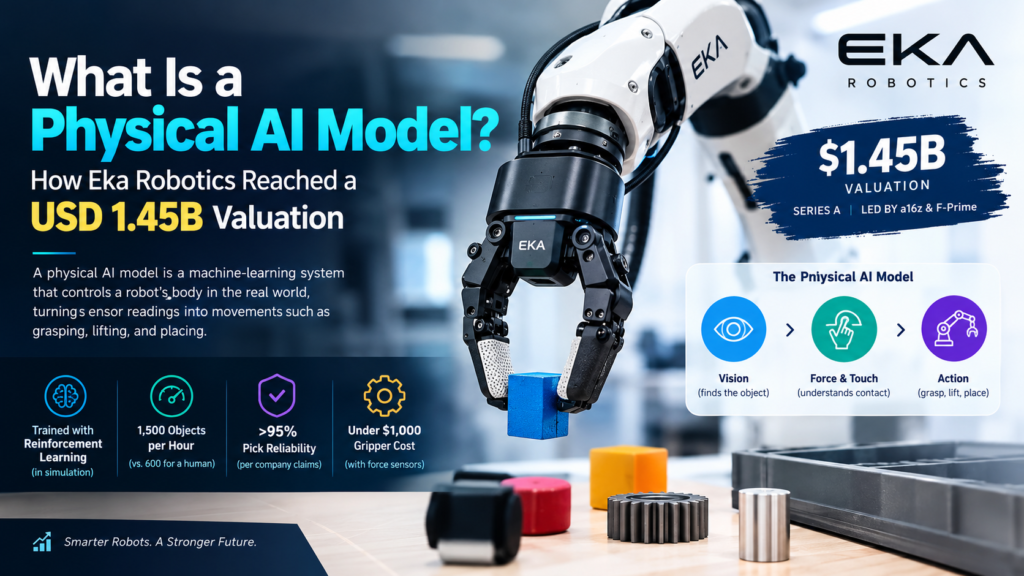
A physical AI model is a machine-learning system that controls a robot’s body in the real world, turning sensor readings into movements such as grasping, lifting, and placing. On October 20, 2026, TechCrunch reported that Eka Robotics raised USD 150 million at a USD 1.45 billion post-money valuation for a physical AI model built around force and touch rather than vision alone.
For decades, picking up an arbitrary object has been one of the hardest unsolved problems in robotics. Billions of dollars in investment and endless training videos have not fully fixed it. Eka Robotics, founded by MIT professor Pulkit Agrawal and former Google DeepMind researcher Tuomas Haarnoja, says it has solved a big piece of the puzzle. The roboticists who have watched its arm work are unusually emphatic about it.
This guide covers what the technology is, how it works, what the reported numbers show, and what remains unproven. Every section stands on its own, so you can jump straight to the question you care about.
What Is a Physical AI Model?
A physical AI model is a trained neural network that perceives the world through sensors and outputs actions for a machine to carry out. Where a text model produces words, a physical AI model produces motor commands, and mistakes have physical consequences: a dropped part, a crushed object, or a damaged robot arm.
Most systems in this category combine three ingredients:
- Sensors that read the environment, such as cameras and force sensors
- A learned policy that decides what to do next
- Hardware that executes the decision, such as an arm and gripper
The hardware matters as much as the software. A brilliant policy attached to a clumsy gripper still fails at the moment of contact, which is exactly where Eka concentrated its design effort. The shared idea across the field is that a learned system, rather than hand-coded rules, drives the robot’s behavior across many objects and situations.
How Is a Physical AI Model Different From a Chatbot?
Question: How does a physical AI model differ from a large language model?
Answer: A large language model predicts text, while a physical AI model predicts actions under real-time constraints, with contact forces it cannot afford to misjudge.
The difference shows up in the cost of error. A chatbot can give a wrong answer, get corrected, and try again for free. A heavy robot arm moving at speed cannot afford a wrong guess about how hard it is touching something. That is why physical systems need tight feedback loops between sensing and action. It is also why their training data is so much harder to collect than text gathered from the internet.
Who Is Eka Robotics and Who Backs It?
Eka Robotics is a robotics startup that builds a manipulation architecture: a force-sensitive gripper paired with a new kind of deep-learning model. According to TechCrunch, the company is running secretive pilots with several industrial customers, focused on pick-and-place and wire manipulation.
Who Founded Eka Robotics?
The founders are Pulkit Agrawal, a professor at MIT, and Tuomas Haarnoja, a former Google DeepMind researcher. They first met as graduate students at the University of California, Berkeley. Both are recognized researchers in reinforcement learning for robot control. Their central bet was that this technique could be pushed to enormous scale inside simulation, instead of depending on footage of humans or operators performing tasks.
How Much Is Eka Robotics Worth?
Question: How much is Eka Robotics worth?
Answer: Eka Robotics is valued at USD 1.45 billion post-money after a USD 150 million Series A round co-led by the venture firms a16z and F-Prime.
Raghu Raguram, the a16z general partner who co-led the round, told TechCrunch that he expects superhuman performance on many dexterous manipulation tasks within the next few months. Treat that as an investor’s forecast rather than a measured result. Investors have an obvious stake in optimism, and the performance data published so far comes from the company itself.
How Does Eka’s Physical AI Model Work?
Eka’s physical AI model is a vision-force-action model: it learns the relationship between language, force inputs, and actions, rather than leaning mainly on camera images. Vision tells the robot roughly where an object is. Force and touch tell it what to do once contact begins.
Vision-Language-Action vs. Vision-Force-Action
The dominant recipe in generative robotics is the vision-language-action (VLA) model, which is trained to connect language, visual input, and movement. Eka swaps the middle signal from vision to force. The table below compares the two designs.
| Aspect | Vision-language-action (VLA) | Vision-force-action (Eka) |
|---|---|---|
| Primary sensing | Camera images plus language | Force and touch signals plus language |
| Core idea | Understand scenes and follow instructions | Control contact: grip, adjust, ease off |
| Main critique | Critics argue it lacks any representation of force and touch | Evidence so far is mostly pick-and-place |
| Evidence so far | Broadly general, but often weak at individual tasks | Strong reported results on picking; wider tasks unproven |
Critics of the current direction in generative robotics, including roboticist Rodney Brooks, argue that these systems will fail unless they represent force and touch. Eka’s results suggest that critique has real merit, although one company’s demo does not settle the debate.
Why Does Force Sensing Solve the “Last Millimeter” Problem?
Answer first: Vision can only estimate where an object sits, while the final act of grasping is controlled by force feedback.
Agrawal told TechCrunch that vision is not the main way to close the final stretch before contact. In his account, the actual grabbing and the search for the right grip happen through forces.
To exploit that, Eka designed a robotic hand that is more flexible than traditional grippers and carries more force sensors. It reacts to contact, which is why it can hold a raspberry without squashing it. The founders are deliberately vague about the details of the design, citing competitive reasons.
How Does Eka Train Its Physical AI Model?
Eka trains its physical AI model largely in simulation, using reinforcement learning to let the robot practice at enormous scale.
Reinforcement learning is a method in which a system learns by trial and error, rewarded for good outcomes and penalized for bad ones. Eka uses a physics simulator to model the many forces a robot meets while trying to grasp something, then turns that into a reinforcement learning environment that can run at scale. The founders say they can generate thousands of hours of robot experience in minutes.
Why Does Simulation Beat Human Demonstrations?
Many rival approaches depend on demonstrations: video gathered from gig workers or robot operators performing tasks over many hours. That data is expensive to collect, and it caps what a robot can learn at roughly the level of the demonstrators.
Kris Hauser, a professor at the University of Illinois Urbana-Champaign, explained why Eka’s approach is different. Reinforcement learning lets the robot surpass the demonstrations it is given, so the system is not limited by the data it was shown. A model trained this way can, in principle, keep improving beyond human skill.
The catch is the so-called sim-to-real gap, the difference between a simulated world and a messy factory. TechCrunch notes that the leap from lab to production line is almost as big as that gap itself. Simulation gets Eka to a strong prototype, but only real deployments can prove the training transfers.
What Do the Reported Performance Numbers Show?
Based on TechCrunch’s reporting, these are the headline figures for Eka’s system:
- Speed: about 1,500 objects per hour, each up to 1 kg, compared with roughly 600 for a human
- Reliability: picks up objects more than 95% of the time, according to Eka
- Gripper cost: under USD 1,000 for the gripper hardware
- Durability: rated for 5 million duty cycles, with a target of 20 million, the bar set by standard industrial arms
- Persistence: tries again, over and over, when the first attempt fails
Most of these figures are company claims, not independent measurements. The arm also moves fast enough to hurt itself. One observer read that as a sign of how much the team trusts its algorithm not to break the robot.
What Do Roboticists Say About Eka’s Robot?
Experts who have seen the system describe an unusual level of polish.
Hauser said the demo had a “wow factor” compared with other robot demonstrations he has seen recently. He highlighted that the robot adapted to a large number of different objects without retraining. He also noticed an almost eerie, humanlike persistence in how it kept trying after a failed attempt.
A roboticist at a frontier lab, who asked not to be named, called the experience emotional. They compared it to the moment robots first achieved reliable walking on legs, five to ten years ago. They offered the robot a raspberry, their favorite test object. A heavy arm rushed toward them, slowed at the last instant, and touched them gently. They said they still carry that feeling in their body.
Reactions like these are anecdotal, and demos are curated. Still, the consistency of the reaction among experienced builders is notable.
How Does a Physical AI Model Fit With General-Purpose Robot Brains?
A physical AI model like Eka’s handles the physical execution, while a broader model decides what the robot should do.
Haarnoja describes the split as top-down versus bottom-up. Most of the field starts with high-level planning and tries to push that intelligence down toward the physical world. Eka starts at the bottom, with the physics of contact, and builds upward.
A dishwasher example makes the division concrete. A general-purpose model might know that clean plates get stacked in the cupboard. Eka’s model is the part that can pick up a plate without breaking it.
This matters commercially. The most general robot models can attempt many tasks, but TechCrunch reports they are often slow, costly, and not very good at them. Models trained for a single task may never justify their cost. Agrawal frames Eka’s goal as closing the gap between generality and performance, a gap that has plagued robotics.
What Challenges Does Eka Still Face?
Even enthusiastic observers flag real open questions. Here are the main ones:
- Field endurance: Hauser said the big test comes when Eka works with integrators on real assembly lines, where the system must run for an entire year without breaking.
- Task breadth: What outsiders have seen is pick-and-place, while many valuable industrial tasks involve more than that.
- Hardware lifespan: The gripper is rated for 5 million cycles against a 20 million cycle industry bar.
- Secrecy: The industrial pilots are confidential, so there is no public production data yet.
- Sim-to-real transfer: Strong simulation results still have to hold up on messy real-world lines.
Eka’s own plan is deliberately narrow. Agrawal says the company is starting with two verticals, pick-arrange-place and wire handling, and wants to make both clear successes before expanding.
What Should Businesses Ask Before Adopting a Physical AI Model?
Use the Lab-to-Line Test, a four-question checklist drawn from the concerns experts raised about Eka. It applies to any vendor in this space.
- Does it generalize without retraining? Ask whether new objects require new training runs or whether the system adapts on its own.
- How does it fail and recover? A robot that retries gracefully is more valuable than one that is only fast when everything goes right.
- How long can it run? Ask for duty-cycle ratings and real runtime data, and compare them with the 20 million cycles of standard industrial arms.
- Does it cover your actual task? Pick-and-place results do not automatically transfer to assembly, insertion, or other value-added work.
A vendor that answers all four with evidence, not demos, is further along than most.
Frequently Asked Questions
What Is Eka Robotics?
Eka Robotics is a startup building a robotic manipulation system that pairs a force-sensitive gripper with a deep-learning model. It was founded by Pulkit Agrawal and Tuomas Haarnoja and valued at USD 1.45 billion after a Series A round.
What Is a Vision-Force-Action Model?
A vision-force-action model is a robot-control model that centers on force inputs, with vision and language as supporting signals. Instead of relying mainly on what the robot sees, it relies on what the robot feels during contact.
How Fast Is Eka’s Robot?
Eka says its robot picks up about 1,500 objects per hour, each weighing up to 1 kg. TechCrunch reports that a human manages about 600 in the same time.
Is Eka’s Physical AI Model Ready for Factory Floors?
Not proven yet. Eka is running confidential pilots with industrial customers, but experts say the real test is a full year of reliable operation on an assembly line, and results beyond pick-and-place are still unseen.
Who Led Eka’s Funding Round?
The USD 150 million Series A was led by the venture funds a16z and F-Prime.
Bottom Line: Why Eka’s Physical AI Model Matters
Eka Robotics matters because it tests a specific idea: that robots get good at manipulation by learning force and touch, trained through massive simulation, not by watching more video. If that idea holds up in factories, the benefit will go beyond one startup. It would shift the field’s attention from vision-heavy models toward systems that feel what they hold.
The evidence today is promising but incomplete. The speed and reliability figures come from the company, the expert reactions are anecdotal, and the hardest tests, year-long runtime and tasks beyond picking, are still ahead. Watch for independent deployment data in the coming months. That is what will show whether this is a breakthrough in robotic manipulation or just a very good demo.
Why Physical AI Could Change Industrial Automation
The wider significance of Eka’s physical AI model lies in the possibility of making robots useful in environments that are difficult to program manually. Traditional industrial robots excel at repetitive tasks when objects arrive in predictable positions and operating conditions remain stable. However, even small variations in an object’s orientation, texture, weight, or position can complicate manipulation.
A force-sensitive system could help address these problems by adjusting its movements as it encounters physical resistance. Instead of relying entirely on a predetermined trajectory, a robot could respond to contact, change its grip, and attempt another approach when the first one fails. Such capabilities could make automation more practical for manufacturers handling diverse products or frequently changing production requirements.
For businesses, the potential benefit is not simply faster picking. It is reducing the engineering effort required to adapt robots to new tasks. If one learned model can handle a broader range of objects without extensive retraining, companies may be able to automate work that previously required expensive custom integration.
What Eka Robotics Must Prove Before Scaling
Despite the promise, a successful demonstration does not automatically translate into a commercially dependable system. Factory operators need predictable performance across thousands of operating hours, not just during carefully selected tests.
The first challenge is reliability. A robot must recognize when a grasp is failing, recover safely, and avoid damaging products or surrounding equipment. Even a small failure rate can become expensive when a system operates continuously at industrial speeds.
The second challenge is hardware durability. Force sensors, grippers, joints, and other moving components experience repeated mechanical stress. Eka’s reported gripper lifespan will need to be evaluated under real operating conditions, including exposure to dust, vibration, temperature changes, and demanding workloads.
The third challenge is economic value. A low-cost gripper could help reduce the initial investment, but businesses must also account for installation, maintenance, integration, training, downtime, and safety requirements. The most useful comparison is total cost per successfully completed task, rather than the purchase price of a single component.
Finally, manufacturers need evidence that the system can move beyond pick-and-place. Wire handling is a potentially important application because flexible cables can bend, twist, and resist movement in ways that rigid objects do not. Demonstrating reliable performance in such tasks would offer stronger evidence of generalizable manipulation skills.
What Businesses Should Watch Next
Companies evaluating physical AI should focus on measurable deployment results rather than valuation headlines or impressive demonstrations. Useful evidence would include independently verified success rates, recovery times after failed grasps, maintenance frequency, and performance across different materials and object shapes.
It will also be important to understand how much simulation training is required before a robot can perform a new task in the real world. If adaptation remains expensive or requires extensive engineering, the commercial advantage may be smaller than anticipated. Conversely, rapid adaptation with minimal downtime could make physical AI attractive to manufacturers that currently depend on manual labor for variable tasks.
Another important consideration is safety. Robots that move quickly and apply substantial force must operate within carefully defined limits, especially when people work nearby. Reliable contact sensing, emergency-stop systems, risk assessments, and appropriate safeguards will remain essential even if the underlying AI becomes considerably more capable.
The Long-Term Outlook for Physical AI Models
Eka Robotics represents a broader shift in robotics research: moving beyond systems that primarily interpret images toward models that learn how actions affect the physical world. Vision remains valuable for locating objects and understanding scenes, but tactile feedback can provide information that cameras cannot reliably capture, particularly during contact.
If Eka demonstrates that simulation-trained policies transfer consistently to industrial environments, its approach could influence how future robotic systems are developed. More capable manipulation models could support applications in electronics assembly, logistics, manufacturing, and other settings where objects vary and precision matters.
However, the company’s reported funding and valuation are indicators of investor confidence, not proof that its technology has achieved dependable commercial scale. The decisive evidence will come from real customer deployments, sustained operating performance, and transparent comparisons against existing automation solutions.
For now, Eka’s physical AI model is a promising development worth watching, rather than a settled breakthrough. Its most important achievement may ultimately be demonstrating that robots can learn not only to see objects and plan movements, but also to respond intelligently to the physical consequences of their actions. Whether that promise becomes an industrial reality will depend on what happens when the demonstrations end and the production lines begin.