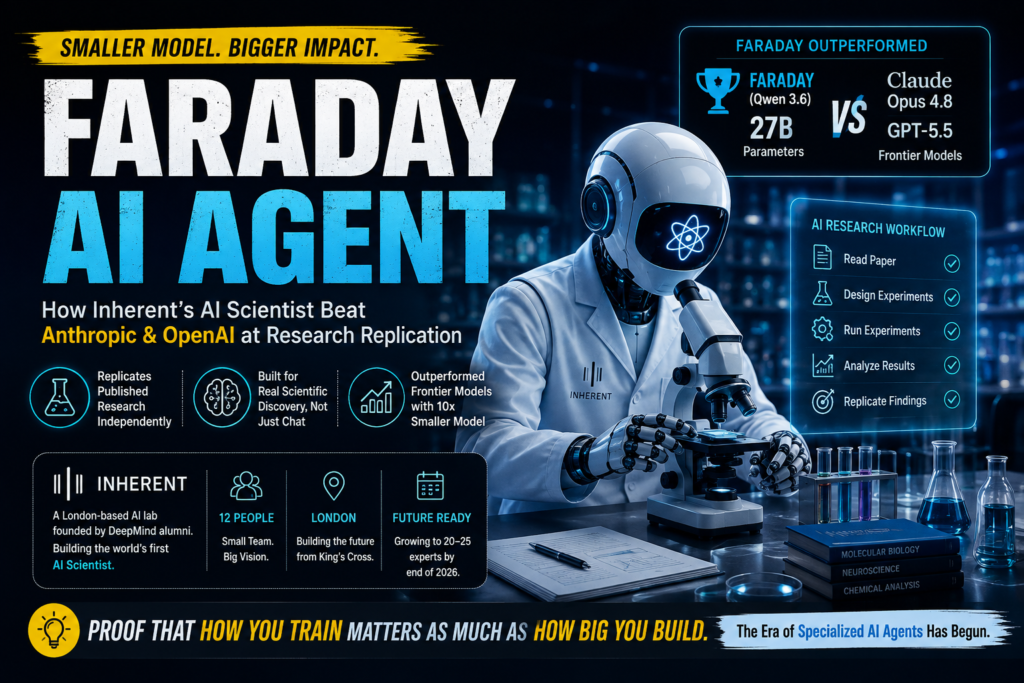
Imagine a 12-person startup in London going up against two of the best-funded AI labs on the planet, and winning, using a model roughly a tenth the size. That’s exactly what happened when British AI lab Inherent released its Faraday AI agent: on the task of independently reproducing the results of published scientific papers, Faraday beat both Anthropic’s Claude Opus 4.8 and OpenAI’s GPT-5.5, according to Inherent (via TechCrunch). The kicker: Faraday runs on a comparatively small 27-billion-parameter model called Qwen 3.6, not a frontier-scale system. Faraday AI agent
For students and young AI professionals in Odisha and across India tracking where the AI industry is headed, this story matters for a reason that goes beyond one benchmark win. It’s a signal that smaller, well-trained AI agents can now compete with giant frontier models on specific, high-value tasks, and that “how you train” is starting to matter as much as “how big you build.”
Who Built the Faraday AI Agent?
Inherent is a London-based AI lab founded by alumni of Google DeepMind. The company emerged from stealth in May 2026 with a $50 million seed round, and just weeks later, it introduced Faraday, its flagship AI research agent.
Inherent was co-founded by chief scientist Edward Hughes along with three other cofounders: Louis Kirsch, Kaloyan Aleksiev, and Tantum Collins. Unlike many AI startups racing to build ever-larger general-purpose chatbots, Inherent has a narrower and more ambitious long-term goal: building an “AI scientist” capable of contributing to real scientific discovery, not just answering questions about it.
The company currently has around a dozen employees, all working in person out of an office in King’s Cross, the London neighborhood that Google DeepMind’s presence helped transform into one of the world’s leading AI hubs. Inherent plans to grow to roughly 20–25 employees by the end of 2026.
AI research agent, an AI system designed to autonomously perform steps of the scientific process, such as designing experiments, running analysis, and interpreting results, rather than simply answering user prompts. Faraday is built specifically for this purpose: it doesn’t just chat about science, it attempts to do parts of the scientific workflow itself, from reading a paper to designing and running the experiments needed to reproduce its findings. Faraday AI agent
How Did the Faraday AI Agent Outperform Anthropic and OpenAI?
Which frontier models did Faraday outperform, and at what task? Faraday outperformed Anthropic’s Claude Opus 4.8 and OpenAI’s GPT-5.5 at a specific benchmark: independently replicating the findings of published scientific papers without being told the correct answer beforehand. This isn’t a general knowledge or reasoning benchmark, it’s a test of whether an AI agent can behave like a working scientist.
Paper replication might sound like an academic formality, but it’s a foundational skill in real research. As Hughes told TechCrunch, “many PhD students actually start by doing this.” Learning to reproduce someone else’s published result teaches a researcher how to design experiments carefully, spot hidden assumptions, and judge which methods actually work, skills that go far beyond memorizing facts.
Importantly, Hughes said beating the frontier agents wasn’t really the point of the exercise. What mattered more to Inherent was how Faraday got there, the training approach behind the Faraday AI agent, not just the leaderboard result.
Why Size Didn’t Matter: Faraday Runs on a Much Smaller Model
Here’s the detail that should catch any investor’s, or any engineering student’s, attention. Claude Opus 4.8 and GPT-5.5 are both massive, frontier-scale systems built by Anthropic and OpenAI, two of the most heavily funded AI labs in the world. Faraday, by contrast, runs on Qwen 3.6, an open-weight model with just 27 billion parameters.
Parameters, the internal numerical values a neural network learns during training. Roughly speaking, parameter count is a rough proxy for a model’s size and, typically, how expensive it is to train and run. A model with fewer parameters generally needs less computing power, which usually also means lower cost.
For context, frontier models from labs like Anthropic and OpenAI are widely understood to be dramatically larger than 27 billion parameters. Inherent essentially took a mid-sized, comparatively inexpensive open-weight model and, through careful training, got it to outperform systems built by companies with vastly larger budgets, on this specific research-replication task.
What Is “Research Taste,” and Why Does It Matter for AI Scientists?
What does Inherent mean by “research taste”? “Research taste” is Inherent’s term for an AI system’s instinct for which experiments are worth running and how to design them well, the kind of judgment an experienced scientist develops over years, rather than a skill that can be listed out as explicit rules.
Inherent’s bar for success with the Faraday AI agent wasn’t just raw accuracy in matching a paper’s results. The team specifically wanted Faraday to demonstrate this harder-to-measure quality of research taste, essentially, good scientific judgment, not just correct answers.
Teaching an AI system something as intangible as taste is difficult, which is where reinforcement learning comes in.
Reinforcement learning (RL), a training method that rewards an AI system for good outcomes rather than explicitly programming rules for it to follow. Instead of telling the model exactly what to do at every step, RL lets the system try different approaches and learns, over many attempts, which strategies lead to better results. Inherent leans heavily on this reward-based approach for the Faraday AI agent, betting that it will generalize better to the company’s long-term goal: agents that can contribute across many different scientific fields, not just replicate known results in one.
Notably, Inherent chose not to build its own coding tool for Faraday. Instead, the Faraday AI agent uses OpenAI’s GPT-5.5 Codex for coding tasks, much the way a human scientist relies on existing software rather than building every tool from scratch. This is a deliberate scoping decision: Inherent is focusing its own research effort on scientific reasoning and “taste,” not on reinventing infrastructure that already exists elsewhere.
Hughes also described the kind of AI teammate Inherent is trying to build, one that doesn’t simply tell users what they want to hear, but comes back and says, in effect: “I got curious about this, and I went off and did these experiments. What do you think of these results?” That collaborative, curiosity-driven behavior is central to how Inherent frames the Faraday AI agent’s purpose.
Faraday AI Agent vs. Frontier Models: A Quick Comparison
| Feature | Faraday (Inherent) | Claude Opus 4.8 (Anthropic) | GPT-5.5 (OpenAI) |
| Base model | Qwen 3.6 (open-weight, 27B parameters) | Frontier-scale proprietary model | Frontier-scale proprietary model |
| Relative model size | Small / mid-sized | Large | Large |
| Primary design goal | AI scientist agent focused on research taste | General-purpose frontier assistant | General-purpose frontier assistant |
| Training emphasis | Reinforcement learning for scientific judgment | Broad general-purpose training | Broad general-purpose training |
| Coding capability | Uses OpenAI’s GPT-5.5 Codex (not self-built) | Built-in coding capability | Built-in coding capability (Codex) |
| Reported result on paper-replication task | Outperformed both rivals, per Inherent | Outperformed by Faraday, per Inherent | Outperformed by Faraday, per Inherent |
| Company stage | ~12 employees, London, $50M seed | Established frontier AI lab | Established frontier AI lab |
Note: These results are based on Inherent’s own claims as reported by TechCrunch. Independent, third-party verification of the benchmark has not been reported.
Inside Inherent Labs: DeepMind Roots, London’s AI Hub, and the “Garden Leave” Debate
Inherent isn’t the only startup founded by former Google DeepMind researchers, but until this announcement, it had received comparatively little attention next to better-funded rivals. What sets the Faraday AI agent story apart is that Inherent is one of the few in this wave of DeepMind-alumni startups to actually show concrete results, rather than promises.
The company operates entirely out of King’s Cross in London, the same neighborhood that grew into a major AI hub partly because of Google DeepMind’s presence there. Hughes has said plainly that Inherent believes “London is the place to be” for this kind of research.
Hughes has also been vocal about a UK-specific hiring practice called garden leave, the common practice of barring departing employees from joining or starting a rival company for months after they resign. Garden leave is a restriction that researchers in the United States generally don’t face, which can give U.S. startups a head start when hiring talent that has left a previous employer. Hughes has publicly called to end the practice, noting that he was personally affected by it before starting Inherent, though he was clear this was a personal view rather an official company position.
Given Inherent’s ambitions around AI world models as well, and reported unsettlement among some Google DeepMind staff following changes in leadership there, Inherent’s planned hiring push could make it an attractive landing spot for researchers currently weighing a move away from bigger labs.
What This Means for Students and Young AI Professionals in India
For anyone in Odisha and the wider Indian AI ecosystem trying to figure out where to focus their learning, the Faraday AI agent story offers a few concrete lessons worth paying attention to:
- Training method matters as much as model size. Faraday’s win shows that a smaller, carefully trained 27-billion-parameter model can outperform much larger frontier systems on a specific task, a reminder that efficient training, not just raw compute, is a real skill worth developing.
- Reinforcement learning is becoming a core AI skill. If you’re building an AI/ML career, understanding reward-based training methods (not just prompting large pretrained models) is increasingly valuable, especially for agentic and research-oriented applications.
- Domain-specific AI agents are a growing category. Faraday isn’t a general chatbot, it’s purpose-built for scientific research tasks. Learning to design narrow, task-specific agents is a distinct and marketable skill separate from general LLM prompting.
- Composability beats reinventing the wheel. Inherent didn’t build its own coding tool; it plugged in GPT-5.5 Codex instead. Knowing how to combine existing AI tools effectively is often more practical than building everything from scratch.
- Small, focused teams can compete with giants. With just a dozen employees, Inherent produced a result that made headlines against Anthropic and OpenAI, encouraging news for anyone in India building AI products or startups with lean teams.
FAQ: Faraday AI Agent, Inherent Labs, and Research AI
What is the Faraday AI agent used for? The Faraday AI agent is designed to independently reproduce the findings of published scientific papers without being told the correct answer in advance, as a step toward Inherent’s larger goal of building an AI system that can help discover new scientific knowledge.
Which company built the Faraday AI agent? Faraday was built by Inherent, a London-based AI lab founded by alumni of Google DeepMind, including chief scientist Edward Hughes and cofounders Louis Kirsch, Kaloyan Aleksiev, and Tantum Collins.
Did Faraday really outperform Anthropic and OpenAI? According to Inherent, Faraday outperformed Anthropic’s Claude Opus 4.8 and OpenAI’s GPT-5.5 specifically on the task of replicating published research findings. This is Inherent’s own reported result, as covered by TechCrunch; it is not an independently verified, third-party benchmark.
What model does the Faraday AI agent run on? Faraday runs on Qwen 3.6, an open-weight model with 27 billion parameters, significantly smaller than the frontier-scale models used by Claude Opus 4.8 and GPT-5.5.
Why does Inherent care about “research taste” instead of just accuracy? Inherent wants Faraday to develop instincts for which experiments are worth running and how to design them well, not just match known results. This quality, “research taste”, is closer to real scientific judgment than to simple pattern-matching, and Inherent believes it’s essential for building an AI system that can eventually contribute to genuine scientific discovery.
How much funding has Inherent raised? Inherent raised a $50 million seed round shortly before releasing Faraday, and it currently plans to grow its team from about a dozen employees to roughly 20–25 by the end of 2026.
Keep Learning About AI Agents and the Future of Work
The Faraday AI agent is a strong example of where applied AI is heading: smaller, smarter, task-specific agents trained with reinforcement learning rather than just scaled-up chatbots. If you want to build hands-on skills in AI agents, LLM engineering, and applied machine learning, explore Kalinga.ai’s AI training programs and workshops designed for students and young professionals across Odisha and India.