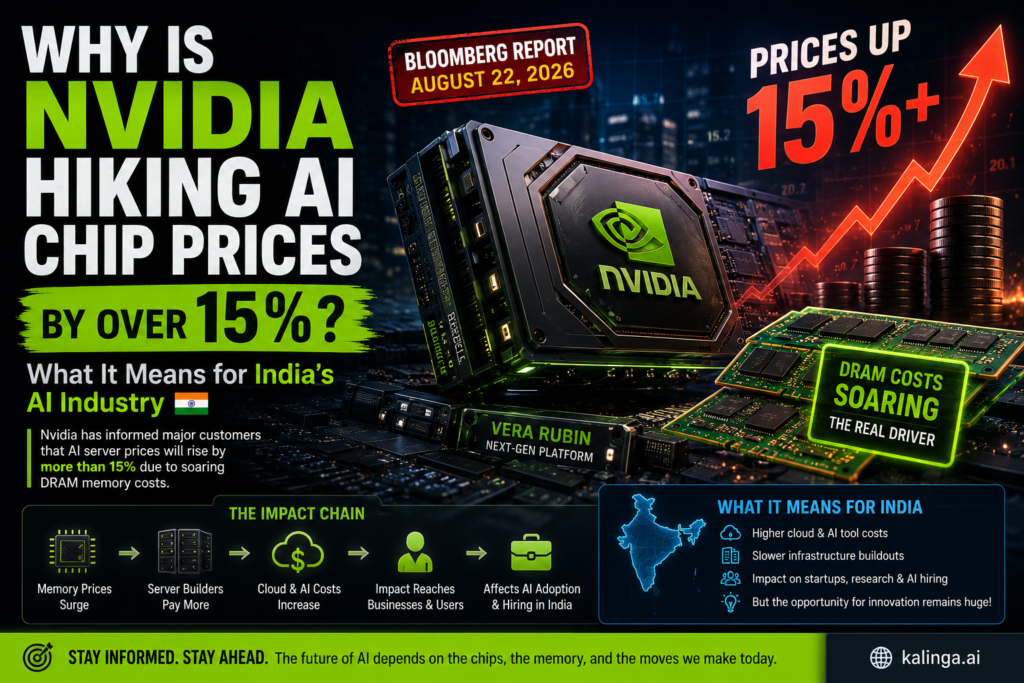
Imagine building a data center around chips that cost 15% more overnight, that’s the reality several of the world’s biggest tech companies are facing right now. The short answer: Nvidia has told some of its largest customers that prices for servers built around its AI chips are rising by more than 15% in many cases, driven mainly by soaring memory chip costs, according to a Bloomberg News report published August 22, 2026. This Nvidia AI chip price hike will hit systems shipping in early 2026, including the flagship Vera Rubin and Grace Blackwell platforms.
If you’re a student, fresher, or young professional tracking the AI industry out of Bhubaneswar or anywhere else in India, this isn’t just Silicon Valley gossip. Chip prices ripple down into cloud computing bills, AI tool subscriptions, and even the pace at which companies hire for AI roles. Let’s break down exactly what’s happening, why it’s happening, and what it means for you.
What Exactly Happened With the Nvidia AI Chip Price Hike?
What did Nvidia actually announce? Nvidia didn’t issue a public statement, instead, some of its largest customers were privately notified that prices of servers containing its AI chips will rise by more than 15% in many cases, per people familiar with the matter cited by Bloomberg. Reuters could not immediately verify the report independently, and Nvidia did not respond to requests for comment outside regular business hours.
The Nvidia AI chip price hike specifically affects systems built around two flagship product lines:
- Vera Rubin, Nvidia’s next-generation AI data center platform
- Grace Blackwell, the current-generation combined CPU-GPU superchip architecture used heavily in hyperscale AI training clusters
DRAM (Dynamic Random Access Memory) is the type of fast, short-term memory chip that stores data actively being processed by a computer or server. In AI servers, DRAM sits alongside the GPU to feed it data quickly enough to keep training and inference running smoothly, and it’s the exploding cost of this component, not the GPU itself, that’s driving the current Nvidia AI chip price hike. Every AI server needs large amounts of DRAM paired with each accelerator, so when memory prices spike, the total system cost spikes with it, even if Nvidia’s own chip pricing stays flat.
How much will the increase actually be? The size of each Nvidia AI chip price hike will vary depending on the chip generation and the specific memory configuration used, meaning not every customer or every server config will see an identical jump, but “more than 15%” is the figure being communicated across the board.
Why Are AI Chip Prices Rising in 2026?
Why now, specifically? The core driver is a global memory chip shortage, not a decision by Nvidia to arbitrarily raise margins. Server builders, the companies that assemble hardware on contract for giants like Microsoft, Google, and Oracle, have already begun passing these increases on to their own customers because the memory components they buy have become dramatically more expensive.
DRAM shortage refers to a supply-demand imbalance where memory chip manufacturers cannot produce enough DRAM to meet exploding global demand, pushing contract prices sharply upward. This isn’t a minor fluctuation, industry analysts have projected conventional DRAM contract prices climbing roughly 58% to 63% quarter-over-quarter in a single quarter of 2026, following an even steeper 90% to 95% surge the quarter before. Some in the industry have started calling this squeeze “RAMageddon,” reflecting just how disruptive the memory shortage has become across the entire tech supply chain.
Who controls the memory supply that’s causing this? Three companies, Samsung, SK Hynix, and Micron, produce the overwhelming majority of the world’s memory chips. Even as their output has increased, demand from AI infrastructure buildouts has outpaced supply, giving these three producers unusual pricing power over an entire industry that depends on them. Micron’s CEO has gone as far as describing memory as the strategic infrastructure of the AI era, a signal of how central this once-commoditized component has become.
It’s worth noting this Nvidia AI chip price hike isn’t happening in isolation. Nvidia had already raised prices on its consumer GeForce graphics cards earlier in the same month, and separate supply-chain reporting has pointed to additional pressures, including tariffs and the cost of shifting Blackwell production to new fabrication facilities, that have been pushing Nvidia’s overall pricing upward through 2026.
Who Gets Hit by This Nvidia AI Chip Price Hike?
Who is actually paying more? The direct hit lands on the “server builders”, companies that assemble AI servers under contract for large data center operators, and by extension, the hyperscalers themselves: Microsoft, Alphabet’s Google, and Oracle have all reportedly been informed of the coming increases by their contract manufacturers.
Here’s how the impact tends to cascade through the AI supply chain:
- Memory manufacturers (Samsung, SK Hynix, Micron) raise DRAM contract prices due to shortage-driven demand
- Server builders absorb higher component costs and pass them to their direct customers
- Hyperscalers (Microsoft, Google, Oracle, Amazon) pay more per AI server deployed
- Cloud customers (enterprises, startups, developers) potentially see this reflected in future cloud compute pricing
- End users of AI-powered tools may eventually feel indirect effects through subscription or usage-based pricing
Given how large modern AI rack-scale systems are, often selling for several million dollars each, a 15% Nvidia AI chip price hike doesn’t stay small for long. Across deployments running into thousands of racks, that percentage translates into hundreds of thousands of additional dollars per rack, adding up to billions across the industry.
Nvidia’s Pricing Moves in 2026: A Quick Comparison
| Product Category | Reported Increase | Primary Driver | Who Absorbs It First |
| AI servers (Vera Rubin, Grace Blackwell) | 15%+ | DRAM/memory shortage | Server builders, hyperscalers |
| Datacenter modules (H200, B200 per some reports) | ~10–15% | Memory + tariffs + production shift costs | Server vendors |
| GeForce RTX 50-series consumer GPUs | ~5–10% | Tariffs, production costs | Retail/gaming consumers |
| Flagship GeForce RTX 5090 | 10%+ | Same as above | Gamers, creators |
The pattern is consistent: this Nvidia AI chip price hike is part of a broader repricing across Nvidia’s entire product stack in 2026, but the AI datacenter segment is seeing the sharpest increases because of how memory-intensive those systems are.
What This Means for AI Costs in India and for Students/Freshers
Does this affect people learning or working in AI in India? Indirectly, yes, while individual students aren’t buying Grace Blackwell servers, this Nvidia AI chip price hike affects the cost structure of the cloud platforms, AI APIs, and compute resources that Indian startups, IT companies, and even AI training programs rely on.
Here’s what to actually watch for if you’re building a career in AI in Odisha or elsewhere in India:
- Cloud compute costs may inch upward, since Microsoft, Google, and Oracle are all facing higher server costs, some of that pressure could eventually show up in Azure, GCP, or OCI pricing for compute-intensive AI workloads.
- Enterprise AI adoption timelines could shift, companies budgeting for large AI infrastructure investments may need to revisit costs, potentially slowing (or in some cases accelerating, to lock in current pricing) deployment plans.
- Demand for AI cost-optimization skills will grow, as infrastructure costs rise, companies increasingly value people who understand how to run AI workloads efficiently, from model optimization to smart cloud resource management.
- Hardware careers gain relevance, the DRAM shortage has put memory and hardware supply chains back in the spotlight, which is good context for engineering students eyeing semiconductor or hardware-adjacent AI roles.
- This is a live case study in AI economics, for anyone studying AI, tracking how a single Nvidia AI chip price hike ripples through hyperscalers, cloud providers, and eventually end-users is a genuinely useful lesson in how the AI supply chain actually works.
Despite the price hikes, demand for Nvidia’s AI hardware isn’t slowing, Nvidia runs a gross margin of roughly 75% on a non-GAAP basis, among the highest in the semiconductor industry, suggesting the company has room to pass along costs rather than absorb them, and that hyperscalers are still willing to pay.
FAQ: Nvidia AI Chip Price Hike, Explained
Q1: What is the Nvidia AI chip price hike, in one line? Nvidia has privately told major customers that prices for AI servers, including Vera Rubin and Grace Blackwell systems, will rise by more than 15% in many cases, mainly because of soaring DRAM memory costs, according to a Bloomberg report from August 22, 2026.
Q2: When does the Nvidia AI chip price hike take effect? The increases apply to systems shipping in early 2026, according to people familiar with the matter cited by Bloomberg. Companies that build servers for major data center operators have already started notifying their own customers.
Q3: Why is memory (DRAM) so expensive right now? Global DRAM demand, driven heavily by AI infrastructure buildouts, has outpaced supply from the three dominant producers (Samsung, SK Hynix, and Micron), pushing contract prices up sharply, with some quarters seeing increases of 90%+ quarter-over-quarter.
Q4: Which companies are directly affected by this price hike? Server builders that assemble AI hardware under contract for Microsoft, Google (Alphabet), and Oracle have reportedly been notified of the increases, meaning the cost pressure starts with these hyperscale cloud providers before potentially reaching enterprise and retail customers.
Q5: Is this the only price increase from Nvidia in 2026? No, Nvidia had already raised prices on consumer GeForce graphics cards earlier in August 2026, and separate reporting has pointed to broader pricing pressure across Nvidia’s datacenter and gaming product lines tied to tariffs and production costs.
Q6: Will this affect AI tool prices or cloud costs for users in India? Not immediately or directly, but rising server costs for hyperscalers like Microsoft and Google can eventually influence cloud compute pricing over time, which matters for Indian startups, IT firms, and students working with cloud-based AI infrastructure.
What’s Next
The Nvidia AI chip price hike is a good reminder that the AI boom runs on a physical, very finite hardware supply chain, not just clever algorithms. If you want to understand how AI infrastructure, tools, and careers are evolving in real time, explore more explainers and workshop resources on Kalinga.ai, built specifically for students and young professionals navigating India’s AI landscape.