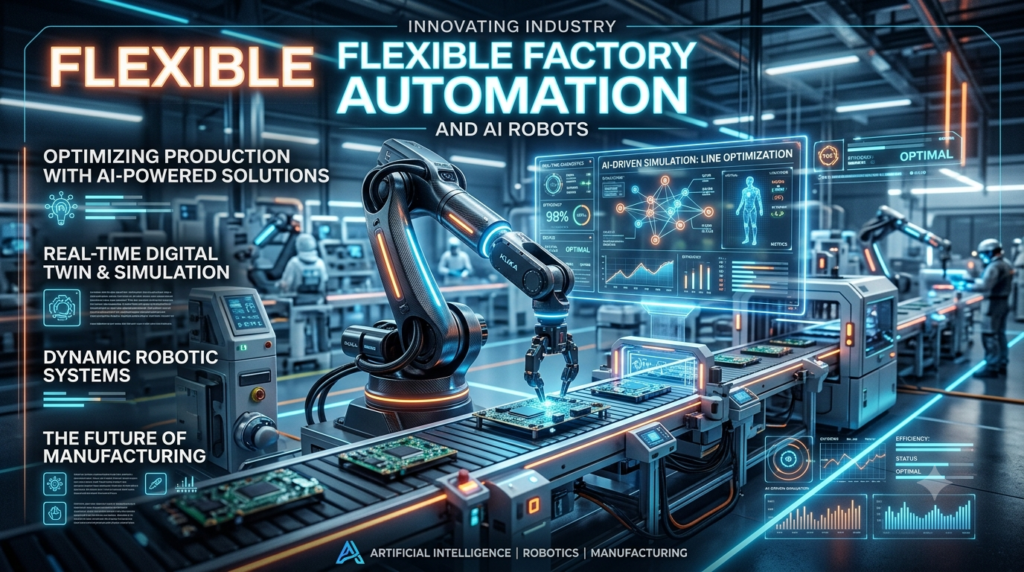
Flexible factory automation uses AI-driven robots that learn new tasks through simulation and demonstration, so a production line can be retooled in minutes instead of weeks or months. Startups like San Francisco-based Industrial Next, which presented on the Startup Battlefield stage at TechCrunch Disrupt 2026 on October 13, are betting this approach will let manufacturers automate delicate work that has long depended on human hands.
For decades, the factory floor has been the least adaptable part of modern manufacturing. Designers can iterate on a product overnight with software, but the robots that build it are usually locked into one task, one part and one process. Change the product slightly and the line can stall, the robot can fail, and the retooling bill can stretch across weeks. That mismatch is what this new wave of companies is trying to fix.
This guide explains what flexible automation is, why traditional robots struggle with change, how simulation-trained robots work, and what Industrial Next has claimed so far. It also gives you a framework for judging whether the technology is ready for your plant.
What Is Flexible Factory Automation?
Definition and expansion
Flexible factory automation is a manufacturing approach where robotic systems can be redeployed, reconfigured and retaught for different tasks and products without traditional programming or heavy physical retooling.
In a conventional setup, a robot arm is programmed for a narrow, repeatable motion: pick this part from this position, place it there, repeat. The system is fast and consistent, but it assumes nothing changes. Flexible systems drop that assumption. They combine perception (vision), an understanding of the task (context) and motion control, so the robot can adapt to variation in parts, positions and even whole product models.
The idea is not new in theory. Manufacturers have talked about “reconfigurable” and “agile” manufacturing for years. What has changed is the toolset. Foundation models, high-fidelity physics simulation and better sensing now make it plausible to teach a robot a process rather than a script.
How flexible automation differs from fixed automation
Fixed automation optimizes for one thing: doing the same task at high volume with minimal variation. It works well for products that stay stable for years. It works badly when product cycles are short, when designs change often, or when a task involves delicate, variable materials.
Flexible automation trades some of that single-purpose efficiency for adaptability. The robot is not built around one part. It is built around a capability, such as threading a cable or peeling a film, that can be applied across parts and product lines.
Core characteristics at a glance
- Task-agnostic stations: self-contained robotic workcells that can be moved, combined and redeployed across product lines
- AI-driven control: models that link vision, task context and motion rather than following fixed coordinates
- Teaching by demonstration and simulation: new tasks are taught virtually or by example, not hard-coded
- Fast changeover: retooling measured in minutes rather than weeks
- Handling of delicate work: tasks that were historically too fiddly for traditional robots
Why Traditional Factory Robots Struggle With Change
What does retooling cost a manufacturer?
Retooling a conventional line typically means reprogramming robots, physically changing fixtures and tooling, or swapping out equipment, and TechCrunch reports this can take weeks or months. During that time the line is down or running below capacity. Those delays add cost, and they also slow down how quickly a company can bring a new product to market.
This is the hidden tax on factory automation. The equipment is expensive, but the expertise and time required to change it are often what really limit a manufacturer’s speed.
Why do manufacturers simplify their products for robots?
Because traditional robots only perform well on repeatable tasks, even a small change in a process or part can cause failure or costly downtime. Industrial Next co-founder Lukas Pankau described this dynamic: manufacturers end up simplifying their products so robots can handle them reliably.
That is backward. In an ideal world, the product design drives what gets built. In practice, the limits of the automation often drive what can be designed. Flexible systems aim to reverse that relationship.
Why is it so hard to make robots flexible?
The core obstacle is data. Language and image models learned from huge quantities of text and pictures scraped from the internet. Robotics has no equivalent library of high-precision physical manipulation.
Pankau put it plainly: there is plenty of data to make robots do showy things like dance, but not enough to make them assemble high-precision parts. Real-world data collection is slow, expensive and hard to scale. Every new part, material and tolerance adds more cases to cover.
How Can Robots Be Retaught in Minutes?
What is a self-contained robotic station?
A self-contained robotic station is a modular workcell that bundles the robot, sensing and AI software needed to perform a task, so it can be reconfigured and moved between product lines. According to TechCrunch, Industrial Next builds AI-powered robotic stations driven by proprietary foundation models that connect vision, task context and motion.
Modularity matters for two reasons. First, it makes redeployment practical, since you move a station instead of rebuilding a line. Second, it lets manufacturers combine stations the way you would combine software modules.
How does simulation replace hard-coded scripts?
Instead of writing step-by-step code, engineers teach the robot an understanding of the process inside a physics-accurate virtual world, then transfer it to the real machine.
Industrial Next says it builds that understanding using a very high-fidelity simulation engine that stays close to real-world dynamics. In plain terms, the robots practice in a detailed virtual environment that mimics real physics. Pankau said this lets them perform high-precision tasks almost without seeing the parts beforehand. New tasks are taught through simulation and demonstration rather than hard-coded scripts.
This is why simulation-trained robots are attracting so much attention. Simulation can generate far more practice than a physical lab ever could, and it can vary conditions endlessly without wearing out hardware or wasting parts.
What is dexterous manipulation, and why does it matter?
Dexterous manipulation is a robot’s ability to handle small, flexible or delicate objects with human-like precision, such as threading a thin cable or seating a tiny connector.
It matters because these are exactly the tasks that have kept humans on assembly lines. Rigid, repeatable motions are easy to automate. Soft, variable, fiddly motions are not. When a robot can master dexterous manipulation, a whole category of work that was previously considered “too hard to automate” opens up.
Case Study: What Industrial Next Announced at Disrupt 2026
The following details come from TechCrunch’s coverage of the company’s Startup Battlefield presentation. They are company claims reported by the publication, not independently verified results.
Who is behind Industrial Next?
Industrial Next was founded in 2021 by Lukas Pankau and Allen Pan, two former Tesla engineers. Pankau was a lead electrical architect at Tesla before moving to Waymo. Pan led Tesla’s autonomous factory efforts and later became a chief architect at autonomous driving company Neolix.
The founders say the idea grew out of a frustration they shared at Tesla. Advanced vehicle and self-driving technology kept running into decades-old factory equipment. Engineers who could use machine learning to help design a car still struggled to program the robots meant to build it. They concluded that manufacturing itself needed to be rebuilt.
What did the company announce?
On stage, Industrial Next announced a partnership with the BMW Group Technology Office to evaluate its AI-powered dexterous manipulation for manufacturing. The word “evaluate” is important. This is a trial relationship, not a confirmed production rollout.
What results does the company claim?
Pankau said some of the company’s workstations are already used in making one of the world’s most popular smartphones, though he could not name the customer. According to TechCrunch, the tasks include:
- Threading a delicate flex cable, which manufacturers had tried and failed to automate for years
- Snapping a tiny connector cap into place
- Film peeling, where robots strip protective film from camera modules and buttons at or above human speed with 100% accuracy, even after being moved to a new phone model and production line they had not seen before
What is the long-term goal?
The stated ambition is to build a full car end-to-end with no human touching it. That is a long way from threading a cable, and the company did not provide a timeline in the coverage. It does show the scale of the thesis: if one platform can adapt across tasks, the same logic could extend from consumer electronics to automotive assembly.
Fixed vs. Flexible Automation: A Direct Comparison
| Factor | Traditional Fixed Automation | Flexible Automation (AI-Driven) |
|---|---|---|
| How tasks are defined | Hard-coded programming for one specific task | Taught through simulation and demonstration |
| Time to change a line | Weeks or months of reprogramming and retooling | Minutes, according to Industrial Next |
| Tolerance for variation | Low; small changes can cause failure or downtime | Higher; designed to adapt to new parts and models |
| Product design impact | Designs often simplified to suit the robot | Designs can stay complex; robot adapts |
| Best suited for | High-volume, long-lifecycle, stable products | Frequent changeovers and delicate or variable tasks |
| Deployment unit | Custom line integration | Self-contained stations that can be moved and combined |
| Main bottleneck | Engineering time to reprogram | Training data and simulation fidelity |
| Maturity | Decades of proven use | Early; evidence still emerging |
The last row is the honest caveat. Fixed automation is boring precisely because it is proven. Flexible systems have to demonstrate reliability at production scale before they displace it.
The Business Case for Flexible Factory Automation
Why does flexible factory automation matter now?
Flexible factory automation matters now because product cycles are shortening while labor-intensive assembly steps remain a bottleneck. Consumer electronics, in particular, release new models on a steady cadence. Each new model traditionally means new fixtures, new programs and new validation. If a station can carry its skills to a new model without a rebuild, the savings compound with every cycle.
Faster changeovers
The headline benefit is time. Shrinking the cost of change from weeks to minutes would let manufacturers respond to design updates, supply shortages or demand swings far more quickly. The retooling window stops being a planning constraint and becomes a routine adjustment.
Better economics for high-mix, low-volume production
Fixed automation only pays back when you run enough volume to amortize the setup. Flexible stations change that math. If the setup cost drops, smaller production runs can become worth automating. That could matter for specialty manufacturing, custom products and any line that sees frequent variation.
Automating the “impossible” tasks
Some steps have resisted automation for years because they involve soft or tiny components. If dexterous manipulation reaches production-grade reliability, those steps become candidates for automation, and the human workforce can shift toward supervision, quality and exception handling.
Better alignment between design and manufacturing
When robots can adapt, designers are less pressured to simplify products for the sake of repeatability. That could mean better products, not just cheaper ones.
Risks and Open Questions
How should you read the early claims?
With interest and with caution. The results reported so far are company statements made on a stage, relayed by a news outlet. A 100% accuracy figure on a film-peeling station is impressive, but important details are missing: sample size, duration, error handling, and what happens at the edges of the process.
What are the main technical risks?
- The sim-to-real gap: simulation is only as good as its physics. Subtle differences between virtual and real materials can cause failures that only appear at scale.
- Long-tail variation: factories produce odd cases. A system that handles 99% of situations may still need robust fallback behavior for the rest.
- Integration complexity: a modular station still has to connect to upstream and downstream equipment, quality systems and safety controls.
- Validation and compliance: regulated or safety-critical industries will demand documented, repeatable validation, which can slow adoption.
What about workforce impact?
Automating tasks that previously required human labor will change roles on the line. The realistic near-term pattern is a shift in the work people do rather than a clean replacement, but companies and policymakers should plan for it deliberately rather than assume it will sort itself out.
Is the business model proven?
Partnerships like the one with BMW’s technology office signal serious industrial interest, but evaluation is not deployment. The real test is repeat orders, multi-site rollouts and published performance data.
How to Evaluate a Vendor Before Committing
Before buying into flexible factory automation, put these questions to any vendor:
- What is the measured changeover time on a real customer line, and how was it measured?
- What are the yield and error rates over a long run, not just in a demo?
- How does the system handle out-of-distribution parts or unexpected conditions?
- Who retrains or retunes the system when a product changes: your team, the vendor, or both?
- How does the station integrate with your existing MES, quality and safety systems?
- What does the simulation cover, and how is it validated against physical reality?
- What are the failure modes, and how does the system fail safe?
- What is the total cost of ownership, including training, maintenance and support?
A vendor with strong answers to these questions has probably moved beyond the demo stage.
Frequently Asked Questions
What is the difference between a flexible robot and a traditional industrial robot?
A traditional industrial robot repeats a programmed motion for one task, while a flexible robot uses AI to adapt to new parts, positions and tasks. The hardware may look similar. The difference is mostly in the software and training approach.
How can a robot learn a task without traditional programming?
It learns the process through simulation and demonstration. The robot practices in a detailed virtual environment, then applies what it learned to the physical task. This replaces hand-written, step-by-step code.
Is flexible factory automation only for electronics?
No, but electronics is the clearest early example. The reported use cases involve smartphone components, yet the same logic applies to any product with delicate parts or frequent design changes. The BMW evaluation suggests automotive interest, though results there are not yet public.
What does “retooling in minutes” really mean?
It means that moving a station to a new task or product should not require weeks of reprogramming or physical rebuilding. It does not necessarily mean zero validation or testing. Quality checks and safety sign-off still take time.
Will AI robots replace factory workers?
They will change the mix of tasks humans do. Automating delicate assembly steps reduces some manual work, while creating demand for supervision, maintenance, quality assurance and process engineering. The pace and the scale will depend on how quickly the technology proves itself.
What should manufacturers do first?
Start with a narrow pilot on a task that is costly, repetitive and currently manual. Define success metrics up front, such as changeover time, yield and uptime, and compare against your existing process.
Key Takeaways
- Flexible factory automation replaces hard-coded, single-purpose robot programs with AI systems taught through simulation and demonstration.
- Traditional automation struggles with change, which forces product simplification and long retooling downtime.
- Industrial Next says its self-contained stations can retool a line in minutes and handle delicate tasks like cable threading and film peeling.
- Its BMW Group Technology Office partnership is an evaluation, not a confirmed rollout.
- The biggest open questions are the simulation-to-reality gap, long-tail variation and independent proof at scale.
- Treat early claims as promising, and verify them with pilots and hard metrics.
Conclusion
The factory has long been the slowest-moving part of a fast-moving technology world. If systems like Industrial Next’s deliver what they promise, the economics of change could shift dramatically: retooling stops being a multi-week project and becomes an adjustment, and tasks once considered too delicate for machines become candidates for automation.
The technology is still early, and the evidence is mostly company-reported. But the direction is clear. Flexible factory automation is moving from research concept to commercial pilot, and manufacturers that start learning now, with careful pilots and rigorous measurement, will be better placed when the technology matures.