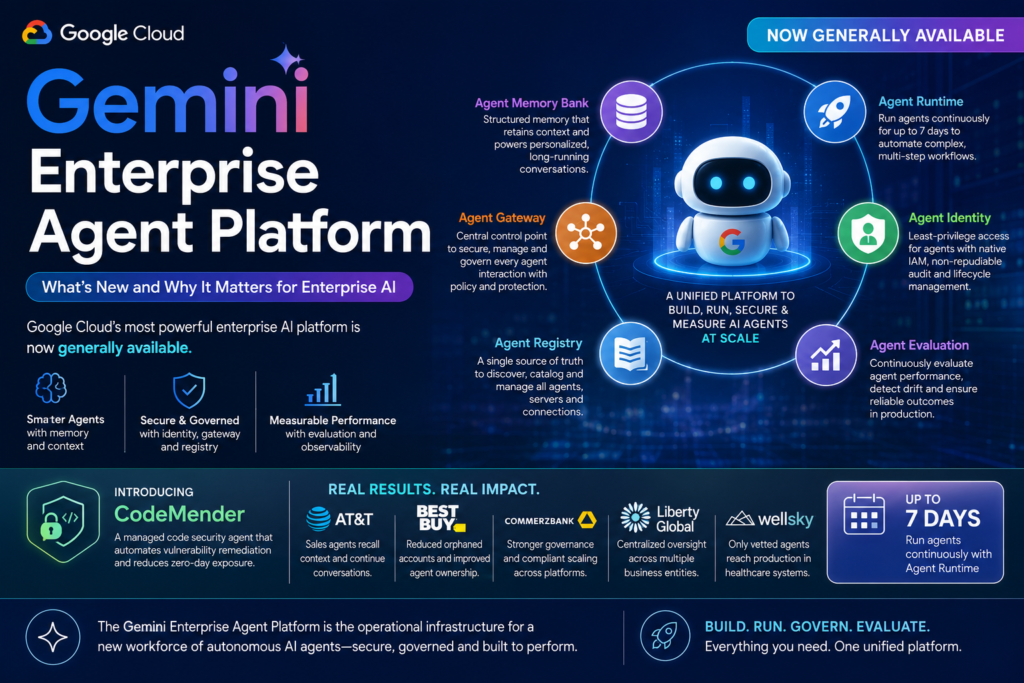
The Gemini Enterprise Agent Platform just made its most powerful enterprise features generally available: Agent Runtime, Agent Identity, Agent Gateway, Agent Registry, Agent Memory Bank, and Agent Evaluation are now open to every organization. In short, Google Cloud has moved its agentic AI stack from “invite-only preview” to “build it today,” giving enterprises a single system to run, secure, and measure AI agents at scale.
If you’ve been waiting for a production-grade way to deploy autonomous AI agents without stitching together a dozen disconnected tools, this update is the one to pay attention to. Below, we break down exactly what changed, why it matters, and how the Gemini Enterprise Agent Platform compares to other options on the market.
What Is the Gemini Enterprise Agent Platform?
The Gemini Enterprise Agent Platform is Google Cloud’s unified system for building, running, securing, and monitoring AI agents across an organization. Rather than treating agents as isolated chatbots, the platform treats them as long-running digital workers that need memory, identity, governance, and performance tracking , the same operational scaffolding a company would give a human employee.
Since its initial launch a few months ago, Google Cloud has been rolling out capabilities gradually, first showcasing them through demos and customer builds. With this release, the Gemini Enterprise Agent Platform graduates its core capabilities from limited access to general availability, meaning any enterprise team can now adopt them without waiting on an allowlist.
Why This Matters Now
Most enterprises experimenting with AI agents run into the same three walls:
- Memory gaps , agents forget context between sessions, forcing users to repeat themselves.
- Security blind spots , agents accumulate permissions like orphaned service accounts, with no clear owner.
- Visibility gaps , teams can’t tell whether an agent’s decisions were actually good, only that it produced an output.
The Gemini Enterprise Agent Platform update directly targets all three problems in one coordinated release.
Key New Capabilities for Long-Running Agents
Enterprise workflows rarely finish in a single exchange. A vendor compliance review, a multi-touch sales sequence, or an IT root-cause investigation can span days, not seconds. To support this, the Gemini Enterprise Agent Platform now generally offers two foundational capabilities: Agent Memory Bank and Agent Runtime.
Agent Memory Bank: Giving Agents Real Context
What is Agent Memory Bank? It’s a feature of the Gemini Enterprise Agent Platform that lets teams define structured schemas so agents automatically extract and retain key conversation context , user preferences, past decisions, and account history , across long-running interactions.
In practice, this means an agent doesn’t start from zero every time a user returns. A customer service agent can recall that a client already escalated an issue last week. A sales agent can remember which objections a prospect raised in a prior call. This is the difference between an AI tool that merely responds and one that actually remembers.
AT&T’s team put this into production for AI-driven sales agents, describing how these agents can resume conversations after a gap by pulling together key facts from earlier interactions , moving the experience from guesswork to genuine recall, with plans to extend the same memory layer across voice and web channels.
Agent Runtime: Automating Multi-Day Work
What is Agent Runtime? It’s the execution engine within the Gemini Enterprise Agent Platform that lets agents run continuously for up to seven days, handling complex, multi-step reasoning tasks without constant human supervision.
This unlocks a category of work that was previously impractical for AI agents:
- Executing a week-long, multi-touch sales outreach sequence
- Orchestrating a multi-stage employee or customer onboarding process
- Continuously monitoring vendor or supply-chain compliance risk
- Running background IT incident response and root-cause patching
Because Agent Runtime keeps state and context intact across the full duration of a task, teams can delegate entire asynchronous workflows rather than babysitting an agent through each individual step.
Securing and Governing Agent Operations on the Platform
Giving agents memory and stamina is only half the equation. Once an agent can act autonomously for days at a time, security and governance become non-negotiable. The Gemini Enterprise Agent Platform addresses this with three newly generally available components: Agent Identity, Agent Gateway, and Agent Registry.
Agent Identity: Least-Privilege Access by Design
What is Agent Identity? It’s a native IAM (Identity and Access Management) type, built on open standards, that enforces least-privilege permissions specifically for AI agents rather than treating them like human users or generic service accounts.
Agent Identity within the Gemini Enterprise Agent Platform does three things worth highlighting:
- Mitigates token theft by binding access directly to the agent’s runtime, rather than issuing long-lived, portable credentials.
- Provides non-repudiable auditing of every action an agent takes, creating a clear record of what happened and why.
- Automates the identity lifecycle, eliminating the dormant, forgotten credentials that plague traditional service-account sprawl.
Best Buy’s cloud platform engineering team described the problem this solves well: in the past, orphaned service accounts, unclear ownership, and permissions that only ever grew created real risk. Agent Identity brings the same accountability to autonomous systems that organizations already expect from human identity management , making it clear who an agent is, what it can touch, and who owns it.
Agent Gateway: One Control Point for Every Agent Interaction
What is Agent Gateway? It’s the centralized control layer of the Gemini Enterprise Agent Platform where organizations secure and govern all interactions across their entire agent ecosystem.
From Agent Gateway, teams can enforce granular access controls through IAM conditions and natural-language policy rules, while Model Armor provides inline protection against prompt injection, tool poisoning, and data leakage. Companies like Broadcom, Palo Alto Networks, and Ping Identity are already using Agent Gateway to govern agents securely at scale.
Agent Registry: A Single Source of Truth for Every Agent
What is Agent Registry? It’s a unified catalog inside the Gemini Enterprise Agent Platform that gives organizations a single view of every agent, server, and connection built across the company.
Rather than teams unknowingly rebuilding the same agent in five different departments, Agent Registry lets everyone discover and reuse what already exists. It also gives administrators the visibility needed to spot and manage agent sprawl before it becomes unmanageable.
WellSky’s CTO described building a proactive framework to catalog, version, and lifecycle-manage AI agents, using a centralized registry to enforce compliance policies so only fully vetted agents ever reach production , critical in a regulated healthcare environment. Commerzbank AG and Liberty Global echoed similar priorities, calling registry and gateway controls essential for compliant, auditable scaling across multi-entity organizations.
Measuring Agent Performance: Evaluation and Observability
Deploying an agent is only the starting line. Enterprises also need to know whether an agent is actually performing well , and whether that performance is degrading over time. The Gemini Enterprise Agent Platform now unifies this through two connected capabilities.
Agent Evaluation
Agent Evaluation continuously monitors agent performance in production, using online evaluation monitors that proactively catch performance degradation and behavioral drift before they become visible problems. Teams can choose from pre-built metrics, custom Python-based scoring, LLM-as-a-judge evaluation, or adaptive rubrics co-developed with Google DeepMind.
Agent Observability
Agent Observability provides end-to-end visibility into how an agent reasons, which tools it calls, and how it performs during execution, through comprehensive tracing and real-time dashboards. Together with Agent Evaluation, this closes the loop: the same metrics used while building an agent are the ones used to grade it after launch, so there’s no disconnect between development and production standards.
CodeMender: The New Code Security Agent
Alongside the Gemini Enterprise Agent Platform update, Google Cloud also introduced CodeMender, a managed code security agent designed to move teams beyond passive vulnerability scanning into automated code remediation. Instead of simply flagging a vulnerability and leaving a developer to fix it, CodeMender helps close the gap between detection and correction , directly reducing zero-day exposure risk across an organization’s codebase.
Real Enterprise Results with the Gemini Enterprise Agent Platform
Several enterprises have already put these capabilities to work in production, and the results speak to how the platform is actually used day to day:
| Company | Feature Used | Reported Outcome |
| AT&T | Agent Memory Bank | Sales agents resume conversations using prior context instead of starting over |
| Best Buy | Agent Identity | Reduced orphaned accounts; clearer agent ownership and least-privilege access |
| Commerzbank AG | Agent Registry, Agent Gateway | Stronger governance, discoverability, and compliant scaling of AI platforms |
| Liberty Global | Agent Gateway, Agent Registry | Centralized oversight across multiple business entities |
| WellSky | Agent Registry | Compliance enforcement ensuring only vetted agents reach healthcare production systems |
Gemini Enterprise Agent Platform vs. Other Enterprise Agent Platforms
How does the Gemini Enterprise Agent Platform stack up against the general category of enterprise AI agent tooling? Here’s a breakdown of the capabilities enterprises typically evaluate:
| Capability | Gemini Enterprise Agent Platform | Typical Agent Frameworks | Point Security Tools |
| Long-running execution (multi-day) | Yes , Agent Runtime, up to 7 days | Limited or session-based | Not applicable |
| Structured cross-session memory | Yes , Agent Memory Bank | Often custom-built | Not applicable |
| Native least-privilege agent identity | Yes , Agent Identity (IAM-based) | Rare; usually generic service accounts | Partial, identity-only |
| Centralized governance gateway | Yes , Agent Gateway with Model Armor | Rare | Yes, but not agent-native |
| Organization-wide agent catalog | Yes , Agent Registry | Rare | No |
| Built-in evaluation + observability | Yes , unified engine | Often separate tools | No |
| Code vulnerability remediation | Yes , CodeMender | No | Sometimes (scanning only) |
The clearest differentiator is unification: rather than assembling memory, identity, governance, and evaluation from separate vendors, the Gemini Enterprise Agent Platform bundles them into one system with shared context.
Frequently Asked Questions
Is the Gemini Enterprise Agent Platform generally available now? Yes. As of this release, Agent Runtime, Agent Identity, Agent Gateway, Agent Registry, Agent Memory Bank, and Agent Evaluation are all generally available to every organization, not just early-access customers.
How long can an agent run continuously on the platform? Agents built on the Gemini Enterprise Agent Platform can run continuously for up to seven days using Agent Runtime, enabling multi-day workflows like extended sales sequences or ongoing compliance monitoring.
Does the Gemini Enterprise Agent Platform help with agent security? Yes. Agent Identity enforces least-privilege access and binds credentials to the runtime itself, while Agent Gateway adds centralized policy enforcement and inline protection against prompt injection and data leakage.
What is the difference between Agent Evaluation and Agent Observability? Agent Observability shows what an agent did , its reasoning steps, tool calls, and execution trace. Agent Evaluation shows whether that behavior was actually good, using pre-built, custom, or LLM-as-a-judge metrics to catch performance drift over time.
Is CodeMender part of the Gemini Enterprise Agent Platform? CodeMender was announced alongside this update as a related but separate managed code security agent, focused on automated vulnerability remediation rather than general-purpose agent orchestration.
Who is already using the Gemini Enterprise Agent Platform in production? Enterprises including AT&T, Best Buy, Commerzbank AG, Liberty Global, and WellSky have publicly described using specific platform features , from Agent Memory Bank to Agent Registry , in live production environments.
Getting Started with the Gemini Enterprise Agent Platform
For teams ready to move past pilot projects, the newly generally available features remove the biggest blockers to production deployment: unreliable memory, weak identity controls, and limited visibility into agent behavior. Google Cloud’s documentation covers setup for each capability, and its recent livestream walks through the full agentic lifecycle from build to governance to evaluation.
The broader signal here is clear , Google Cloud is positioning the Gemini Enterprise Agent Platform not as a chatbot builder, but as operational infrastructure for a workforce of autonomous digital agents. For enterprises already running pilots, general availability of Agent Runtime, Agent Identity, and the surrounding governance stack is the milestone that makes scaled, production deployment realistic.