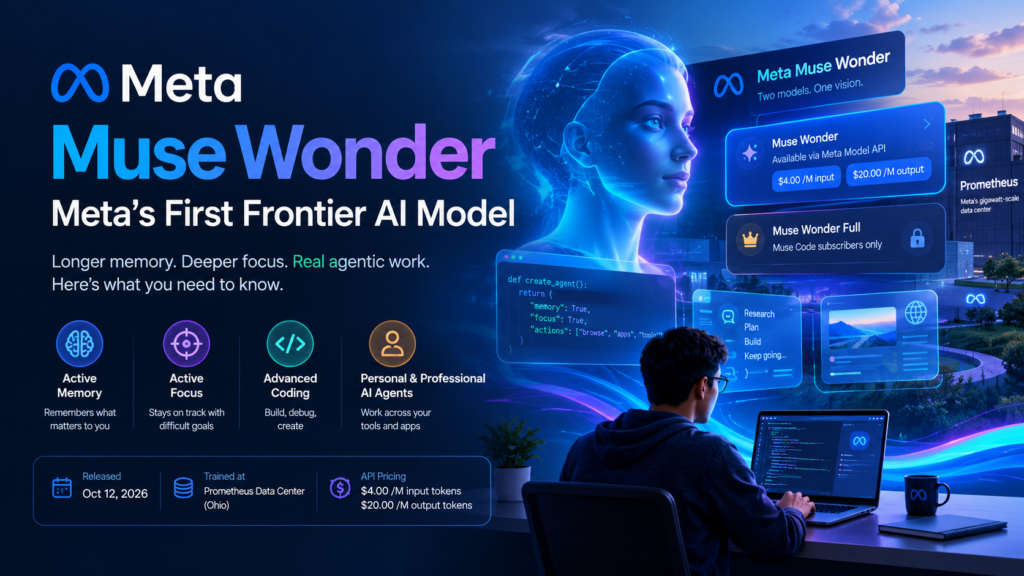
Meta Muse Wonder is Meta Superintelligence Labs’ first frontier AI model, released on October 12, 2026 as two models: Muse Wonder and Muse Wonder Full. Both are built for long-running personal and professional agent work, such as coding, research and memory-heavy tasks. Muse Wonder is available through the Meta Model API at $4.00 per million input tokens and $20.00 per million output tokens, while Muse Wonder Full is reserved for Muse Code subscribers.
If you have been following the AI race, you already know the usual names: OpenAI, Anthropic and Google. Meta spent more than a year largely on the sidelines of top-tier model releases. This launch changes that conversation, and this guide breaks down what was announced, what is verified, and what you should do with the information.
Meta Muse Wonder at a Glance
Here are the facts that matter most, in one scannable list:
- Release date: Monday, October 12, 2026
- Who built it: Meta Superintelligence Labs
- Models: Muse Wonder and Muse Wonder Full
- Positioning: Meta’s first attempt at a frontier model, aimed at personal and professional AI agents
- API access: Muse Wonder only, through the Meta Model API
- Pricing: $4.00 per million input tokens, $20.00 per million output tokens
- Muse Wonder Full access: Muse Code subscribers only, not served through the API
- Signature features: Active Memory and Active Focus
- Training site: Meta’s gigawatt-scale Prometheus data center in Ohio
- Benchmark caveat: Published scores come from Meta’s own testing
What Is Meta Muse Wonder?
Meta Muse Wonder is a pair of large AI models designed to act as capable, persistent agents rather than one-shot chatbots. Meta describes them as its most capable models to date and as the next step on its “scaling ladder” toward what it calls personal superintelligence.
That phrase is marketing language, so treat it as a statement of direction rather than a measured result. What is concrete is the design goal. The models are meant to remember what matters to a user across conversations, stay focused on difficult goals, and take actions across tools such as browsers and apps.
What Is the Difference Between Muse Wonder and Muse Wonder Full?
Muse Wonder is the broadly accessible model, and Muse Wonder Full is the premium variant. According to reporting from TechCrunch, Muse Wonder can be accessed through the Meta Model API, while Muse Wonder Full is available only to Muse Code subscribers and is not served through the API.
Both models share the same family and the same headline capabilities. Meta says both deliver state-of-the-art results on key benchmarks for personal and professional agents, memory and coding. Meta has not published a simple public explanation of exactly how the two differ in size or architecture, so avoid guessing at parameter counts.
Who Built Meta Muse Wonder, and Where Was It Trained?
Meta Superintelligence Labs built it, and it was trained at the company’s Prometheus data center in central Ohio. Meta describes Prometheus as gigawatt-scale, and TechCrunch notes the facility came online earlier this year.
The timeline is also worth knowing. Meta says it began a ground-up overhaul of its AI efforts fourteen months before this release. TechCrunch ties the restructuring to Scale AI founder Alexandr Wang, who reorganized Meta’s AI work in August 2025. The Wonder models are the first frontier-class release since that shake-up.
When and Where Can You Use Meta Muse Wonder?
You can use Muse Wonder today if you are a developer on the Meta Model API or a Muse Code user. Muse Wonder Full is available today for Muse Code subscribers. Consumer-facing access in the Muse app is coming later.
Meta Model API Access
The Meta Model API is the main route for developers who want to build with Muse Wonder. If you are building an agent, a coding tool or an internal assistant, this is where you would integrate the model. Meta has not published detailed regional availability in the sources reviewed for this article, so check the developer documentation for your country before you plan a build.
Muse Code Access
Muse Code is Meta’s coding product, and it is the only place you can reach Muse Wonder Full. Subscribers get the larger variant, which signals that Meta wants to monetize its strongest model through a product rather than a raw endpoint.
Muse App and Muse Agent Rollout
Meta says Muse Wonder will soon power experiences in the Muse app, rolling out to subscribers first. TechCrunch reports that both models will also power the Muse agent. Meta also says it plans to use Muse Wonder to help develop specialized models for everyone using Muse in the future.
How Much Does Meta Muse Wonder Cost?
Muse Wonder costs $4.00 per million input tokens and $20.00 per million output tokens through the Meta Model API. TechCrunch notes that this puts it at roughly the same price level as GPT-6 Sol or Opus 5.5.
That matters because it tells you how Meta sees its own model. A frontier price tag signals that Meta is not positioning this as a budget option. It is competing on capability, memory and agent performance, not on being the cheapest token.
Here is a quick sense of what those prices mean in practice:
| Usage example | Input tokens | Output tokens | Approximate cost |
|---|---|---|---|
| Light test run | 1 million | 100,000 | $4.00 + $2.00 = $6.00 |
| Medium agent workload | 5 million | 500,000 | $20.00 + $10.00 = $30.00 |
| Heavy coding session | 20 million | 2 million | $80.00 + $40.00 = $120.00 |
These figures are simple arithmetic from the published per-million rates. Real costs depend on how many tokens your prompts and the model’s responses actually use.
What Are Active Memory and Active Focus?
Active Memory and Active Focus are the two ideas Meta uses to explain why Muse Wonder is built for agents. Together they describe an assistant that remembers you and keeps working until the job is done.
What Is Active Memory?
Active Memory is Meta’s term for carrying important context about a user across conversations and retrieving the right details when they become relevant. In plain terms, the model should remember what matters to you and recognize when an earlier detail changes the answer to a new question.
Reliable memory is one of the hardest problems for personal agents. A model can be brilliant in a single conversation and still feel useless if it forgets your preferences, your projects or your constraints the next day. Meta research scientist Kavya Kopparapu said in the launch video that the team put major effort into making the model remember what is important to users over days, weeks and months.
What Is Active Focus?
Active Focus describes how the model keeps working toward a hard goal instead of giving up at the first obstacle. According to Meta, that means trying alternative approaches, working through blockers and adapting to new information. It also means asking for clarification when needed and checking in before taking important actions.
That last point is a quiet but important design choice. An agent that acts on your behalf should know when to pause. Meta evaluates this ability with FocusBench, and it tests sustained execution on long-running software projects with SWE-Marathon.
Frontier Coding and Domain Expertise
Coding is where memory and focus come together, because software work means tracking requirements and iterating through repeated test-and-fix cycles. Meta says both models were trained on diverse, long-running tasks to help them sustain progress from small apps to complex software. Meta’s demos include a playable 3D kitchen game built from customizable image inputs.
Meta also highlights domain expertise in law, finance and health. One example is Harvey’s Legal Agent Benchmark, which asks models to work from source documents and follow detailed instructions to produce legal work products.
How Does Meta Muse Wonder Perform on Benchmarks?
Meta says its testing shows scores comparable to Fable 5.1 and GPT-6 Astra, and a higher MemoryBench score than Fable, Opus or Astra. These results appear in Meta’s model card and were reported by TechCrunch.
The key caveat is simple: these are first-party numbers. Independent evaluations had not been widely published at the time of writing. Treat the claims as promising but unverified until third-party testers confirm them.
Which Benchmarks Does Meta Highlight?
Meta points to a handful of evaluations that map to the model’s pitch:
- MemoryBench: Tests continual learning and memory construction, where Meta reports a lead over several rival models
- FocusBench: Measures how well the model stays on task toward a challenging goal
- SWE-Marathon: Checks sustained execution on long-running software projects
- Harvey’s Legal Agent Benchmark: Evaluates legal work products built from source documents
Why Benchmark Scores Are Not the Whole Story
Two models can score similarly and still behave very differently on unfamiliar tasks. Meta makes this point itself, nodding to the community debate about overfitting to popular tests. In its analysis, Muse Wonder Full performed better on tasks it was not specifically tuned for than the trend from Muse Spark 1.3 would predict, which Meta attributes to a larger, stronger base model.
That is an interesting claim, and also one that only real-world use can confirm. If you are choosing a model for production work, run your own evaluation on your own tasks.
Muse Spark vs. Muse Wonder vs. Muse Wonder Full
The Wonder models sit above Muse Spark, which was designed as a lightweight, low-latency model. TechCrunch frames the new models as larger and more capable, with higher benchmark scores and better results on complex tasks like coding.
| Feature | Muse Spark | Muse Wonder | Muse Wonder Full |
|---|---|---|---|
| Positioning | Lightweight, low latency | Frontier model for agents | Frontier model for agents (premium access) |
| Relative capability | Lower | Higher | Higher |
| Meta Model API | Yes (earlier versions available) | Yes | No |
| Muse Code | Yes (Spark 1.2 launched with it) | Yes | Subscribers only |
| Core pitch | Speed and efficiency | Active Memory, Active Focus, coding | Same capabilities, restricted access |
| Price | Not covered here | $4.00 / $20.00 per million tokens | Not served through API |
Use this table as a map, not a spec sheet. Meta has not published every detail for each variant, so the safest reading is the one the company itself provides.
Why Meta Muse Wonder Matters Strategically
This release matters because it shows Meta can now compete at the top tier, not just near it. Meta’s earlier proprietary model, Muse Spark, arrived in April 2026 as the company’s return to frontier competition after the Llama era. Around that time, Alexandr Wang publicly described Muse Spark as an early appetizer and said stronger systems were on the way.
Meta Muse Wonder is the follow-through on that promise. A few strategic signals stand out:
- Proprietary direction: Meta’s flagship line is no longer built around open weights, a shift from the Llama family.
- Agents as the product: The marketing centers on personal and professional agents, not just chat quality.
- Memory as a moat: Long-term personalization is hard to copy, and Meta has an enormous consumer audience to apply it to.
- Infrastructure scale: Training at a gigawatt-scale site shows how much capital the race now demands.
Whether Meta can turn that scale into a product people prefer is still an open question. Models are only as useful as the experiences built on top of them.
Is Meta Muse Wonder Safe?
Meta says Muse Wonder is its most aligned model and carries its strongest safeguards yet against chemical, biological, radiological, nuclear and cyber misuse. The company also says it wants to preserve frontier cyber capabilities for defensive use, under its own scaling framework.
Because a personal agent may see messages, calendars and private documents, Meta says it trained the models to handle private information with discretion and to resist adversarial instructions. A fuller safety report with additional evaluations is promised soon. Until it arrives, treat safety claims as stated intent and wait for independent review.
What Should Learners and Builders Do Now?
Start by testing Meta Muse Wonder on one real task you already do, and compare the results against the model you use today. That is the fastest way to separate marketing from usefulness.
If you are a student, fresher or early-career professional learning AI, here is a practical approach:
- Pick a memory-heavy task. For example, a multi-day research project where context builds up over time.
- Pick a coding task. Use a small app or a bug-fix workflow, since Meta emphasizes coding and long-running software work.
- Compare cost and quality. At $4.00 and $20.00 per million tokens, Muse Wonder is priced like other frontier models, so quality needs to justify it.
- Track failure modes. Note where the model forgets, loops or acts without checking in.
- Revisit when independent benchmarks land. Third-party results will tell you more than any launch blog post.
For developers, the key decision is routing. Many teams now use more than one model, sending each task to whichever performs best for the price. Meta Muse Wonder gives you another option to evaluate, especially if memory and long-running agent behavior matter to your product.
What Are the Limitations and Open Questions?
The biggest open questions are independent verification, regional availability and the exact gap between Wonder and Wonder Full. Here is what remains unclear based on the public information available:
- Third-party benchmark results across a broad set of tasks
- Context window size and modality details for the API model
- Availability and pricing outside the United States
- The full safety report Meta says is coming
- How Active Memory handles privacy controls and user deletion in practice
None of these are reasons to dismiss the launch. They are reasons to verify before you commit a product or a budget to it.
Frequently Asked Questions About Meta Muse Wonder
What is Meta Muse Wonder?
It is Meta’s first frontier AI model release, made up of Muse Wonder and Muse Wonder Full, built for personal and professional AI agents. It was released on October 12, 2026 by Meta Superintelligence Labs.
Is Muse Wonder available through an API?
Yes, Muse Wonder is available through the Meta Model API. Muse Wonder Full is not served through the API and is limited to Muse Code subscribers.
How much does Muse Wonder cost?
It costs $4.00 per million input tokens and $20.00 per million output tokens. That is roughly comparable to GPT-6 Sol or Opus 5.5, according to TechCrunch.
What is Active Memory in Muse Wonder?
Active Memory is the model’s ability to carry important user context across conversations and retrieve relevant details when needed. Meta says it tested this on MemoryBench and reports a higher score than Fable, Opus and Astra.
Is Muse Wonder better than other frontier models?
Meta says it is comparable to Fable 5.1 and GPT-6 Astra on its benchmarks, but those results are self-reported. Wait for independent testing, and run your own comparison on your own tasks.
Is Muse Wonder open source?
There is no indication that it is open weights. Meta’s Muse line has been proprietary since Muse Spark, a change from the open-weight Llama family.
Will Muse Wonder power the Muse app?
Yes, Meta says it will soon power experiences in the Muse app, rolling out to subscribers first. TechCrunch also reports that both models will power the Muse agent.
The Bottom Line on Meta Muse Wonder
Meta Muse Wonder is a credible first frontier AI model from a company that spent a year rebuilding its AI stack. The pitch is clear: an agent that remembers you, stays focused on hard goals and writes serious code. The price is frontier-level, the access is split between an API model and a subscriber-only model, and the benchmark claims still await outside confirmation.
For developers and learners, the smart move is neither hype nor dismissal. Test the model on real work, watch for independent results, and keep your options open.