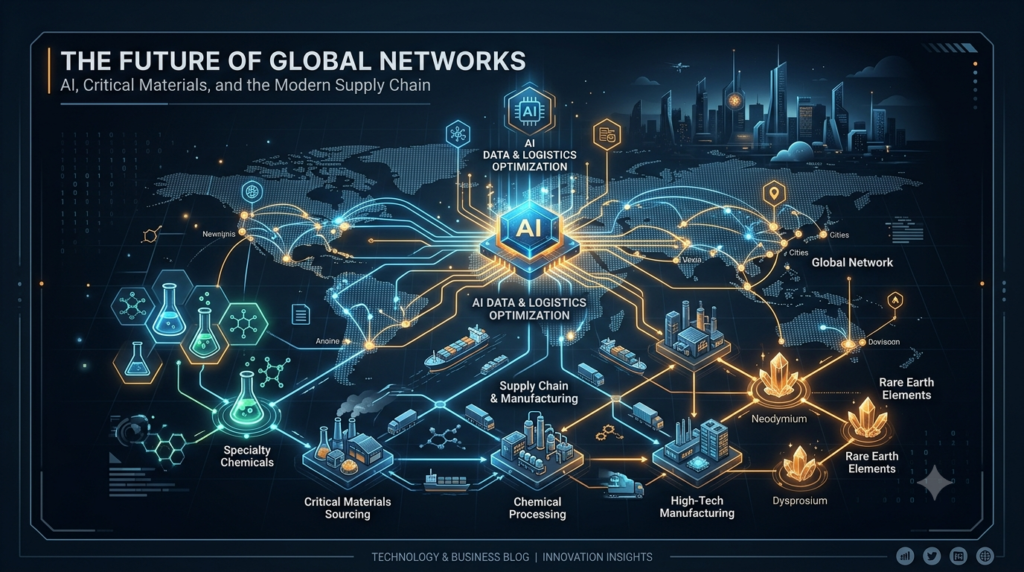
Scimplify funding refers to the USD 25 million all-equity strategic round, led by Hitachi Ventures, that the Bengaluru-based specialty chemicals startup announced on October 14, 2026. The capital will expand Scimplify’s AI-coordinated manufacturing network into the United States and Japan, as buyers in semiconductors, defense and energy look for critical materials from outside China.
Most AI funding headlines are about chatbots, copilots and coding agents. This one is about tungsten, rare earths and specialty chemicals, the unglamorous inputs that decide whether chips get made, batteries get built and defense systems get delivered. The Scimplify funding story matters because it shows where applied AI is quietly earning real revenue: inside physical supply chains, not just inside software.
This guide breaks down the Scimplify funding round into standalone sections. You will learn who invested, what the startup actually does, how its Scinode AI platform works, what its growth numbers show, where the risks sit, and what it all means for India’s deep-tech talent. Every figure comes from TechCrunch’s reporting by Jagmeet Singh, published October 14, 2026, unless stated otherwise.
Scimplify Funding at a Glance
The fastest way to understand the round is to see its core facts side by side. Here is a framed list of the key points:
- Round size: USD 25 million, all equity, described as a strategic round.
- Lead investor: Hitachi Ventures.
- New investors: Henkel and Teknor Apex, both existing customers.
- Returning investors: Accel India, Bertelsmann India Investments, Omnivore and 3one4 Capital.
- Reported valuation: About USD 250 million post-money, according to a person familiar with the deal. The company declined to confirm it.
- Total equity raised: USD 80 million to date, per the startup.
- Annualized revenue run rate: About USD 200 million, roughly triple a year earlier.
- Next target: USD 400 million annualized run rate over the next year.
- Headquarters: Bengaluru, India. Founded in 2023.
These bullets are written to stand alone. Each one can be lifted into an answer without the surrounding text.
What Is Scimplify?
Scimplify is an Indian startup that develops and manufactures specialty chemicals and critical materials for global industrial customers, using an AI platform to speed up production and sourcing. It was founded in 2023 and is headquartered in Bengaluru.
The company does not simply trade chemicals. Once it receives a customer order, it develops the manufacturing process at its own research facilities in Bengaluru and Hyderabad, then transfers that process to partner factories for commercial production. Its in-house team of scientists and engineers oversees production across a network of more than 500 manufacturing facilities.
In practice, Scimplify behaves like an outsourced R&D and supply-chain department for manufacturers. A customer brings a materials requirement, and the startup finds a way to make it, qualify it and ship it, often from a country other than China.
Who does Scimplify serve?
Scimplify serves more than 1,000 customers and has delivered products to more than 40 countries. Named customers include Japanese electronics manufacturer TDK, German chemicals group BASF and Hitachi. That last name is notable, because Hitachi’s venture arm also led the new round.
How big is the team?
The startup employs about 340 people, including roughly 70 scientists. Most of the workforce is in India, with local teams in the U.S., Japan, Indonesia and the UAE.
Who Led the Scimplify Funding Round?
Hitachi Ventures led the round. Two of Scimplify’s own customers, Henkel and Teknor Apex, joined as new investors, while Accel India, Bertelsmann India Investments, Omnivore and 3one4 Capital returned as existing backers.
The investor mix is the real signal. When a lead investor and two additional investors are also buyers, the round is a vote of confidence from people who have seen the product delivered. Corporate investors with their own supply chains have a direct reason to want a faster, more diversified source of materials.
This is an observation about structure, not a claim about motive. TechCrunch describes the round as strategic, and the participation of customers fits that description.
What Is the Valuation Behind the Scimplify Funding?
The round reportedly values Scimplify at about USD 250 million after the investment, according to a person familiar with the transaction. The startup itself declined to disclose its valuation, so treat the number as reported rather than confirmed.
That figure compares with USD 150 million after the USD 40 million Series B round in March 2025. The new round brings total equity funding to USD 80 million.
How does this round compare with the Series B?
The table below sets the two financing events next to each other, using only figures reported by TechCrunch.
| Detail | Series B (March 2025) | Strategic round (October 2026) |
|---|---|---|
| Amount raised | USD 40 million | USD 25 million |
| Post-money valuation | USD 150 million (reported) | About USD 250 million (reported by a person familiar; not confirmed by the company) |
| Round type | Series B | All-equity strategic round |
| Lead investor | Not covered in the source article | Hitachi Ventures |
| Total equity funding after round | Not stated in the source article | USD 80 million |
The valuation rose by roughly two-thirds between the two rounds on the reported numbers, while the business reported tripling its annualized revenue run rate over the past year.
Why Critical Materials Supply Chains Need an Alternative to China
A critical materials supply chain is the network of mining, refining, chemical processing and manufacturing that turns raw inputs into the specialty materials used in electronics, energy systems and defense equipment. When one country dominates several steps in that network, every downstream manufacturer inherits the risk.
TechCrunch frames the Scimplify funding story around that exact risk: manufacturers across industries are trying to reduce reliance on Chinese suppliers. Scimplify helps customers set up alternative sources for materials whose supply is concentrated in China and a few other countries.
Why is materials discovery not the bottleneck?
AI and advanced computational tools have accelerated materials discovery and research. The harder problem is commercialization. Turning promising chemistry into a product that can be bought at scale means developing production processes, qualifying facilities and meeting stringent quality standards, all while navigating supply chains limited to a handful of countries.
That gap between a lab result and a reliable supply contract is where Scimplify positions itself. It is not competing to invent new molecules. It is competing to shorten the path from a customer’s requirement to a finished, qualified material.
Why does this matter right now?
Demand is rising from two directions. According to Scimplify co-founder Sachin Santhosh, AI is fuelling demand for materials used in electronics and energy infrastructure, and ongoing wars are driving demand from the defense industry. Both pull on the same constrained supply chains.
How Scimplify Works: From Customer Requirement to Finished Material
Scimplify’s model has four steps: receive a customer requirement, develop the process in its own labs, transfer it to partner factories, and manage quality and regulatory compliance through its AI platform. The speed comes from running these steps as one coordinated system instead of as separate vendor handoffs.
- Requirement intake. A customer specifies the material, quality and regulatory needs.
- Process development. Scimplify’s scientists build the manufacturing process at research facilities in Bengaluru and Hyderabad.
- Factory transfer. The process moves to partner factories for commercial production.
- Oversight. In-house scientists and engineers supervise production across more than 500 facilities.
What is Scinode, the Scimplify AI platform?
Scinode is Scimplify’s proprietary AI platform that coordinates the work by identifying suitable production routes and manufacturing facilities while tracking quality and regulatory requirements. Santhosh told TechCrunch that it uses specialized AI agents for different functions, including research, manufacturing and quality control.
He described the design principle this way: each agent works backward from what the customer would want. That approach, he said, helps the company move faster and remember customer context for future references.
The practical benefit is institutional memory. A new order from a returning customer starts with the context of the last one instead of starting from zero.
How much faster is Scimplify than traditional development?
In some cases, Scimplify has gone from receiving a customer’s requirements to delivering finished material in two months, compared with the 12 to 18 months such work typically takes, according to Santhosh. He cited a project involving TDK as an example and noted that timelines vary by project.
This is a company-reported figure from an interview, and it describes some cases, not every order. Read it as a best-case benchmark, not an average.
The Growth Numbers Behind the Scimplify Funding
Scimplify reports an annualized revenue run rate of about USD 200 million, tripling from a year earlier, with a target of USD 400 million over the next year. The other operating metrics point in the same direction.
| Metric | Earlier reference point | Latest reported figure |
|---|---|---|
| Annualized revenue run rate | About one-third of today’s level, a year earlier | About USD 200 million |
| U.S. annualized run rate | About USD 10 million, a year ago | About USD 60 million (sixfold increase) |
| U.S. share of business | Not stated | Roughly 30% |
| Revenue from customers outside India | Less than 5%, about 18 months ago | More than half |
| Energy, electronics and defense share of revenue | Less than 15%, a year ago | About 45% to 50% |
| Customers served | Not stated | More than 1,000 across 40+ countries |
Is Scimplify profitable?
Scimplify has been EBITDA-positive for the past two months and expects to turn profitable after tax this month, according to Santhosh. These are self-reported figures, and two months of positive EBITDA is a short track record. Still, for a hardware-adjacent startup that is scaling fast, reaching operating profitability early is unusual and gives the company more control over its next funding decision.
Why is revenue shifting outside India?
The startup is Indian, and about 90% of its manufacturing currently takes place in India. Yet customers outside India now generate more than half of revenue, up from under 5% roughly 18 months ago. That shift shows the model works as an export engine: Indian process development and manufacturing, sold into global supply chains that want an alternative to China.
Why Semiconductors, Defense and Energy Are Driving Scimplify Growth
Energy, electronics and defense now account for about 45% to 50% of Scimplify’s revenue, up from less than 15% a year ago. That is a dramatic change in customer mix within twelve months, and it explains why the Scimplify funding round attracted strategic investors.
These sectors share three traits. They buy materials with tight quality specifications, they face long qualification cycles, and they are sensitive to supply concentration. A supplier that can compress a 12 to 18 month development timeline has an obvious advantage in all three.
TechCrunch also reports that semiconductors, defense and energy are emerging as key growth markets for the company. The shift from commodity-style chemical sourcing to specification-driven strategic materials is the core of the business story.
Tungsten and Rare Earths: The Next Frontier for Scimplify
Scimplify is working on producing tungsten derivatives from scrap, and it is also working on rare earth materials. Both categories are ones where global supply remains heavily dependent on China.
Producing tungsten derivatives from scrap is a notable approach. Instead of competing for primary mined supply, the company is aiming to create an alternative source by reprocessing existing material. That gives customers a path to supply that does not run through the same concentrated pipeline.
TechCrunch does not report commercial volumes or customers for these programs, so they should be read as active development areas, not proven revenue lines. The rare earth work is described only as ongoing.
Where Will the Scimplify Funding Go?
Scimplify plans to deploy around USD 7.5 million of the new capital on U.S. expansion, including building out its manufacturing network, and about USD 2 million on further development of Scinode. Together, that accounts for about USD 9.5 million of the USD 25 million round.
TechCrunch does not break down the remaining capital, so it would be speculative to say how it will be used. What the company has said is that it plans to expand its production network to the U.S. and Japan over the next year, to attract more customers in both markets.
Why expand manufacturing to the U.S. and Japan?
The U.S. has become the startup’s key growth market, now roughly 30% of business. Customers in both the U.S. and Japan have a strong interest in sourcing outside China. Local or allied-country production can shorten logistics and ease qualification concerns, though the article does not go into those details. The expansion also reduces the concentration risk of the startup’s own footprint, since about 90% of manufacturing is currently in India.
Scimplify vs Traditional Specialty Chemical Sourcing
Scimplify differs from traditional sourcing by combining process development, factory management and AI coordination under one accountable partner. The comparison below summarizes the differences using the company’s own description of its model.
| Factor | Traditional sourcing | Scimplify model |
|---|---|---|
| Development timeline | 12 to 18 months typical | As little as two months in some cases (company-reported) |
| Process ownership | Spread across suppliers and the customer | Scimplify develops the process in-house, then transfers it |
| Manufacturing base | A few suppliers, often concentrated in one country | Network of 500+ facilities, about 90% in India today |
| Quality and compliance tracking | Manual, supplier by supplier | Tracked through the Scinode platform |
| Customer memory across orders | Held by individual people | Retained by AI agents for future orders |
| Best suited for | Established, standardized chemicals | New or hard-to-source critical materials |
When should a manufacturer choose each? Traditional sourcing still works for standardized chemicals with many reliable suppliers. A coordinated model like Scimplify’s is the stronger fit when the material is hard to source, supply is concentrated, or the development timeline is the bottleneck.
Risks and Open Questions Around the Scimplify Funding Story
The main risks are concentration of manufacturing in India, reliance on partner factories for quality, and the fact that most performance figures are company-reported. A balanced reading of the Scimplify funding news should hold the optimism and the questions together.
Here are the open questions worth watching:
- Verification: The revenue run rate, profitability timeline and two-month delivery claim come from the company’s co-founder, not from audited statements.
- Valuation: The USD 250 million figure comes from an unnamed source, and the startup did not confirm it.
- Execution risk: Building manufacturing networks in the U.S. and Japan is a different challenge from managing partner factories in India.
- Pace of growth: Moving from about USD 200 million to a USD 400 million run rate within a year requires sustained execution.
- Early programs: Tungsten-from-scrap and rare earth work are described as in progress, with no reported commercial results.
None of these invalidate the story. They define what a careful reader should track in the next two to four quarters.
What the Scimplify Funding Means for India’s Deep-Tech Talent
For India’s students and early-career professionals, the Scimplify funding story is a signal that chemistry, materials science and AI skills are converging into a single career path. This section is Kalinga.ai’s analysis, not reporting from the source article.
Scimplify employs about 70 scientists out of roughly 340 people, and it runs research facilities in Bengaluru and Hyderabad. The platform side, Scinode, uses AI agents across research, manufacturing and quality control. A company like this needs chemists who can work with data, engineers who understand process scale-up, and software builders who can design agent workflows for physical operations.
Three practical takeaways for learners:
- Build hybrid skills. Pair a core science or engineering background with working knowledge of AI agents and data pipelines.
- Study supply chains, not just models. Many of the strongest AI applications now sit inside operations, procurement and quality control.
- Watch deep-tech hubs. Bengaluru and Hyderabad are home to Scimplify’s research facilities, which shows where this kind of work is being built.
For Odisha’s growing tech community, the lesson is that AI careers are not limited to consumer apps. Industrial AI, where models coordinate real factories and real materials, is a fast-growing space.
Frequently Asked Questions About Scimplify Funding
How much did Scimplify raise?
Scimplify raised USD 25 million in an all-equity strategic round. The round was led by Hitachi Ventures, and it brings the startup’s total equity funding to USD 80 million.
Who invested in the Scimplify funding round?
Hitachi Ventures led the round, with new investors Henkel and Teknor Apex joining. Existing backers Accel India, Bertelsmann India Investments, Omnivore and 3one4 Capital also participated.
What is Scimplify’s valuation after this round?
The round reportedly values Scimplify at about USD 250 million, according to a person familiar with the transaction. The company declined to disclose its valuation. The previous reported valuation was USD 150 million after the March 2025 Series B.
What does Scimplify do?
Scimplify develops and manufactures specialty chemicals and critical materials, using an AI platform called Scinode to coordinate production routes, factories, quality and regulatory requirements. It develops processes at its labs in Bengaluru and Hyderabad, then transfers them to partner factories.
How fast can Scimplify deliver a new material?
In some cases, Scimplify has delivered finished material in two months, versus the 12 to 18 months typical for such work. The company says timelines vary by project.
What is Scimplify’s annualized revenue run rate?
Scimplify reports an annualized revenue run rate of about USD 200 million, triple the level a year earlier. It is targeting USD 400 million over the next year.
Is Scimplify profitable?
Scimplify says it has been EBITDA-positive for the past two months and expects to be profitable after tax this month. These figures are company-reported.
What will Scimplify do with the new funding?
About USD 7.5 million is earmarked for U.S. expansion, including manufacturing, and about USD 2 million for further development of Scinode. The company also plans to expand its production network to the U.S. and Japan over the next year.
Which customers does Scimplify work with?
Named customers include TDK, BASF and Hitachi. Henkel and Teknor Apex are also customers that have now become investors.
Conclusion: What the Scimplify Funding Round Tells Us
The Scimplify funding round shows that applied AI is moving from software into the physical supply chains of strategic industries. A USD 25 million strategic round led by a corporate venture arm, joined by customers, and backed by a reported tripling of revenue run rate, is a clear sign that buyers want alternatives to concentrated materials supply.
The story is not finished. Many of the numbers are company-reported, expansion into the U.S. and Japan is still ahead, and the tungsten and rare earth programs are early. But the structure of the business, process development plus partner factories plus an AI coordination layer, is a model worth watching across the global materials industry.
If you are tracking how AI is reshaping industries beyond chatbots, the Scimplify funding story is a strong case study. For more breakdowns of AI infrastructure, policy and enterprise adoption, explore the guides and learning resources at Kalinga.ai.
Source: Jagmeet Singh, “Scimplify raises $25M to challenge China’s grip on critical materials with AI,” TechCrunch, October 14, 2026.