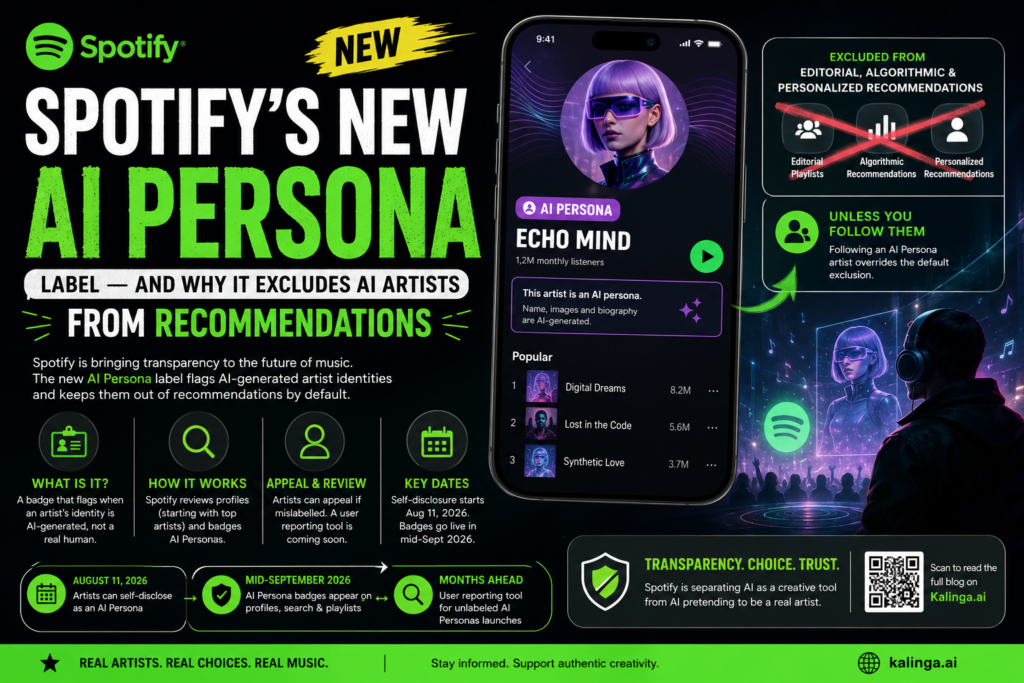
Imagine scrolling through your Discover Weekly and finding a “new favorite artist”, except that artist doesn’t actually exist as a person. That’s the exact problem Spotify is trying to fix with its new Spotify AI Persona label, a badge that flags artist profiles built around AI-generated identities rather than real musicians, and by default keeps their music out of Spotify’s recommendation system. The rollout begins in mid-September 2026, and artists can already self-disclose starting August 11, 2026, through Spotify for Artists.
If you’ve been following the AI-in-music debate, whether as a student researching media tech in Odisha, a musician wondering how this affects your streams, or just a curious listener, this piece breaks down exactly what’s changing, why, and what it means for you.
What Exactly Is the Spotify AI Persona Label?
AI Persona label is a new badge Spotify is adding to artist profiles to flag when the public identity of an artist, their name, photos, and bio, is AI-generated rather than representing a real human being. It’s not a judgment on how the music itself was made; it’s specifically about whether the person “behind” the music actually exists.
Once applied, the badge shows up in several places: on the artist’s profile banner and About section, in Search results, and on track rows inside playlists. This matters because, as of now, a lot of AI-generated musical acts on streaming platforms look and sound convincingly human, making it hard for listeners to tell who, or what, they’re actually listening to.
Why is Spotify doing this? Spotify said its programming is focused on “elevating music from authentic artists building careers in music,” while still acknowledging that artists have creative choice in how they present themselves.
How Will Spotify Identify AI Personas?
Spotify isn’t relying purely on artists to self-report. The company will actively review artist profiles and flag ones where the artist’s name and imagery appear to represent photorealistic, AI-generated identities.
Which artists get reviewed first? Spotify said it will begin its review with profiles that have already met certain audience thresholds, meaning the most-listened-to artists are checked before smaller or newer profiles. This is a practical rollout choice, it targets the accounts with the biggest potential impact on listener trust first, rather than trying to audit every profile on the platform simultaneously.
Artists who feel they’ve been mislabeled will also have a way to appeal the AI Persona label if they believe it was applied incorrectly, giving the system a built-in correction mechanism rather than a one-way flag.
How Does the AI Persona Label Affect Spotify Recommendations?
Will AI Persona music still show up in my Discover Weekly or Radio?
By default, no. Spotify will exclude AI Personas from its editorial recommendations (playlists curated by Spotify’s team), algorithmic recommendations (like Discover Weekly or Release Radar), and personalized recommendations, unless you specifically follow that AI Persona artist.
What does “unless you follow them” actually mean?
Following an artist is treated as an explicit signal, it tells Spotify’s system that you deliberately want to hear more from that specific act, AI-generated or not. So the exclusion isn’t a total ban on AI Persona music appearing anywhere on the platform; it just removes it from the passive discovery layer, where listeners are typically served content without asking for it by name.
This distinction is important. It means AI Persona artists aren’t being removed from Spotify, they’re being pushed out of the algorithmic spotlight unless a listener actively opts in.
Timeline: Key Dates for the Spotify AI Persona Rollout
| Date | What Happens |
| August 11, 2026 | Artists can begin self-disclosing as an AI Persona via Spotify for Artists |
| Mid-September 2026 | AI Persona badges start appearing on flagged profiles across Spotify (profile, Search, track rows) |
| Ongoing (post-launch) | Spotify reviews additional profiles beyond the initial high-audience threshold batch |
| “Months ahead” | Spotify will launch a tool letting users report unlabeled AI Persona profiles |
Why Now? Spotify’s Broader Fight Against AI “Slop”
This isn’t Spotify’s first move on AI music policy. The company first announced its AI music policy in September 2025, which introduced labeling for AI-generated tracks using industry-standard identification methods and banned unauthorized AI voice clones and deepfakes.
What is “AI slop,” and why does Spotify care? AI slop refers to low-quality, mass-produced AI-generated content flooding a platform, often at a volume and speed that human-made content can’t match. Spotify has previously tested tools specifically to stop AI slop from being wrongly attributed to real artists, since a flood of low-effort AI tracks can hurt the listening experience and, in the worst case, drive paying subscribers to cancel.
At the same time, Spotify isn’t anti-AI, it’s trying to walk a middle path. The platform has been actively building AI-powered features like Prompted Playlists (rolled out to the U.S. and Canada in January 2026), an AI DJ with voice command personalization, and a ChatGPT-like music assistant launched in July 2026. So the AI Persona label isn’t a rejection of AI in music, it’s an attempt to separate “AI as a creative tool” from “AI pretending to be a real human artist.”
What Counts as an AI Persona vs. AI-Made Music?
Does an AI Persona label mean the song was made with AI?
No, and this is the most misunderstood part of the policy. Spotify explicitly clarified that the AI Persona badge is a judgment on the artist’s public identity, not on how the music was produced. A real human artist could use AI tools to write, produce, or mix a track and still not get an AI Persona label, because they exist as an actual person behind the profile.
Information about how a specific track was made, whether AI vocals, AI production, or AI mastering were involved, is instead surfaced through Spotify’s separate features:
- AI Credits, disclosure info about AI tool usage in a specific track’s production
- SongDNA (beta, launched March 2026), lets users explore the creative connections and influences behind a song
- AI Persona badge, flags whether the artist’s identity itself is AI-generated
- Track labeling, flags AI-generated audio using industry-standard detection
This layered system means a listener could, in theory, see a real human artist’s profile with AI Credits on a track, or an AI Persona artist whose music is untouched by generative tools in a technical sense, the two labels are answering different questions entirely.
How Spotify’s Approach Compares to Other Platforms
| Platform/Feature | AI Persona / Identity Label | AI-Made Track Label | Recommendation Exclusion |
| Spotify | Yes, AI Persona badge (Sept 2026) | Yes, since Sept 2025 policy | Yes, by default, unless followed |
| Suno | Not applicable (AI music generator, not a streaming discovery platform) | Announced watermarking of AI-generated songs (Aug 2026) | Not applicable |
| YouTube | Partial, AI-generated content disclosure required in uploads | Yes, “Altered or synthetic content” labels | No blanket recommendation exclusion for AI-labeled content |
This table reflects publicly announced policies as of August 2026; platform features evolve quickly, so specifics may shift.
What This Means for Musicians and Listeners
For independent artists, especially those building a career using legitimate AI production tools, the key takeaway is: using AI in your workflow doesn’t automatically get you labeled, only misrepresenting your identity as human when it isn’t does. For students and young creators in Odisha exploring AI music tools as part of a portfolio, this distinction matters if you’re planning to release music on Spotify under your own name while using AI-assisted production.
For listeners, the AI Persona label functions similarly to a “verified vs. unverified” signal, it’s a transparency layer, not a content ban. You can still choose to listen to and follow AI Persona artists; you just won’t be served their music passively through algorithmic discovery unless you opt in.
Key points to remember:
- The AI Persona badge is about artist identity, not music production methods
- Labels start appearing in mid-September 2026; self-disclosure opened August 11, 2026
- AI Personas are excluded from editorial, algorithmic, and personalized recommendations by default
- Following an AI Persona artist overrides the default exclusion
- Artists can appeal a label they believe was applied in error
- A user-reporting tool for unlabeled AI Persona profiles is coming in the following months
FAQ: Spotify AI Persona Label
Does the Spotify AI Persona label mean the artist’s music was made using AI?
No. Spotify has clarified the badge only reflects whether the artist’s public identity, name and imagery, is AI-generated, not whether AI tools were used to create the music itself.
When will I start seeing AI Persona badges on Spotify?
Badges begin appearing in mid-September 2026, though artists have been able to self-disclose as an AI Persona through Spotify for Artists since August 11, 2026.
Will AI Persona artists disappear from Spotify?
No. Their music remains on the platform and searchable; it’s simply excluded from Spotify’s editorial, algorithmic, and personalized recommendation systems by default, unless a listener actively follows that artist.
How does Spotify decide which profiles get reviewed for AI Persona labeling?
Spotify is starting its manual review process with artist profiles that have already met certain audience/listenership thresholds, prioritizing widely-heard artists before expanding to smaller profiles.
Can an artist dispute an AI Persona label?
Yes. Spotify has said artists will be able to appeal the label if they believe it has been applied incorrectly to their profile.
How does this relate to Spotify’s AI music slop problem?
The AI Persona label builds on Spotify’s existing AI music policy (first announced September 2025), which already labels AI-generated tracks and bans unauthorized AI voice clones, this new step specifically targets fabricated artist identities, a related but distinct problem from mass-produced low-quality AI tracks.
Curious how AI is reshaping creative platforms beyond music, from content moderation to generative tools students can actually use? Explore more breakdowns like this on Kalinga.ai, and check out our upcoming AI/tech workshops for learners in Odisha.