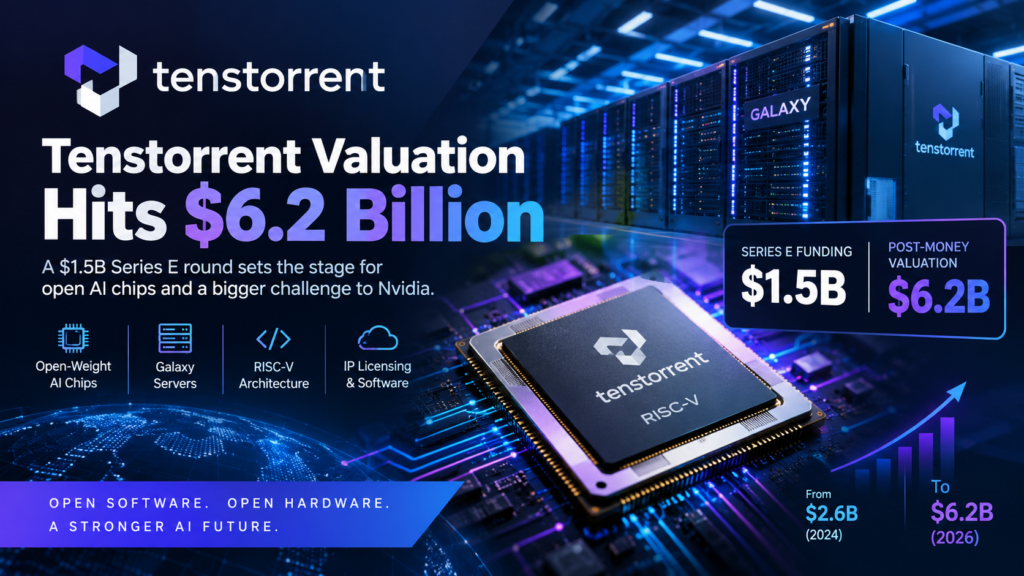
The Tenstorrent valuation is now $6.2 billion post-money, following a $1.5 billion Series E that values the company at $6.2 billion after the investment. That is more than double the $2.6 billion it fetched in its previous financing, and it signals that investors still want a credible alternative to Nvidia, especially one built on open software and RISC-V. technodebiggo
If you came here for the short version, this post covers what the number means, who paid it, and where the money goes. It also covers why open-weight AI chips are suddenly a serious investment theme, and what could go wrong.
Key Facts at a Glance
- Round: $1.5B Series E at a $6.2B post-money valuation, announced October 19, 2026 tenstorrent
- Leads: Trace Capital and Innovation X, with participation from ARK Invest, Fidelity, Morgan Stanley, Sandisk and T. Rowe Price-advised accounts theaiinsider
- Prior round: more than $693 million in December 2024 at a $2 billion pre-money valuation tradersunion
- Use of funds: deploying Galaxy servers at scale, serving open-weight LLMs and video generation models, and advancing the RISC-V CPU and AI core IP it licenses theaiinsider
- CEO: Jim Keller, who is credited with work on Apple’s A4/A5, AMD’s Zen and Tesla’s Full Self-Driving chip tenstorrent
- Not disclosed: revenue figures, a detailed allocation of proceeds, and a timetable for the planned Galaxy server deployments citybiz
What Is the Tenstorrent Valuation, and What Does $6.2 Billion Actually Mean?
The Tenstorrent valuation is the price investors implicitly put on the whole company in its most recent funding round. It is $6.2 billion on a post-money basis, meaning the figure includes the new $1.5 billion of cash.
Definition + Expansion. Post-money valuation equals pre-money valuation plus the new capital raised. One analysis noted that the $6.2 billion post-money figure implies a pre-money valuation of approximately $4.7 billion, assuming the full $1.5 billion is new primary capital. That is an inference rather than a company-stated number, so treat it as an estimate. The distinction matters because comparing a post-money number to an older pre-money number can exaggerate or understate growth. Press coverage has mixed the two, which is why the Tenstorrent valuation sometimes appears as $2 billion and sometimes as $2.6 billion for the 2024 round. citybiz
Is $6.2 billion a lot for a chip startup? It places Tenstorrent among the more valuable private chip designers outside the incumbent camp. Even so, it is small next to the data-center revenue of the market leader, and it is a private-market price, not a public-market one. A private valuation reflects investor expectations about future contracts, not current profits.
How Did the Tenstorrent Valuation Change Between 2024 and 2026?
The short answer is that it went from $2.6 billion to $6.2 billion in about 22 months. Here is the comparison:
| Metric | Series D (Dec 2024) | Series E (Oct 2026) |
|---|---|---|
| Amount raised | More than $693 million | $1.5 billion |
| Valuation | $2B pre-money (about $2.6B post) | $6.2B post-money |
| Lead investors | Samsung Securities and AFW Partners | Trace Capital and Innovation X |
| Stated focus | Open-source stacks, hiring, design centers, systems and clouds for AI developers | Galaxy server deployment, open-weight model serving, IP licensing |
| Context | Early commercial traction, roughly $150M in contracts | Not disclosed, with no revenue figure published |
The 2024 details come from Crunchbase’s report on the Series D and eWeek’s coverage of the contract figure. The 2026 details come from the company’s announcement and wire coverage. crunchbaseeweek
Why the Jump Matters
A valuation that more than doubles tells you three things.
- Investors see demand for non-Nvidia silicon. Bloomberg’s report described sustained investor appetite for alternative silicon architectures despite broader market scrutiny. Yahoo Finance
- The business has broadened. The company now sells hardware, systems and licensed IP, not just chips.
- Independence had a price. Bloomberg reported that Tenstorrent remained independent after preliminary takeover discussions earlier this year with Intel and Qualcomm. Choosing to stay independent and raise instead is a statement about how the company sees its own upside. Yahoo Finance
The Tenstorrent valuation, in other words, is not just a headline number. It is the market’s current estimate of whether a full-stack, open approach can scale.
Who Is Backing Tenstorrent?
The Series E was led by Trace Capital and Innovation X. The investor list also includes ARK Invest, Fidelity, Morgan Stanley, Sandisk and T. Rowe Price-advised accounts, and a wire report adds Tether Investments, Troluce Capital, Virtu Financial and XTX Markets. technodetenstorrent
Existing relationships matter here too. Tenstorrent counts Bezos Expeditions, Samsung, LG Electronics, Hyundai Motor Group, and Fidelity Management & Research Company among its backers. Samsung and LG are also licensees of its processor IP. That mix of financial investors and industrial customers is unusual and worth watching: the people paying for the technology are also the people owning part of the company. unite
One more detail from the announcement: an existing investor, Protagonist, said it was increasing its stake and credited the company with strong results in video generation. That is a vendor-side quote, so read it as endorsement, not independent benchmarking.
What Does Tenstorrent Actually Build?
Tenstorrent is an AI compute company that designs chips, the servers around them, and the software that runs on them. It builds RISC-V-based AI processors and systems for developers, enterprises, and sovereign infrastructure. unite
Definition + Expansion: RISC-V. RISC-V is an open instruction-set architecture, meaning any company can design processors for it without paying a licensing fee to a single owner. That is the opposite of a closed, proprietary ecosystem. For Tenstorrent, it underpins both its AI chips and its CPU designs, and it is central to why RISC-V AI chips attract investor interest as a way to avoid dependence on one supplier.
Tenstorrent Galaxy Servers
Tenstorrent Galaxy servers are the rack-scale systems that carry the company’s accelerators. Per one overview, its Wormhole and Blackhole processors run AI models in servers it sells as Galaxy systems. The Series E money is earmarked to deploy Galaxy servers at scale, which is a shift from selling chips and cards to operating and shipping complete systems. revenuememotenstorrent
At the smaller end, the company has sold hardware ranging from a $999 PCIe card to a $440,000 server cluster, according to Sacra’s profile. That range is an older data point, so check current pricing before relying on it. sacra
IP Licensing
Beyond hardware, Tenstorrent licenses its TT-Ascalon RISC-V CPU and Tensix AI cores to chip designers including Samsung and LG. This is the third revenue layer next to chips and systems. Licensing gives the company a way to earn money even when a customer wants to build its own silicon, a trend the company itself describes as chip designers, sovereign players, and inference platforms moving to own their AI compute. tenstorrenttenstorrent
Why Do Open-Weight AI Chips Matter?
Open-weight AI chips are processors and systems optimized to run models whose weights are publicly available, so customers can host, tune and inspect them without relying on a single vendor’s cloud. The term pairs two kinds of openness: open model weights on the software side and open hardware and software stacks on the infrastructure side.
Why now? Three forces are converging.
- Open models are good enough to deploy. Enterprises can run capable open-weight models on their own premises instead of sending data to an outside API.
- Control and sovereignty matter. Governments and regulated industries want infrastructure they can audit and keep in-country.
- Cost pressure is rising. Buyers are looking for options beyond the most expensive memory-heavy designs.
Tenstorrent argues its approach fits this moment. It says its open-source software stack lets developers run frontier models locally and lets enterprises deploy models on their own premises, and it describes the latency and throughput as industry-leading. Those are company claims, not independently verified results. unite
A quote from the 2024 round captures the strategic logic. Keller argued that open source helps build a bigger platform because it attracts engineers, a view reported in eWeek’s Series D coverage. The company has also said it avoids expensive high-bandwidth memory, which it frames as a cost advantage. eweek
The open software side also does double duty commercially. One analysis argued that the open-source strategy is part of the monetization model, not just a developer relations tactic, because community contributions spread the software-enablement work beyond the company’s own engineers. sacra
How Will Tenstorrent Use the $1.5 Billion?
According to the announcement, the capital will go toward three areas:
- Scaling Galaxy servers. Deploying them at volume is the headline use of funds, and the company framed the round as funding volume manufacturing and global commercial expansion. tenstorrent
- Serving open-weight models. The company will continue to serve open-weight LLMs and video generation models on its own systems. theaiinsider
- Advancing licensed IP. CPU and AI core designs for other chipmakers remain a core line of business.
What the company did not say matters as much. It did not share revenue, a breakdown of spending, or a delivery timeline. Without those, outside observers can judge ambition but not execution.
Tenstorrent vs. the Proprietary GPU Model
The table below is a qualitative comparison of strategies, not a benchmark. It reflects how the company positions itself and how coverage describes the market.
| Dimension | Tenstorrent approach | Proprietary GPU ecosystem |
|---|---|---|
| Core architecture | RISC-V CPUs plus Tensix AI cores | Closed, vendor-controlled stack |
| Software | Open-source compiler and runtime | Largely proprietary tooling |
| Memory strategy | Avoids costly high-bandwidth memory, per company statements | Relies heavily on high-bandwidth memory |
| Business model | Chips, Galaxy systems and IP licensing | Primarily chips and systems |
| Customer control | High: on-premises, sovereign and custom-silicon options | Often tied to vendor cloud and software |
| Scale and track record | Early, with limited disclosed revenue | Dominant data-center revenue base |
| Main risk | Executing at volume and winning developers | Dependence on one supplier |
The last two rows tell the real story. Openness is an advantage in control and cost, but scale and ecosystem maturity still favor the incumbent. The 2024 coverage noted that Tenstorrent’s roughly $150 million in contracts was dwarfed by Nvidia’s billions in data center revenue each quarter. The gap has presumably narrowed, but the 2026 numbers have not been published. eweek
Risks and Open Questions
A $6.2 billion valuation is a promise, not a result. These are the questions worth tracking.
- Can it manufacture at volume? Early chips were made by GlobalFoundries, with later designs planned at TSMC according to eWeek’s reporting. Another source says Tenstorrent chose Samsung Foundry for a later chiplet process. Supply-chain choices affect cost and timing, and the details have shifted over the years. eweek
- Will developers switch? Software ecosystems are sticky. Open source lowers the barrier, but moving workloads still takes engineering effort.
- What is the revenue? The absence of disclosed revenue makes it hard to judge whether the Tenstorrent valuation is supported by sales or mostly by expectation.
- Can it keep pace on performance? The company has said it intends to release new processors on a regular cadence, but cadence claims have varied across reports, from every year to every two years.
- How reliable are the benchmarks? Statements about industry-leading latency and strong video-generation results come from the company and an existing investor. Independent testing would carry more weight.
Keep one more caveat in mind. Several outlets describe the company as Santa Clara-based, while older reports say Toronto. The company’s own release lists Santa Clara, and it operates offices across several countries.
What This Means for Developers, Enterprises and Investors
For developers: An open stack that runs open-weight models locally is attractive if you want to avoid lock-in. Test the toolchain on your own workload before committing, because ecosystem maturity is the real hurdle.
For enterprises: On-premises deployment of open models on non-proprietary hardware is a viable option to evaluate, particularly where data control or regulation applies. Ask vendors for reference deployments and measured results.
For investors and analysts: Read the Tenstorrent valuation as a signal about the category more than a verdict on one company. The round shows capital is flowing to alternatives, and that strategic parties such as Sandisk and Cadence are showing interest, which could signal interest from companies that could become suppliers or partners. biggo
For the wider market: The deal reinforces a pattern of funding for chip startups that began well before 2026. Earlier rounds at Lightmatter, Etched and others, summarized by Crunchbase, showed the same appetite. What is new is the combination of open software, open instruction sets and open-weight models in a single pitch. crunchbase
Frequently Asked Questions
What is the Tenstorrent valuation after the Series E?
$6.2 billion post-money, following a $1.5 billion raise announced on October 19, 2026.
Who led the Tenstorrent Series E?
Trace Capital and Innovation X led the round, per the announcement as reported by TNGlobal. Some outlets also highlight existing investor Protagonist’s follow-on participation. technode
How much did the Tenstorrent valuation rise compared with 2024?
It more than doubled, from about $2.6 billion post-money in December 2024 to $6.2 billion.
Did Tenstorrent consider being acquired?
Bloomberg reported preliminary takeover talks with Intel and Qualcomm earlier in 2026, after which the company chose to stay independent.
What are Tenstorrent Galaxy servers?
They are the company’s rack-scale AI systems built around its own processors, and they are the main focus of the Series E spending.
What are RISC-V AI chips?
They are AI processors and CPUs built on the open RISC-V instruction set, which any company can implement without a single owner’s license.
Does Tenstorrent publish revenue?
Not in this announcement. The company did not disclose revenue figures.
The Bottom Line
The Tenstorrent valuation of $6.2 billion reflects a clear investor thesis: open software, open instruction sets, and open-weight models can support a real alternative to the incumbent AI hardware stack. The Tenstorrent Series E gives the company capital to move from promising designs to volume systems, and its licensing business provides another potential path to revenue. With $1.5 billion in new funding, the company has an opportunity to expand its Galaxy server deployments, improve its AI computing infrastructure, and strengthen its position in a market dominated by established players.
However, a higher valuation does not automatically translate into commercial success. Tenstorrent must demonstrate that its technology can compete on performance, reliability, availability, and total cost of ownership. Its open-source software strategy and RISC-V architecture offer customers greater flexibility, but convincing developers and enterprises to adopt a new hardware platform will take time. Organizations already invested in Nvidia’s ecosystem may face significant migration costs, software compatibility challenges, and additional engineering work before switching becomes practical.
The company’s ability to manufacture and deliver systems at scale will be equally important. Designing competitive AI processors is only one part of the challenge; securing manufacturing capacity, managing supply chains, supporting customers, and maintaining a predictable product roadmap are essential for sustainable growth. Galaxy servers could help Tenstorrent move beyond individual chips into complete computing systems, but the success of that strategy will depend on actual customer demand and successful deployments.
Investors and industry observers should also pay attention to the company’s licensing business. By licensing its RISC-V CPU and Tensix AI core intellectual property to other chip designers, Tenstorrent can potentially generate revenue without manufacturing every processor itself. This approach could diversify its business, although the scale and profitability of licensing remain difficult to assess without more detailed financial disclosures.
Over the next few quarters, several indicators will help determine whether the Tenstorrent valuation is justified: disclosed revenue growth, new customer contracts, Galaxy server deliveries, independent performance benchmarks, and evidence of broader developer adoption. Progress in these areas would strengthen the case for Tenstorrent as a credible alternative in AI computing. Delays, weak demand, or limited software support could challenge investor expectations.
Ultimately, the Tenstorrent valuation is a bet on the future of open AI infrastructure, not proof that the company has already displaced Nvidia. The $1.5 billion Series E provides significant resources to pursue that ambition, but execution will determine the outcome. For developers, enterprises, and investors, the most important question is no longer simply whether Tenstorrent can build alternative AI chips. It is whether the company can turn its technology, open ecosystem, and funding into reliable products that customers are willing to adopt at scale.