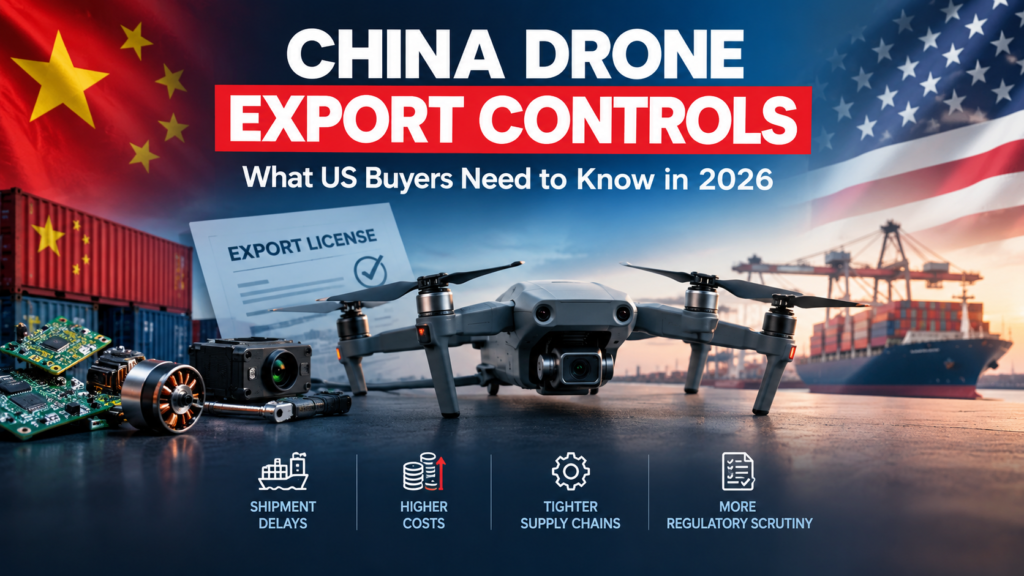
China drone export controls now require strict, case-by-case review for controlled drones, key components, and related technologies headed to the United States, and the announcement took effect on August 5, 2026. If you already own a drone, nothing changes for you today. If you build, sell, or buy drones in the US, expect slower shipments, tighter supply, and higher costs on controlled parts. ctils
Most drone headlines are about longer flight times or sharper cameras. This one is about licenses, politics, and parts. In this guide, we unpack the China drone export controls in plain language, show how they stack on top of US restrictions, and give you a checklist for what to do next. Every section stands alone, so jump to whichever question matters most to you.
What Are China Drone Export Controls?
Definition: China drone export controls are the licensing and review rules that decide whether a Chinese company may ship drones, drone components, or drone-related technology to a foreign buyer.
Expansion: These rules operate through China’s dual-use export control list, a catalog of items with both civilian and military uses. Anything on that list needs government approval before it leaves the country. The August 2026 change did not invent a new list. It changed how US-bound requests are handled: items on the list headed to the US face case-by-case strict review and are not eligible for licensing facilitation measures. tribune
Beijing has adjusted this framework before. Earlier amendments that took effect on September 1, 2024 added high-precision measurement equipment to the control list and adjusted standards for certain unmanned aircraft components. The 2026 move is different because it singles out one destination country. dronelife
Key Facts About China Drone Export Controls at a Glance
- Who announced it: China’s Ministry of Commerce, citing national security and international obligations such as non-proliferation. ctils
- When: The rules took effect immediately on Wednesday, August 5, 2026. tribune
- What is covered: Drones, key components, and related technologies that already appear on China’s dual-use list.
- Where it applies: Shipments bound for the United States.
- What it is not: An outright ban. The rule does not block drone exports to the US entirely. pickdrones
- Legal reference: Announcement No. 34 of 2026. pickdrones
- End date: None. Global Trade Alert records no revocation date and says the measure was not announced as temporary. globaltradealert
What Changed on August 5, 2026?
Under the new China drone export controls, exporters sending listed drone items to the US can no longer count on a routine approval path. Each application gets individual scrutiny, and the fast-track procedures that normally smooth the process do not apply. The change also arrived alongside other retaliatory steps, which we cover below.
What Does “Case-by-Case Strict Review” Mean?
Short answer: Every export application for a listed item going to the US is judged on its own facts, and approval is not assumed.
In practice, regulators weigh the product, the buyer, and the intended use. Exporters lose access to licensing facilitation measures, which are the streamlined processes that normally speed up repeat or low-risk shipments. The likely result is longer waits and more uncertainty, even for companies with clean compliance records. That is a different effect from a flat prohibition, but a slow license can be just as disruptive to a product launch or a production line.
Which Products Do China Drone Export Controls Cover?
The framework reaches well beyond finished aircraft. One analysis notes that China’s existing control framework includes certain engines, infrared imaging equipment, synthetic aperture radar, lasers, radio equipment, and anti-drone systems. In summary, the categories include: remio
- Complete drones that meet controlled specifications
- Propulsion systems and engines
- Infrared and thermal imaging equipment
- Synthetic aperture radar
- Lasers and radio equipment
- Counter-drone systems
China drone export controls are built around technical performance, end users, and end uses rather than brand names. The focus falls on items with long endurance, long range, large-capacity spraying, high-power propulsion, long-distance communication, or special mission capabilities. The same analysis points out that a standard consumer drone may not be on China’s list at all, even though US rules might still restrict it. Always check your specific model against the official list rather than assuming. SubstackSubstack
Is This a Ban on Drone Exports?
No. China drone export controls add friction, not a wall. Reporting is consistent that the rule requires individual review rather than prohibiting shipments. Approvals remain possible, but they are slower, less predictable, and entirely at Beijing’s discretion. Treat it as a throttle on supply rather than a switch that turns it off. pickdrones
Why Did Beijing Act Now?
Timing explains most of the story. The measure landed in the middle of a fast-moving dispute over who controls the drone market, and Chinese officials framed it as a security measure.
The FCC Connection
The US side of the dispute has been escalating for months. In December 2025, the FCC added DJI and Autel Robotics to its Covered List, blocking authorization of new drone models and key components from both manufacturers. The agency’s determination was broader than two brands. It covers all foreign-made drone systems, citing unacceptable risk to US national security. pickdronescmgm
Then came a second step. On July 21, 2026, the FCC proposed banning the import, marketing, and sale of foreign-made “military-grade” drones, naming DJI and Autel and targeting capabilities such as swarming, high-resolution thermal cameras, and LiDAR on aircraft weighing 25 kg or more. Trade outlets reporting on the August announcement describe it as a direct response to that FCC proposal and to a US decision to blacklist dozens of Chinese firms. Reporting suggests Beijing is answering in kind, so China drone export controls should be read as part of a tit-for-tat trade fight rather than a standalone policy. pickdronespickdrones
The Wider Countermeasures
The drone rule did not arrive alone. China also placed a US company, Compliance Testing LLC, on its countermeasure list and barred organisations and individuals in China from transactions or cooperation with it. Six additional US-linked entities received similar treatment, including Applied DNA Sciences, Altana Technologies, the Responsible Business Alliance, and Human Rights in China. A Chinese spokesperson added that Beijing will take further countermeasures if the US introduces new restrictive measures. In other words, further escalation is explicitly on the table. TODAY’S PAPER | August 05, 2026 | EPAPER +2
How Do China Drone Export Controls Compare With US Restrictions?
The two sets of rules are mirror images that act on opposite ends of the same supply chain. This table shows the differences:
| Feature | China’s Export Measure | US FCC Restrictions |
|---|---|---|
| Regulator | Ministry of Commerce | Federal Communications Commission |
| Key date | August 5, 2026 | December 2025 (Covered List); July 2026 (military-grade proposal) |
| Direction | Controls goods leaving China for the US | Controls equipment entering the US market |
| Main tool | Strict case-by-case export review | Blocking new equipment authorizations |
| Targets | Listed dual-use drones, components, and technology | Foreign-made drones and key components, with DJI and Autel named |
| Existing products | Not recalled; applies to new shipments | Previously authorized models stay available |
| Stated rationale | National security and non-proliferation | National security risk |
| Open-ended? | No revocation date recorded | Subject to ongoing rulemaking and litigation |
Two details in the table deserve a closer look. First, on the Chinese side, drones and parts already in the United States are not affected, because the controls apply only to new export shipments leaving China. Second, on the US side, a drone that was registered and authorized by the FCC before the ban is still available for sale. Both governments are mainly restricting the future, not confiscating the past. pickdronestomsguide
The Double-Restriction Problem for the US Drone Supply Chain
Here is where the two systems collide. When China drone export controls overlap with the FCC Covered List, some products face barriers at both ends. One analysis lays out a simple matrix: if the FCC does not block a product and China’s list excludes it, goods flow freely; if the FCC blocks it and China’s list includes it, the result is a double restriction. Substack
The impact reaches American brands too. A drone assembled in the United States can still depend on controlled technology or components sourced from China, so a product may need Chinese export approval before leaving China and American authorization before a new model can enter the market. That is why the US drone supply chain feels the effect even when a finished drone carries a domestic label. remio
Many US makers have spent the past year pivoting toward domestic production, helped by FCC officials who have signaled a path to exemptions. FCC Chairman Brendan Carr used the phrase “American drone dominance” in a CES speech. But building a fully domestic supply chain takes years, while export licensing delays hit within weeks. gigazine
Who Is Affected by China Drone Export Controls?
The answer depends on where you sit in the chain.
Hobbyists and Existing Drone Owners
You are largely unaffected. Your drone will not be grounded or recalled. The FCC has also said that existing foreign-made drones, including those from DJI, Autel, and Potensic, will continue receiving firmware updates and security patches at least until January 1, 2027. The practical risk for hobbyists is mainly future availability and pricing of new models and accessories. tomsguide
Commercial Operators and Public Safety Agencies
Agriculture, inspection, mapping, and emergency-response teams depend on a steady flow of replacement aircraft, payloads, and batteries. China drone export controls could lengthen lead times for any listed item. DroneLife reports the likely effects include longer lead times, delayed product launches, and higher production costs. If your fleet relies on sensors, thermal payloads, or long-endurance platforms, those are exactly the categories most likely to face scrutiny. pickdrones
US Drone Manufacturers
Assemblers that rely on Chinese motors, imaging modules, or radio components feel this first. Smaller US manufacturers with fewer alternative suppliers are expected to be hit hardest. Larger firms can absorb delays or redesign around new suppliers; startups often cannot. pickdrones
Importers, Distributors, and Resellers
Distributors should confirm whether a product falls under China drone export controls before committing to large orders. Pre-orders and fixed-price contracts carry the most risk, because an exporter’s license can stall after a deal is signed. One analysis also notes that stricter customs procedures introduced earlier in 2026 sit alongside the new controls, so paperwork accuracy matters more than ever. remio
What Should You Do Now?
Use this checklist to prepare for China drone export controls:
- Audit your bill of materials. Identify every part that originates in China, then compare each against the dual-use list.
- Ask suppliers direct questions. Request written confirmation of export-license status and expected lead times.
- Build buffer stock. Stock critical spares such as batteries, propellers, gimbals, and radios while supply is normal.
- Qualify second sources. Start testing non-Chinese alternatives for listed components now, since certification takes time.
- Review contracts. Add delay, substitution, and price-adjustment clauses to supply agreements.
- Track both regulators. Watch the Ministry of Commerce and the FCC, since changes on either side can shift your risk.
- Get professional advice. For legal or compliance decisions, consult a trade-compliance attorney. This article is informational and is not legal advice.
FAQ: China Drone Export Controls
Did China ban drone exports to the US?
No. The rule requires strict case-by-case review for listed items rather than banning shipments outright.
Will my DJI drone stop working?
No. Existing drones are not recalled, and the controls apply to new export shipments. Updates for existing foreign-made drones are expected to continue at least through January 1, 2027, according to the FCC’s current position.
Do China drone export controls apply to every drone?
No. They apply to drones, components, and technologies that appear on China’s dual-use export control list. Controls are tied to performance thresholds and end uses, so a typical consumer model may fall outside them. Always verify the specific product.
Are the controls temporary?
Nothing in the public record says so. Global Trade Alert lists the measure as in force with no revocation date.
What is the official reference for the rule?
Reporting cites it as Announcement No. 34 of 2026 from China’s Ministry of Commerce.
Can an American-made drone be affected?
Yes. If the aircraft uses controlled Chinese components or technology, those parts may need Chinese export approval even when final assembly happens in the US.
Is there any US relief in sight?
Some. The FCC has created limited exemptions, including a June 16, 2026 order removing certain toy drones that meet strict technical specifications from the Covered List. Those carve-outs are narrow, though, and do not address controlled components. cmgm
What to Watch Next
Three developments will shape how China drone export controls play out:
- The FCC’s military-grade drone proposal. Its final form will influence whether Beijing escalates or holds steady.
- DJI’s court fight. DJI has filed a lawsuit challenging the FCC’s decision, and the outcome could reset the US side of the equation. stratnewsglobal
- Further Chinese countermeasures. Officials have already warned of more steps if Washington adds new restrictions.
Also watch the FCC’s limited exemptions: some foreign-made drones may be imported only until the end of 2026, so deadlines are approaching on that side as well. stratnewsglobal
Bottom Line
The impact of China drone export controls will extend beyond international trade headlines. For US drone manufacturers, commercial operators, and public-sector agencies, the central concern is whether critical components will remain affordable and readily available. Batteries, motors, sensors, cameras, communication systems, and other specialized electronics can all affect production schedules, maintenance costs, and the ability to scale drone operations.
Companies that rely heavily on Chinese suppliers should assess their exposure before disruptions become urgent. Start by identifying which components come from China, determining how long existing inventories will last, and checking whether alternative suppliers can meet technical, quality, and regulatory requirements. Diversifying suppliers may increase short-term procurement costs, but it can reduce the risk of unexpected shortages and delayed deliveries.
The distinction between China drone export controls and US drone restrictions is also important for buyers. Export controls can affect the movement of products and components across borders, while US regulatory measures may influence which equipment can receive approval or enter the market. These policies can overlap, creating additional uncertainty for businesses planning future purchases or upgrading their fleets.
For commercial drone operators, the practical response is to review procurement contracts, maintain essential spare parts, and monitor announcements from relevant Chinese and US authorities, including the Federal Communications Commission (FCC). Businesses should also evaluate whether alternative components are compatible with existing aircraft and whether switching suppliers could affect certification, cybersecurity assessments, or maintenance procedures.
Ultimately, China drone export controls highlight a broader challenge for the US drone industry: reducing supply-chain dependence without sacrificing performance, affordability, or operational reliability. Companies that prepare early will be better positioned to manage changing regulations, protect project timelines, and maintain business continuity as the drone trade dispute develops.
How Businesses Can Prepare for Future Drone Supply-Chain Disruptions
Looking ahead, US drone companies should treat supply-chain resilience as a long-term business priority rather than a temporary response to trade restrictions. Tracking policy announcements, maintaining relationships with multiple suppliers, and testing alternative components can help organizations respond quickly when requirements change. Businesses should also compare the total cost of switching suppliers, including testing, integration, employee training, and potential downtime.
For industries such as agriculture, construction, surveying, infrastructure inspection, and emergency response, reliable drone availability directly affects daily operations. A shortage of essential parts could delay projects and increase maintenance expenses. By developing contingency plans and reviewing inventory regularly, operators can reduce these risks. Ultimately, understanding China drone export controls early can help US businesses make smarter purchasing decisions and prepare for a more uncertain global drone market.
Clarify the audience throughoutAdd concrete resilience actions