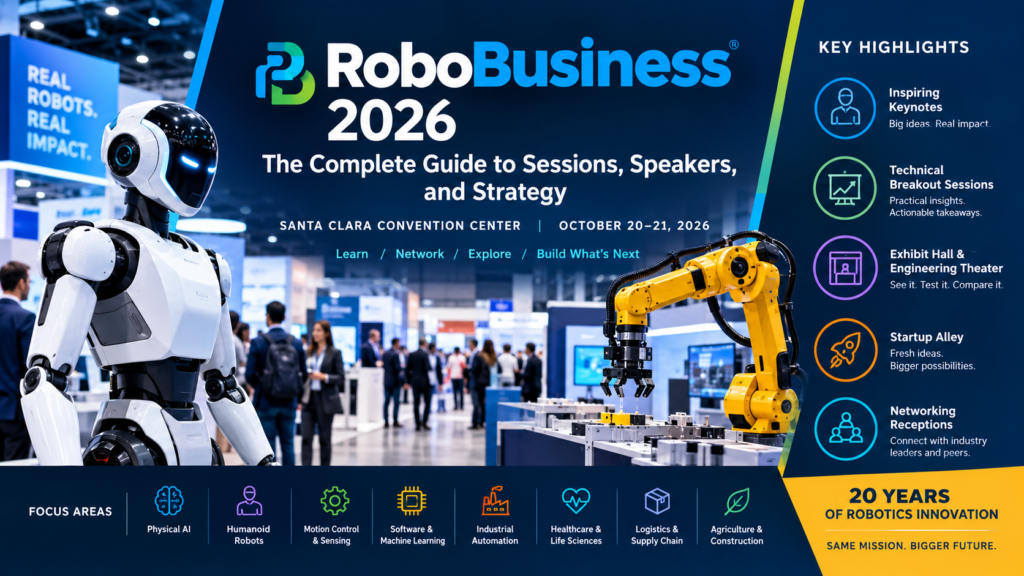
RoboBusiness 2026 runs October 20–21 at the Santa Clara Convention Center, and the best way to attend is to pick one goal for every time slot: a keynote for perspective, a breakout for tactics, and the show floor for hands-on evaluation. This guide sorts the program by theme and by job role, so you can build a schedule around what you need to decide, build, or buy.
Robotics events can feel like a firehose of announcements. This year’s edition adds another layer because the show marks its 20th anniversary, bringing the people who shaped the industry together with the founders and engineers shipping robots today. If you are an engineer vetting actuators, a founder preparing investor meetings, or an operator trying to separate real deployments from polished demos, RoboBusiness 2026 has sessions aimed at your problem.
Note: Day 1 details below reflect published schedules as of October 20, 2026. Times and rooms can change, so confirm on-site.
What Is RoboBusiness 2026?
RoboBusiness 2026 is a two-day commercial robotics conference and expo produced by The Robot Report and its parent company, Arrowfly. It is built for the people who design, fund, and deploy robots for real work rather than for casual spectators.
The program blends keynotes, parallel breakout tracks, an Engineering Theater on the exhibit floor, a Startup Alley, and networking receptions. Topics range from motion control and sensing to software, machine learning, and legged robots. Applied sectors include manufacturing, logistics, healthcare, agriculture, and construction. As a robotics conference, it leans toward practical deployment questions: what works, what it costs, and what breaks.
RoboBusiness 2026 Quick Facts
- Dates: October 20–21, 2026
- Location: Santa Clara Convention Center, Santa Clara, California
- Milestone: 20th anniversary of the event
- Exhibit hall: More than 100 exhibitors were announced ahead of the show
- Day 1 opening keynote: 9:15 a.m. PT, in the second-floor theatre
- Show floor opens: 10:00 a.m. on Day 1
- Day 1 closing keynote: 4:30 p.m., followed by a networking reception
- Registration: Available on site
Who Should Attend
The core audience is anyone who builds, buys, or funds commercial robots. That includes robotics engineers, product leaders, startup founders, venture investors, system integrators, and enterprise operations teams evaluating automation. Component suppliers also benefit, because many sessions focus on actuators, sensors, safety, and motion control.
How Is RoboBusiness 2026 Organized?
The event runs on three parallel layers: keynotes, breakout sessions, and the show floor. Keynotes happen in the theatre on the second floor. Breakout sessions take place in numbered rooms upstairs from the exhibit hall, starting at 10:30 a.m. on Day 1. The show floor opens at 10:00 a.m. and hosts demonstrations, the Engineering Theater, and Startup Alley.
This layered format means you rarely have to choose between learning and looking. A practical rhythm is to attend a keynote, use the hour before a breakout to walk the floor, and return to the floor whenever a session slot holds nothing relevant to your work. Knowing how RoboBusiness 2026 is organized helps you avoid dead time between rooms.
What Time Does the Action Start and End?
Day 1 starts at 9:15 a.m. PT and finishes with a networking reception after the 4:30 p.m. keynote. The reception is presented by Harmonic Drive and takes place in the exhibitor hall, with drinks, light appetizers, and a chance to meet speakers. A ticketed Women in Robotics Luncheon begins at 12:15 p.m.
Keynotes: The Bookends of the Program
Keynotes frame the conversation. The opening session looks backward and forward, while the closing session asks whether AI is actually working in production. Together, they set the intellectual frame for RoboBusiness 2026.
Opening Keynote: The Next 20 Years of Robotics
The first session, “The Next 20 Years of Robotics,” features Rodney Brooks (co-founder and CTO of Robust AI), Jonathan Hurst (co-founder and chief robot officer at Agility Robotics), and Ken Goldberg (UC Berkeley), with Steve Crowe of The Robot Report listed as the moderator. Robotics has moved from promising technology to a core business tool across manufacturing, logistics, healthcare, agriculture, and defense. Expect the discussion to cover which breakthroughs defined the last two decades and which technologies, markets, and obstacles will shape the next two.
Why it matters: These three speakers represent different philosophies. Brooks is known for pragmatic, deployment-minded views of robotics. Hurst leads a company building bipedal robots for logistics. Goldberg bridges academic research and industrial grasping and manipulation. Listening to them together is a quick way to calibrate your own roadmap against the long view.
Closing Keynote: Beyond the Demo
The final keynote, “Beyond the Demo: AI in Production Robotics,” runs at 4:30 p.m. The panel includes leaders from Amazon Robotics, Teradyne Robotics, ABB Robotics, Cambridge Consultants, and Cobot. The title signals the show’s central tension: a model that impresses on stage is not the same as a system that runs every shift.
Stay for this one even if your day has been packed. It gives you a cross-section of how large operators and platform vendors talk about reliability, data, and scaling, and it flows directly into the reception where you can follow up with speakers.
Physical AI: The Dominant Theme at RoboBusiness 2026
Physical AI refers to artificial intelligence systems that perceive, reason about, and act in the physical world, usually through robots. Unlike a chatbot, a physical AI system must handle sensor noise, contact forces, safety constraints, and hardware that wears out. The expanded view: physical AI is less a single technology than a stack that includes foundation models, simulation, data pipelines, edge compute, controls, and safety assurance.
At RoboBusiness 2026, physical AI shows up in nearly every track, usually framed around deployment rather than demonstration. Several sessions illustrate the range:
- Data collection: Instawork’s Aaron Bromberg discusses capturing usable data from real workers on real shifts and what it takes to run camera systems commercially at scale.
- Infrastructure: Intel’s Nagesh Puppala covers the open infrastructure needed to move physical AI from prototype to production.
- Deployment economics: Inbolt’s Rudy Cohen argues the bottleneck is deployment, not data, and focuses on closing control loops at servo frequency to cut the fixtures, wiring, and retuning that turn each installation into an expensive project.
- Safety-critical autonomy: FieldAI’s Andrey Konchenko describes a physics-first foundation model designed for risk-aware operation.
- Development workflow: Robust AI’s Anthony Jules explains how agentic coding helps lean teams move faster from the earliest design phase.
- Production automation: Vention’s François Giguére offers a framework for evaluating AI-defined automation in your own operations.
- Hard domains: Chef Robotics founder Rajat Bhageria makes the case that food is among physical AI’s toughest benchmarks, and also a promising catalyst.
What Is the Common Thread?
The common thread is that deployment, not capability, is the bottleneck. Speakers repeatedly point to data quality, integration cost, safety, and uptime as the factors that decide whether a physical AI project survives contact with a factory floor or a warehouse. If you are building or buying, prioritize sessions that give frameworks, decision rules, or lessons learned over pure product pitches.
Humanoid Robots: From Viral Videos to Bills of Materials
Humanoid robots are general-purpose machines with human-like form, usually bipedal or wheeled-base, designed to work in spaces built for people. The expanded picture is more sober than the headlines: the hard problems are actuation, sensing, safety, supply chain, and cost, not just walking.
The humanoid program at RoboBusiness 2026 is unusually component-focused, which is a good sign for a maturing market. Here is how the sessions break down:
- Economics and supply chain: Michelle Sun of Core Matter Labs examines the humanoid bill of materials and the geopolitical and economic realities behind the supply chain (10:30 a.m., Room 203).
- Motion and actuation: Kollmorgen offers a joint-by-joint guide to evaluating motion partners (11:30 a.m., Room 203), while Harmonic Drive covers integrated drive actuators that combine gearheads, motors, drives, and sensors (10:30 a.m.).
- Real manufacturing deployments: EmbodyX’s Dr. Weiwei Chen shares what the company has learned putting humanoids to work in factories (1:15 p.m., Room 203).
- Force and torque sensing: ForceN’s Robert Brooks summarizes three years of lessons from working with leading humanoid makers (2:15 p.m., Room 203).
- Safety: Novanta addresses functional safety for humanoid actuators (2:15 p.m., Room 204), and Benjamin Twombly of Critical Systems Analysis asks whether humanoids can be safe (3:30 p.m., Room 203).
- Tactile sensing: A panel with Protolabs, VPG, and Simplexity explores how touch sensing is evolving (11:30 a.m., Room 204).
On the show floor, the Engineering Theater adds sensor solutions from InvenSense (11:00 a.m.) and a certifiable safety architecture talk from Synapticon (11:45 a.m.). A dedicated “State of Humanoids” panel was also announced for the event; check the official agenda for its slot.
Is the Humanoid Hype Justified?
The sessions suggest a more nuanced answer: the opportunity is real, but it is gated by components, cost, and safety certification. Rather than debating whether humanoids will arrive, the speakers are asking what has to be true for them to be affordable, safe, and reliable in volume. That is the right question for engineers and buyers alike.
Business, Funding, and Startup Strategy
RoboBusiness 2026 devotes serious attention to the commercial side of robotics, including how companies raise money, price products, and work with large partners. For founders and investors, this is arguably the most valuable slice of Day 1.
The marquee session is F-Prime Capital’s annual “State of Robotics Investments” report, presented by Sanjay Aggarwal and Betsy Mulé at 1:15 p.m. in Room 207. It covers funding trends, emerging technology categories, and the sectors attracting the most investor interest. For context, The Robot Report tracked 162 financial transactions totaling about $4.87 billion in disclosed funding in August 2026 alone, so the appetite for robotics investment trends is clearly strong.
Other business-focused sessions include:
- Startup Bootcamp Part 1: Best practices for robotics startups, led by MassRobotics and Foley Hoag partners (10:30 a.m., Room 207).
- Startup Bootcamp Part 2: Working with corporate partners, featuring MassRobotics, WiBotic, and Analog Devices (11:30 a.m., Room 207).
- The Economics of Robotics: RoboStrategy’s Jack Pearson offers mental models for judging whether a robotics business can create and capture lasting value (2:15 p.m., Room 207).
- The RaaS Playbook: Leaders from Locus Robotics, Roboworx, and Aescape discuss pricing, service, and scale for robots-as-a-service (3:30 p.m., Room 207).
How Should Founders Use These Sessions?
Treat Room 207 as a strategy track. Attending the two bootcamp sessions, the investment report, the economics talk, and the RaaS panel gives you a connected view of positioning, fundraising, partnerships, unit economics, and business models. Then use Startup Alley and the reception to test what you learned in real conversations.
Field, Outdoor, and Specialized Robotics
Not every robot lives in a warehouse. A strong set of sessions at RoboBusiness 2026 addresses outdoor, agricultural, construction, and consumer environments, where weather, terrain, and unpredictability change the engineering rules.
- Outdoor autonomy ecosystems: Autonomous Solutions’ Mel Torrie explains how autonomous vehicles and advanced robotics are converging to reshape field deployments (10:30 a.m., Room 206).
- Scaling field programs: Raise Robotics’ Kenrick Tjandra offers a decision rule for allocating engineering capacity and gates that keep field programs from stalling (1:15 p.m., Room 206).
- Reliable outdoor robots: A panel with WiBotic, Burro, Nextpower, and Catalyze Robotics links engineering decisions to uptime and total cost of ownership (2:15 p.m., Room 206).
- Dexterous agricultural robots: AgRobotics founder Brent Shedd discusses what is working and what a realistic commercial path looks like (3:30 p.m., Room 206).
- Data center construction: ABB Robotics’ Ali Raja explores how robotics and prefabrication can ease labor pressure in modular data center builds (1:15 p.m., Room 204).
- Indoor shared spaces: Hello Robot and A&K Robotics discuss navigation challenges for robots around people (3:30 p.m., Engineering Theater).
If your robots work outside a controlled facility, Room 206 is the place to camp for the afternoon.
The Show Floor and Engineering Theater
The exhibit hall is where claims become demonstrations. It opens at 10:00 a.m. on Day 1 and includes live robot demos, Startup Alley, and the Engineering Theater, which runs short technical talks throughout the day. Topics include servicing robots from a tablet (DeviceNexus, 12:30 p.m.) and verifying compiled binaries against safety requirements (Aurora Labs, 2:00 p.m.).
A useful approach to the floor is to decide in advance what you are evaluating. Pick two or three categories, such as actuators, tactile sensors, or safety controllers, and visit every relevant booth with the same list of questions about lead time, certification, support, and total cost.
Which Sessions Fit Your Role? A Comparison Table
| Role | Best Day 1 Focus | Example Sessions | Primary Takeaway |
|---|---|---|---|
| Robotics engineer | Actuation, sensing, safety | Joint-by-joint humanoid motion; force and torque sensing; functional safety | Component choices that cut integration risk |
| AI/software lead | Physical AI and tooling | Open infrastructure for physical AI; agentic coding; AI-defined automation | How to move from prototype to production |
| Startup founder | Strategy and capital | Startup Bootcamp; State of Robotics Investments; RaaS Playbook | Fundraising, pricing, and partner tactics |
| Investor | Market signals | F-Prime report; Economics of Robotics; humanoid bill of materials | Where capital is flowing and where risk hides |
| Operations leader | Deployment reality | Beyond the Demo keynote; field robotics panels; humanoids in manufacturing | What reliable deployment actually requires |
| Field/outdoor developer | Rugged autonomy | Outdoor autonomy ecosystems; reliable outdoor robots; scaling field programs | Uptime and total cost of ownership |
Frequently Asked Questions About RoboBusiness 2026
When and where is RoboBusiness 2026?
It takes place October 20–21, 2026, at the Santa Clara Convention Center in Santa Clara, California.
Can I still register?
Yes. Registration is available on site. Check the official event page for current pass options.
What is the biggest theme this year?
Physical AI in real deployment. Even sessions on humanoid robots, outdoor autonomy, and business models circle back to the gap between impressive demos and dependable production systems.
Is there a networking event on Day 1?
Yes. A networking reception presented by Harmonic Drive follows the closing keynote in the exhibitor hall. A separate ticketed Women in Robotics Luncheon begins at 12:15 p.m., featuring a fireside chat between Amazon Robotics’ Bhavana Chandrashekhar and MassRobotics’ Joyce Sidopoulos.
How big is the exhibit hall?
Organizers announced more than 100 exhibitors. Third-party listings cite higher figures, so rely on the official site for the latest count.
Where can I find Day 2 details?
Use the official RoboBusiness agenda page. This guide focuses on Day 1; schedules for October 21 should be confirmed there.
Practical Tips for Getting the Most From the Event
Build a schedule with one anchor session per time block, then leave slack. Back-to-back sessions in different rooms leave no time for the conversations that often matter most. These habits help:
- Set three goals before you arrive. For example: evaluate two actuator suppliers, meet one investor, and learn one deployment framework.
- Pair each session with a floor visit. If a talk covers tactile sensing, visit the sensor booths right after while the details are fresh.
- Prioritize frameworks over pitches. Sessions that promise decision rules, checklists, or lessons learned usually deliver more reusable value.
- Capture contacts with context. Write down what you discussed and the next step before the next conversation erases it.
- Use the reception strategically. Speakers are far more approachable over drinks than at the stage door.
Conclusion: What RoboBusiness 2026 Signals About the Industry
RoboBusiness 2026 reflects a robotics industry that is moving from “can it work?” to “can it work reliably, safely, and profitably?” The program’s emphasis on physical AI deployment, humanoid supply chains, safety certification, and unit economics suggests the field is entering a more disciplined phase. For attendees, the opportunity is to learn from people who have already hit the walls and are willing to say where they were.
Plan your schedule around your biggest open decision, take advantage of the floor and the reception, and use the program as a map of where commercial robotics is headed over the next 20 years.