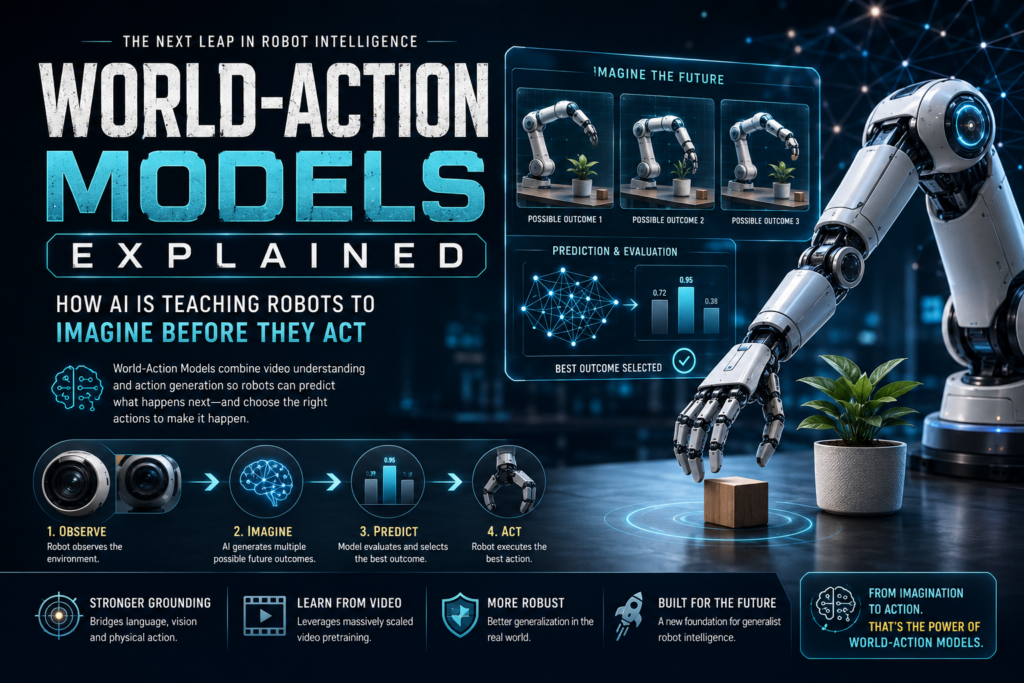
World-Action Models (WAMs) are a new class of robot AI that learn to control machines by starting from a pretrained video-generation backbone instead of a vision-language model. Instead of mapping words and pixels directly to motor commands, a World-Action Model first predicts how a scene will visually change, then derives or generates the actions needed to make that change happen. This single shift in starting point is reshaping how researchers and companies build generalist robots in 2026.
If you’ve followed robotics AI over the last two years, you’ve likely heard of Vision-Language-Action (VLA) models — the dominant recipe behind systems like Pi-0 and NVIDIA GR00T. World-Action Models are the second major bet in the field, and they’re growing fast enough that some researchers now describe them as a true paradigm shift rather than a passing trend. This article breaks down what World-Action Models are, how they differ from VLAs, why they emerged now, and where the technology is headed.
What Are World-Action Models?
Definition: A World-Action Model is a robot control policy built on top of a pretrained video or world-model backbone, fine-tuned to predict both future visual states and the robot actions that produce them.
Expansion: To understand why that matters, it helps to separate two older building blocks that World-Action Models combine. A visuomotor policy takes a current observation plus a language instruction and outputs an action sequence. A world model takes a current state plus an action and predicts what happens next, usually as a future image, video, or latent representation. A World-Action Model sits at the overlap of the two: it reuses a video-generation backbone as a prior for how scenes evolve, and then adapts that backbone to also emit robot actions.
This is different from earlier “world models for robotics” that only simulated outcomes for planning. World-Action Models are deployed as the actual control policy — the same network that imagines the future is the one steering the robot arm.
The core appeal is straightforward: video-generation models are already trained on enormous amounts of footage showing hands reaching, tools moving, and objects being manipulated, almost always paired with language descriptions. That gives a World-Action Model a head start on connecting words to physical outcomes — something traditional vision-language backbones have struggled with.
World-Action Models vs. Vision-Language-Action Models: Key Differences
Both approaches aim to build generalist robot policies, but they start from different pretrained foundations and make different bets about where the hardest problem in robotics actually lives.
| Aspect | World-Action Models (WAM) | Vision-Language-Action Models (VLA) |
|---|---|---|
| Pretrained starting point | Video or world-model backbone (e.g., Wan, Cosmos) | Vision-language model (VLM) backbone |
| Core bet | Visual-change prediction transfers to action generation | Internet-scale language/vision knowledge transfers to action generation |
| Main known weakness | High compute cost, slower inference | “Grounding gap” between language understanding and physical action |
| Representative systems | DreamZero, LingBot-VA, Cosmos Policy, Fast-WAM | Pi-0, Pi-0.5, NVIDIA GR00T, Being-H0.5 |
| Typical inference speed | ~590–800ms per action chunk (video generation in the loop) | ~190ms per action chunk |
| Training compute (rough order) | Often 5–10x higher due to long video-token sequences | Lower; sequences are mostly text and a few images |
| Strength shown in evaluation | Strong real-world generalist score (RoboArena) and robustness on perturbed simulation benchmarks | Mature, well-converged recipe with broad data co-training |
The practical takeaway: World-Action Models trade higher training and inference cost for a potentially stronger grounding signal between language, vision, and physical change. Vision-Language-Action models remain cheaper to train and run, but they still have to learn the link between instructions and motor behavior almost entirely from limited robot demonstration data.
Why World-Action Models Are Gaining Momentum Now
World-Action Models are not a brand-new idea — early versions go back to 2023’s UniPi. So why has this approach suddenly become one of the most active areas in robot foundation model research?
The grounding gap that pushed researchers toward WAMs
Traditional VLAs adapt a vision-language model that was never trained to produce physical actions. Several research teams have documented that fine-tuning these backbones for action generation can degrade the model’s original language and vision capabilities, sometimes described as catastrophic forgetting during the transition from VLM to VLA. Techniques like discrete action tokenization and gradient isolation between the language backbone and the action head have reduced this problem, but a persistent shortfall remains: the model still has to learn how to turn an instruction into reliable physical behavior almost entirely from comparatively small robot datasets. This shortfall is often called the language-to-action grounding gap, and it’s the single biggest reason World-Action Models exist as an alternative path.
Three reasons video pretraining helps robots learn
Researchers exploring World-Action Models point to three recurring hypotheses, treated as working theories rather than settled facts:
- Predicting outcomes is often easier than predicting actions directly. If a model already knows what a scene should look like after a successful action, working backward to infer the action (inverse dynamics) tends to be a more tractable problem than generating that action from scratch.
- Video pretraining already encodes language-to-physical-change grounding. Because modern video-generation models are trained to turn text descriptions into visually accurate outcomes, that mapping may transfer usefully to robot control, reducing how much grounding has to be learned from demonstrations alone.
- Video data acts as a regularizer. Robot demonstration datasets are tiny compared to web-scale video. Pretraining or co-training on video can reduce overfitting to the narrow, repetitive patterns found in most robot datasets.
A simple test of this idea: when researchers prompted a frontier video model (Google’s Veo 3.1) with a single robot-camera frame and a two-step instruction it had never seen, the generated rollout produced smooth, plausible motion toward the right objects in the right order — even though the model had never been trained as a robot policy. The hands and gripper morphed inaccurately, and it wasn’t reliable enough for actual control, but the result illustrated why video backbones are seen as a promising prior. Turning that “zero-shot imagination” into dependable control is exactly what World-Action Model fine-tuning attempts to do.
How World-Action Models Actually Work
Modern World-Action Models vary widely in implementation, but nearly all of them can be mapped along three design axes.
Paradigm: what the model predicts
Question: What does a World-Action Model actually output at inference time? Direct answer: It depends on the formulation, but the three dominant approaches are inverse dynamics, joint prediction, and representation-only generation.
- Inverse dynamics generates a predicted future video or latent first, then derives the action sequence needed to produce that transition. This is the easiest version to understand conceptually and traces back to UniPi; modern examples include LingBot-VA, which fine-tunes a Wan 2.2 video backbone for closed-loop robot rollouts.
- Joint prediction generates video and actions together in a single pass, with no separate inverse-dynamics step. DreamZero is the leading modern example, denoising future video tokens and robot-action tokens inside one transformer initialized from a 14-billion-parameter Wan video diffusion model.
- Representation-only World-Action Models use the video backbone purely to build internal representations and skip generating actual video frames at inference, trading some accuracy for substantially faster inference. Fast-WAM is the clearest public example of this direction.
How actions enter the model
A core technical challenge for any World-Action Model is that the pretrained backbone knows how to denoise visual tokens, not continuous robot actions — a real modality mismatch. Researchers currently solve this in three main ways: adding dedicated action tokens and an action head alongside video tokens (the most common default); encoding actions as visual targets the video model can natively “draw,” as seen in Cosmos Policy’s approach of representing actions as synthetic latent video frames; or compressing behavior into latent plans or latent actions learned from trajectories or even unlabeled video, an approach used by Being-H0.7.
Architecture styles
The third axis is how the video and action components are structurally connected:
- Hierarchical designs run video prediction and action generation as separate, modular stages connected one-way. This is flexible but creates weaker coupling between imagined outcomes and generated actions.
- Monolithic transformers denoise video and action tokens together in one unified stack, giving strong coupling at the cost of having to optimize for two very different types of data in the same weights.
- Mixture-of-Transformers (MoT) designs use modality-specific expert transformers for video and action that share information through joint attention while keeping separate weights. This has become the current default across both World-Action Models and modern VLAs, balancing modularity with coupling.
Do World-Action Models Outperform Traditional Robot Policies?
Question: Is there real evidence that World-Action Models work better than VLAs in practice? Direct answer: Early real-world signals are promising, but the comparison isn’t settled.
On RoboArena, one of the few open, real-world generalist robot benchmarks, an April 2026 leaderboard snapshot showed DreamZero — a World-Action Model — reaching a score of 1750, ahead of Pi-0.5’s 1622 and well ahead of the original Pi-0’s 1475. Notably, DreamZero achieved this while training only on the DROID dataset, without an additional large-scale cross-embodiment training stage that many top VLAs rely on.
That said, this is a single data point, not proof that World-Action Models are categorically better. Other comparisons, including simulation benchmarks like LIBERO-Plus and RoboTwin 2.0-Plus, show World-Action Models reaching strong robustness scores without the broad training-data mixtures VLAs typically need, but these tests remain limited to simulated environments rather than open-world deployment. The honest summary: World-Action Models show real promise, but neither approach has definitively “won” yet.
The Trade-offs: Training Cost and Inference Speed
World-Action Models don’t come free. Because they process long sequences of video tokens rather than a handful of images and text tokens, they carry meaningfully higher costs across the entire pipeline.
- Training compute is substantially higher. Video token sequences used by World-Action Models are often roughly 10x longer than typical VLA training sequences, which directly raises compute requirements. Rough lower-bound estimates put a representative World-Action Model action-tuning stage at around 9 zettaFLOPs, compared to under 1 zettaFLOP for an efficient VLA action-tuning stage on similar data.
- Inference is several times slower. Representative benchmarks show common World-Action Model inference modes taking roughly 590–800 milliseconds per action chunk, compared to about 190 milliseconds for a modern VLA like Pi-0.5 — a 3–4x slowdown that matters significantly for real-time robot control.
- Systems complexity increases. Long video-token sequences strain GPU memory, multi-node communication, and data-loading pipelines, making World-Action Models harder to run without serious infrastructure investment.
- Data quality requirements rise. Because video-generation quality appears closely linked to downstream policy performance in current World-Action Models, teams have to invest heavily in video filtering, captioning, and latent representation quality — concerns that matter less for VLA training.
These costs are exactly why faster variants like Fast-WAM, which skip video generation at inference entirely, are expected to become an increasingly important research direction.
Will World-Action Models Replace VLAs, or Merge With Them?
Question: Is one of these two approaches going to win outright? Direct answer: Most signs point toward convergence rather than a single winner.
Several recent systems already blur the line between the two camps. Physical Intelligence’s Pi-0.7, fundamentally a VLA, conditions its action expert on visual subgoals generated by a world-model component — and reports that this measurably improves instruction-following and training speed. Meanwhile, Being-H0.7 combines a VLA-style understanding backbone with a latent World-Action Model-style prior/posterior interface trained on hundreds of thousands of hours of video. Industry examples like Sereact’s Cortex 2.0 add a world-model planning layer that scores candidate future trajectories before execution, blending foresight with action execution in a single deployed system.
This emerging pattern suggests the next generation of robot foundation models will likely be hybrids: drawing grounding and visual foresight from World-Action Model-style components while keeping the broad language understanding and efficient training recipes that VLAs have already refined. A fourth, more speculative path — robotics-first foundation models trained from scratch on massive embodied datasets rather than adapted video or language backbones — remains largely blocked for most research groups due to data access, but could eventually compete with both established camps.
Frequently Asked Questions About World-Action Models
What is the main difference between a World-Action Model and a world model? A world model predicts future states given a current state and an action, often for simulation or planning. A World-Action Model goes a step further: it’s fine-tuned to also generate the actual robot actions, making it a deployable control policy rather than just a prediction tool.
Are World-Action Models actually used in real robots today? Yes. Systems like DreamZero and LingBot-VA have been evaluated on real robot hardware and benchmarked on open, real-world platforms like RoboArena, alongside simulation benchmarks like LIBERO and CALVIN.
Why are World-Action Models so much slower than VLAs? Because most World-Action Model designs generate or denoise video tokens at inference time, and video sequences are far longer than the text-and-image sequences VLAs typically process. Representation-only variants that skip video generation, like Fast-WAM, are one proposed fix.
Do World-Action Models need less robot training data than VLAs? In some cases, yes — the video pretraining prior can reduce how much robot-specific data is needed to reach a given performance level. However, this benefit typically comes at the cost of significantly higher training compute, so it’s a trade-off rather than a clear efficiency win.
Which companies are building World-Action Models? Public examples include NVIDIA (DreamZero, Cosmos Policy), Ant Group (LingBot-VA), Rhoda AI (DVA), Sereact (Cortex 2.0), and Mimic Robotics (mimic-video), alongside active university and open-research contributions.
Key Takeaways
- World-Action Models start from pretrained video or world-model backbones rather than vision-language models, betting that visual-change prediction transfers more directly to robot action than language-to-action mapping does.
- The approach addresses the “grounding gap” that limits even modern, well-optimized Vision-Language-Action models.
- World-Action Models currently show strong real-world results on benchmarks like RoboArena, but at meaningfully higher training compute and slower inference than VLAs.
- The field hasn’t settled on one dominant formulation — inverse dynamics, joint prediction, and representation-only approaches are all actively competing.
- The most likely future isn’t one paradigm beating the other; it’s a hybrid of World-Action Models and Vision-Language-Action models, a pattern already visible in systems like Pi-0.7 and Being-H0.7.
World-Action Models are still young, fast-moving, and far from standardized — but they represent a genuinely different bet on how robots should learn to act in the physical world, and that bet is already paying off in early benchmarks.