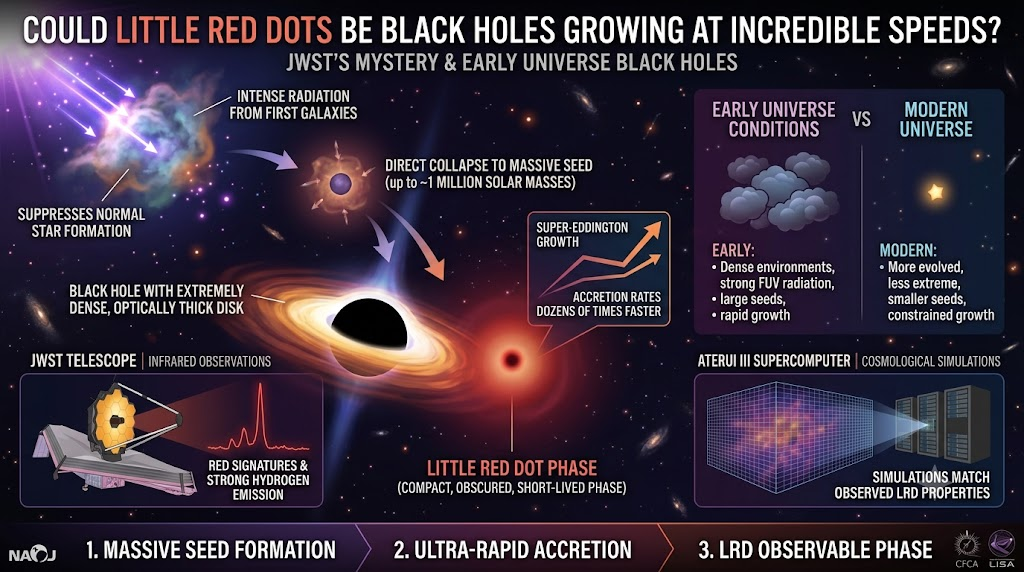
Could Little Red Dots Be Black Holes Growing at Incredible Speeds?
What if some of the tiny red objects James Webb sees are actually black holes caught during a spectacular growth spurt?
New supercomputer simulations suggest that JWST’s mysterious Little Red Dots may be rapidly growing black holes surrounded by extremely dense gas. The simulations, published in Nature on September 16, 2026, show how unusually massive black-hole seeds could form naturally in the early Universe and then grow at rates dozens of times faster than would be possible under present-day conditions.
The result could provide an important explanation for one of modern astronomy’s biggest puzzles: how black holes containing millions or even billions of Suns appeared so soon after the Big Bang.
Rather than requiring exotic physics or an extraordinarily unlikely chain of events, the new model points to something more familiar: radiation, gas, gravity and the unusual environment of the early Universe.
What Are JWST’s Little Red Dots?
Question: What are Little Red Dots?
Little Red Dots (LRDs) are compact, extremely red sources discovered by the James Webb Space Telescope in the distant early Universe. Their nature has remained uncertain, but the new simulations suggest they could be short-lived phases of rapidly growing black holes surrounded by dense, obscuring gas.
The name is deliberately simple. In JWST images, these objects appear small and unusually red, but their apparent simplicity hides a much more complicated story.
JWST observes the Universe primarily in infrared wavelengths. That makes it exceptionally useful for studying very distant objects because light from the early Universe has been stretched toward longer wavelengths as the Universe expanded.
The telescope has therefore been able to reveal populations of objects that earlier observatories could not study in comparable detail.
Among those discoveries are the Little Red Dots, which became particularly interesting because their compact appearance and unusual spectra did not immediately point to a single obvious explanation.
Definition + Expansion: What Is a Black Hole Seed?
A black hole seed is an initial black hole that can later grow into a much more massive black hole.
The new simulations indicate that some seeds in the early Universe could have been extraordinarily massive from the beginning,potentially reaching up to about one million times the mass of the Sun. That is dramatically larger than the stellar-mass black holes produced when individual massive stars collapse.
Starting with a heavier seed changes the growth problem.
If astronomers want to explain a billion-solar-mass black hole only a few hundred million years after the Big Bang, beginning with a relatively massive seed gives the black hole a major head start.
The new study combines that large starting point with an unusually efficient growth mechanism.
Why Have Little Red Dots Puzzled Astronomers?
The mystery begins with timing.
Astronomers have observed extremely massive black holes at epochs when the Universe was less than 600 million years old. These objects somehow accumulated enormous amounts of mass remarkably early in cosmic history.
That creates a basic question:
How did black holes become so massive when the Universe itself was still so young?
A conventional growth scenario can struggle with that timeline. Black holes gain mass by accreting matter, but there are physical limits on how efficiently that process can normally operate.
This is why astronomers have considered different types of black-hole seeds and different growth mechanisms.
Some models begin with the remnants of the first stars. Others investigate ways in which much larger objects could collapse directly into black holes.
The new study takes another important step by connecting seed formation, rapid growth and the observed properties of Little Red Dots within one cosmological simulation.
Question: Does this study prove that every Little Red Dot is a black hole?
No. The simulations provide a physical scenario that can reproduce the observed properties of LRDs, but observations and future tests remain important. The researchers’ result is best understood as a strong theoretical explanation linking these objects to an early, rapidly growing phase of black-hole formation.
That distinction matters.
A simulation can show that a particular process is physically plausible and can reproduce observed features. It does not automatically establish that every observed object followed exactly the same history.
How Did ATERUI III Simulate the Early Universe?
The research team led by Sunmyon Chon of the Max Planck Institute for Astrophysics used Japan’s ATERUI III supercomputer at the National Astronomical Observatory of Japan.
The researchers did not simply simulate an isolated black hole.
Instead, they started on the scale of a developing galaxy environment and progressively examined smaller structures, eventually resolving individual gas clouds. This multiscale approach allowed the researchers to connect the large-scale environment of early galaxies with the small-scale physics involved in black-hole formation.
That is computationally demanding.
The ATERUI III system has a stated theoretical performance of 1.99 petaflops and includes systems designed for high memory bandwidth and large memory capacity. The study used its high-speed data-transfer capabilities for the large-scale simulations.
Why Simulate the Whole Environment?
A black hole does not form in isolation.
Its surroundings determine how much gas is available, how that gas behaves and how radiation affects the material around it. The early Universe also contained dense groups of young galaxies whose radiation could dramatically influence neighboring clouds.
The researchers therefore wanted to reproduce those environmental conditions rather than assume the black-hole seed already existed.
The result was a chain of events:
- Dense early galaxy environments produce strong radiation.
- Far-ultraviolet radiation reaches nearby gas clouds.
- The radiation suppresses ordinary star formation in some clouds.
- The gas avoids fragmenting into many smaller stars.
- Instead, it can collapse into a massive object.
- That object becomes a massive black-hole seed.
- Dense gas surrounding the seed enables extremely rapid growth.
- The resulting black hole can appear as a Little Red Dot.
That sequence is central to the new explanation.
How Could Radiation Help Create a Black Hole?
Radiation may sound like something that should prevent collapse, but in this scenario it plays a surprisingly important role.
The simulations show that intense far-ultraviolet (FUV) radiation from nearby star-forming galaxies can suppress star formation inside particular gas clouds.
Normally, gas can cool and fragment into many smaller structures. Those structures can eventually produce populations of stars.
But strong FUV radiation can interfere with that process.
The Direct-Collapse Idea
Instead of allowing a gas cloud to break into many ordinary stars, the intense radiation can keep the cloud from following the usual fragmentation pathway.
The gas can therefore remain concentrated and collapse into a single massive object.
According to the simulations, that object can become a supermassive star, which subsequently collapses to form a black-hole seed with a mass of up to approximately one million Suns.
Question: Why is a massive starting seed important?
A heavier seed requires less time to reach the enormous masses observed in the early Universe. If the seed begins at roughly a million solar masses rather than with the mass of a typical stellar remnant, the subsequent growth problem becomes substantially easier.
This is one reason the new model is significant.
It does not rely only on making black holes grow faster. It also gives them a much larger starting point.
Why Could These Black Holes Grow Dozens of Times Faster?
Creating a massive seed is only half the problem.
The black hole still needs to accumulate additional mass.
This is where the simulations reveal another unusual feature of the early Universe: dense gas disks surrounding the newly formed black holes.
The gas around these black holes can become extremely thick and optically dense.
Question: What does an optically thick gas disk do?
An optically thick environment prevents radiation from escaping easily. The trapped radiation changes how matter interacts with the black hole and allows gas to be accreted at rates far above the ordinary Eddington limit for a limited period.
What Is the Eddington Limit?
The Eddington limit is a theoretical balance between the inward pull of gravity and the outward pressure produced by radiation during accretion.
When matter falls toward a black hole, it heats up and releases enormous amounts of radiation. That radiation can push against incoming material, creating a natural limit on how quickly the black hole can normally consume its surroundings.
But the simulated early-Universe environment changes that balance.
The dense gas can trap radiation, allowing the black hole to experience a period of super-Eddington accretion,growth at rates above the conventional Eddington limit.
According to the research team’s simulation, this phase can allow the black hole to grow at tens of times the Eddington rate for a relatively short period.
The study reports that a seed of roughly one million solar masses can grow to around 30 million solar masses by redshift z ≈ 8, roughly 600 million years after the Big Bang, under the simulated conditions.
That is an extraordinary growth spurt.
How Do the Simulations Match JWST’s Little Red Dots?
This is where the study becomes particularly interesting.
The simulations do not merely produce massive black holes. They also produce objects whose observational properties resemble those of the Little Red Dots detected by JWST.
The simulated black holes are surrounded by dense gas that acts like a cosmic cocoon.
That gas can scatter and absorb light, producing the compact, red appearance associated with LRDs. The simulations also reproduce spectral characteristics associated with the objects, including strong hydrogen emission.
Question: Why is matching the spectrum important?
An object’s color alone is not enough to identify what it is. Spectral features provide much more detailed information about the physical conditions around the object.
The new simulations are therefore significant because they aim to reproduce not just the existence of a massive black hole, but also the observable signatures that JWST actually detects.
According to the research team, the strong H-alpha emission associated with LRDs can arise from the dense gas surrounding the growing black hole rather than requiring a separate broad-line region.
That creates a much more complete connection between theory and observation.
Why Does the Early Universe Allow Growth That Is Difficult Today?
The answer is largely environmental.
The modern Universe is comparatively structured and evolved. Galaxies have developed, gas has been consumed or redistributed, and the extreme conditions present during the earliest stages of galaxy formation are no longer widespread.
The early Universe was different.
Dense regions could contain rapidly forming galaxies packed relatively close together. Their radiation could influence neighboring gas clouds, while enormous reservoirs of relatively pristine gas were available for star and black-hole formation.
That combination created opportunities that are difficult to reproduce today.
Early Universe vs Modern Universe
| Feature | Early Universe scenario | Modern Universe |
| Gas environment | Dense and abundant | More evolved and redistributed |
| Nearby radiation | Strong FUV radiation from young galaxies | Conditions generally less extreme |
| Black-hole seeds | Could reach up to ~1 million solar masses in the simulation | Comparable formation pathway is not generally available |
| Gas around seed | Dense, optically thick disks | Much less likely under the same conditions |
| Accretion | Can become strongly super-Eddington | Usually much more constrained |
| Observable phase | Compact, obscured and red | Different environments and signatures |
The comparison does not mean modern black holes cannot grow rapidly.
Instead, it highlights why the simulated combination of conditions was particularly favorable during the Universe’s infancy.
Could Little Red Dots Be the Missing Link to Supermassive Black Holes?
The new model provides a possible evolutionary sequence.
A dense early galaxy environment produces intense radiation. That radiation influences a neighboring gas cloud, helping it form a massive black-hole seed.
The seed becomes surrounded by dense gas and enters a period of extremely rapid growth.
During this stage, the object could appear to JWST as a Little Red Dot.
As the surrounding environment changes and the black hole continues evolving, it can eventually become part of the population of massive black holes found in galaxies.
This provides an attractive connection between two previously difficult questions:
- Why do LRDs exist?
- How did enormous black holes form so early?
The Nature study proposes that both phenomena can emerge from the same physical scenario.
Question: Does this explain every early supermassive black hole?
Not necessarily. The model provides one pathway that naturally produces massive seeds and rapid growth, but the population of early black holes may not have a single origin. Future observations will be important for determining how broadly this scenario applies.
Why Does This Matter for the First Galaxies?
Black holes are not merely passive objects sitting inside galaxies.
When they grow rapidly, they can release enormous amounts of energy and drive powerful outflows. Those outflows can influence the surrounding gas and potentially affect how stars form.
That means the formation of early black holes could also influence the development of their host galaxies.
The research team describes the work as connecting the first stars, the first black holes and the first galaxies within a common evolutionary picture.
This matters because galaxies did not appear fully formed.
They developed through a complicated interaction between dark matter, gas, stars, radiation and black holes.
Understanding how the earliest black holes emerged can therefore help astronomers understand how the first large-scale cosmic structures developed.
How Does This Study Change the Black-Hole Formation Question?
For years, the basic question was:
How could a black hole become enormous so quickly?
The new simulations divide that problem into two connected stages.
Stage 1: Start Big
The early environment can produce a black-hole seed with a mass of up to approximately one million Suns.
That is already far more massive than a typical black hole created from the collapse of one star.
Stage 2: Grow Extremely Fast
The surrounding dense gas creates conditions for super-Eddington accretion, allowing the seed to grow much faster than black holes normally can under modern conditions.
Together, those mechanisms reduce the amount of time required to build a massive black hole.
This is important because the Universe had only a few hundred million years to produce some of the massive black holes observed by JWST.
The model therefore addresses both the starting-mass problem and the growth-rate problem.
How Do Simulations and JWST Work Together?
A telescope and a supercomputer answer different questions.
JWST observes what is actually out there.
A simulation asks whether known physical laws can reproduce those observations.
When the two agree, astronomers gain a stronger framework for interpreting distant objects.
| Approach | What it provides | Role in the Little Red Dot mystery |
| JWST observations | Real infrared observations and spectra | Reveals LRDs and their physical signatures |
| Cosmological simulations | Models of gas, radiation and gravity | Tests how LRD-like objects could form |
| Spectral comparison | Matches predicted and observed signatures | Tests whether the physical model fits |
| Future observations | Larger and more diverse samples | Determines how widely the model applies |
The new study is especially useful because the simulation was designed to follow the process from cosmological environment to individual gas clouds and black-hole growth, rather than treating the black hole as an isolated object.
That makes the result more than a simple computer-generated picture.
It is an attempt to reconstruct a physical history.
What Could Astronomers Learn From More Little Red Dots?
The next challenge is sample size.
One proposed model becomes much more useful when astronomers can compare it against many objects with different ages, environments and properties.
JWST is continuing to identify LRDs, giving researchers more opportunities to test whether their characteristics consistently match rapidly growing black holes.
Future observations could investigate:
- How common LRDs were during different stages of the early Universe.
- Whether their spectra consistently match black-hole accretion models.
- How long the LRD phase lasts.
- How massive their black-hole seeds are.
- How much dense gas surrounds them.
- Whether LRDs evolve into the massive black holes found in later galaxies.
- How early black holes influence star formation in their host environments.
The answers could reveal whether the new scenario is a dominant pathway or one of several ways that the first supermassive black holes formed.
What Does This Tell Us About the Universe’s First 600 Million Years?
The most striking implication is that the early Universe may have been capable of producing massive black holes surprisingly efficiently.
The simulations show a pathway in which environmental conditions naturally create massive seeds, followed by a short but extraordinarily rapid growth phase.
That changes the way we can think about cosmic evolution.
The first galaxies were not simply collections of stars gradually building up over enormous periods. Their environments could contain intense radiation fields, dense gas clouds and rapidly growing black holes interacting with one another.
The Universe was young, but it was not necessarily simple.
In fact, its extreme conditions may have accelerated some of the processes that later became much less efficient.
Why the Little Red Dot Mystery Is Important Beyond Black Holes
The discovery is exciting because it demonstrates how modern astronomy increasingly combines observations, physics and high-performance computing.
JWST revealed objects that were difficult to interpret.
Researchers then used a supercomputer to reproduce the physical conditions that might create those objects.
The result was a model connecting several phenomena that once appeared separate: massive black-hole seeds, rapid accretion, dense gas, early galaxies and the mysterious red sources seen by Webb.
That is an important pattern in science.
Sometimes a strange observation does not require a completely new law of physics. It may instead require a better understanding of how familiar physics behaves under conditions that are no longer common.
The new study suggests that could be exactly what is happening with Little Red Dots.
What Happens Next?
The research does not close the investigation.
Instead, it gives astronomers a set of predictions to test.
If LRDs are rapidly growing black holes, future observations should continue to reveal properties consistent with dense, obscured accretion environments. Larger samples can also show whether the proposed pathway explains the abundance and diversity of LRDs across cosmic time.
The researchers also point toward a broader evolutionary connection.
These early massive black-hole seeds could eventually become the supermassive black holes found in later galaxies. Their activity may also have affected the first generations of stars and galaxies.
Future gravitational-wave observatories could add another piece to the puzzle. The research team identifies these early massive seeds as potential progenitors of gravitational-wave sources that future missions such as LISA could investigate
So the story may eventually stretch from infrared images of tiny red points to gravitational waves produced by massive black-hole systems.
FAQ: Little Red Dots and Early Black Holes
What are JWST’s Little Red Dots?
Little Red Dots are compact, extremely red sources observed by the James Webb Space Telescope in the early Universe. Their exact nature has been debated, but new simulations suggest they can represent rapidly growing black holes surrounded by dense gas.
Are Little Red Dots definitely black holes?
The new study provides a detailed black-hole formation and growth scenario that reproduces important observed properties of LRDs, but it should not be interpreted as proof that every Little Red Dot is a black hole. Further observations are needed to test how broadly the model applies.
How did the early Universe create massive black-hole seeds?
The simulations show that intense far-ultraviolet radiation from nearby young galaxies could suppress ordinary star formation in certain gas clouds. Instead of fragmenting into many stars, the gas could collapse into a massive star that eventually formed a black-hole seed of up to about one million solar masses.
Why can these black holes grow so quickly?
The simulated black holes become surrounded by dense, optically thick gas disks. The trapped radiation allows them to accrete matter at super-Eddington rates, with the simulations showing growth at tens of times the conventional Eddington rate for a limited period.
What is ATERUI III?
ATERUI III is a dedicated astronomy supercomputer operated by Japan’s National Astronomical Observatory. It has a theoretical performance of 1.99 petaflops and was used to perform the detailed cosmological simulations behind the new study.
Why are Little Red Dots important for understanding the early Universe?
They may represent a short-lived stage in the formation of massive black holes. If the model is confirmed, LRDs could help explain how black holes with millions or billions of solar masses appeared only a few hundred million years after the Big Bang.
Key Takeaways
- Little Red Dots are mysterious compact red sources discovered by JWST in the early Universe.
- A new Nature study published September 16, 2026 proposes that LRDs can be rapidly growing black holes surrounded by dense gas.
- Simulations using Japan’s ATERUI III supercomputer show that massive black-hole seeds can form naturally in dense early-Universe environments.
- Intense far-ultraviolet radiation can suppress ordinary star formation and help a gas cloud collapse into a massive object.
- The resulting black-hole seeds can reach up to about one million solar masses in the simulation.
- Dense gas surrounding the seeds can trap radiation and enable super-Eddington growth.
- The simulations show a seed growing from roughly one million to 30 million solar masses by about 600 million years after the Big Bang under the modeled conditions.
- The simulated objects reproduce important observed properties of Little Red Dots, including their red appearance and spectral characteristics.
- The model offers a possible explanation for how supermassive black holes formed surprisingly early in cosmic history.
- More JWST observations and future facilities will be needed to determine how widely this explanation applies.
The mystery of the Little Red Dots may therefore be pointing toward something much bigger: a previously hidden phase in the birth of the Universe’s most massive black holes. As Webb continues looking deeper into cosmic history, these tiny red sources could become some of the most useful clues we have for understanding how the first galaxies and black holes took shape. keep exploring kalinga.ai for more.