Why Is Elias 2-24 b the Youngest Known Planet?
Question: What makes Elias 2-24 b the youngest known planet?
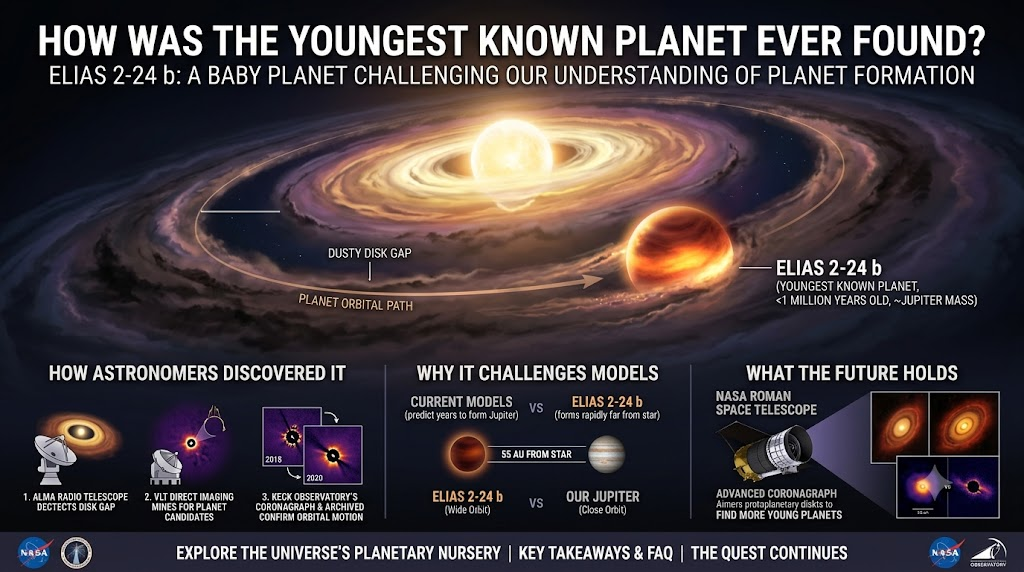
Elias 2-24 b is less than 1 million years old, making it the youngest planet confirmed by astronomers so far. It is particularly valuable because the planet is still embedded in the dusty disk surrounding its young host star, allowing scientists to study a world during an extremely early stage of planetary development.
Previous record holders for the youngest known planets were all more than 5 million years old, according to Lucas Cieza, a professor at the Instituto de Estudios Astrofísicos in Chile and a co-author of the research.
That age difference is enormous in planetary terms.
A planet that is only hundreds of thousands of years old is still extremely close to the beginning of its existence. Elias 2-24 b therefore provides astronomers with something that is rarely available: an opportunity to investigate a giant planet while its surrounding formation environment is still present.
Definition + Expansion: What Is an Exoplanet?
An exoplanet is a planet that orbits a star outside our solar system.
Astronomers have confirmed thousands of exoplanets using techniques such as observing planetary transits, measuring gravitational effects, and directly imaging planets in especially favorable systems. Elias 2-24 b is unusual because it is both extremely young and located far from its star, making it possible to observe it through specialized high-contrast imaging techniques.
Most known exoplanets are much older than Elias 2-24 b. Many also orbit relatively close to their stars, where they can be detected more easily using established methods.
The youngest known planet is different because astronomers are catching it near the beginning of its planetary life.
Where Is Elias 2-24 b?
Elias 2-24 b orbits a young star located approximately 450 light-years from Earth.
That may sound unimaginably distant,and it is. One light-year represents the distance light travels in one year, so the system is far beyond anything humans could physically reach with current technology.
Yet astronomical observations allow researchers to study the system from Earth because light and other electromagnetic signals carry information across space.
The planet itself is approximately Jupiter-mass, meaning it has a mass broadly comparable to Jupiter, the largest planet in our solar system.
Its distance from its host star is even more striking.
Elias 2-24 b orbits at approximately 55 times the Earth-Sun distance. For comparison, Earth is defined as being one astronomical unit (AU) from the Sun on average, while Jupiter is a little more than five AU from the Sun.
That puts Elias 2-24 b much farther from its star than Jupiter is from the Sun.
Question: Why does the planet’s distance from its star matter?
Distance is important because current planet-formation models generally predict that building a Jupiter-size planet becomes more difficult and time-consuming at large orbital distances. Elias 2-24 b appears to have reached enormous size surprisingly quickly despite being roughly 55 times farther from its star than Earth is from the Sun.
This combination,very young age, Jupiter-like mass, and very wide orbit,is what makes the system especially challenging for existing theories.
How Did Astronomers Discover the Youngest Known Planet?
The discovery began with observations of young stars surrounded by disks of gas, dust, ice, and rocky material.
Astronomers know that these disks can contain the raw ingredients from which planets develop. They also contain structures such as gaps that may be produced by growing planets interacting gravitationally with the surrounding material.
The researchers examined archived observations of seven young stars obtained with the coronagraph at the W. M. Keck Observatory in Hawaii.
What Is a Coronagraph?
A coronagraph is an instrument designed to block or suppress much of a star’s intense light so that much fainter objects near the star can be detected.
This is crucial for directly imaging planets. A star can be billions of times brighter than a planet orbiting nearby, so even a large planet can disappear in the star’s glare.
By suppressing the star’s light, astronomers can search for faint objects close to it.
In the Elias 2-24 system, an especially important clue was a gap in the surrounding dusty disk.
Question: Why would a gap in a planet-forming disk suggest that a planet is present?
A sufficiently massive growing planet can interact with material in the disk around its star and carve a gap along its orbit. Researchers therefore expected a forming planet to potentially appear within one of these gaps,and that is where they found the faint object associated with Elias 2-24 b.
The object was not immediately accepted as a confirmed planet. Astronomers needed additional observations to determine whether it was genuinely orbiting the star or was simply an unrelated background object or imaging artifact.
That distinction eventually became possible through archived observations.
Why Is Planet Formation So Difficult to Understand?
Stars form inside enormous clouds containing gas and dust. As a young star develops, leftover material can form a rotating disk around it.
Within that disk, particles collide and accumulate. Over time, larger bodies can emerge, eventually producing planets.
But the details of how this process produces giant planets,especially massive planets far from their stars,remain an active area of research.
Scientists use observations, physical theories, and computer simulations to develop planet-formation models. Those models must explain the properties of the planetary systems astronomers observe.
The problem is that direct observations of planets during their earliest stages are extremely limited.
Most known exoplanets are billions of years old. By that stage, the dusty environment associated with their formation has long disappeared, leaving astronomers to reconstruct their histories from the mature systems they observe today.
The youngest known planet changes that situation.
Instead of studying only the finished product, researchers can study a planetary system while the construction process is still underway.
Why Does Elias 2-24 b Challenge Existing Planet-Formation Models?
The biggest surprise is not simply that Elias 2-24 b is young.
It is that the planet appears to have reached roughly Jupiter’s mass in less than 1 million years, despite orbiting approximately 55 times farther from its star than Earth is from the Sun.
According to the research source, current models suggest that forming a Jupiter-size planet at Jupiter’s distance from the Sun takes around 5 million years.
A giant planet forming much farther away would generally be expected to take even longer under those models.
Yet Elias 2-24 b appears to have become a giant planet within a fraction of that timeframe.
Question: Does Elias 2-24 b prove that current planet-formation theories are wrong?
Not exactly. Instead, the discovery indicates that existing models may be missing important processes or may not fully describe how some giant planets can form under certain conditions.
Lucas Cieza said the discovery shows that even the best current planet-formation models are still missing important processes.
That is an important distinction. Scientific models are not fixed answers; they are frameworks that researchers continually test against new observations.
When a newly observed system does not fit comfortably within existing expectations, scientists can investigate which assumptions need to be modified or which additional physical processes might be involved.
The Distance Problem
Consider the scale of the system.
Earth sits roughly one astronomical unit from the Sun. Jupiter is a little more than five astronomical units away. Elias 2-24 b is about 55 astronomical units from its star.
That means the newly confirmed planet occupies an orbit approximately ten times farther out than Jupiter’s orbit around the Sun.
The fact that a Jupiter-mass planet could appear at such a distance so early in the star system’s history is therefore a significant challenge for astronomers trying to explain giant-planet formation.
What Does the Dusty Disk Tell Scientists?
The disk surrounding Elias 2-24 is more than background scenery.
It contains material left over from the star’s formation and provides the environment in which planets can develop. Astronomers can study structures within these disks to look for evidence of interactions between forming planets and their surroundings.
The gap associated with Elias 2-24 b is particularly important.
If a planet is sufficiently massive, its gravity can influence nearby material and produce a gap or other structures in the disk. Finding the faint object inside the gap provides a physical connection between the observed disk structure and the planet itself.
Question: Is the gap itself proof that a planet exists?
No. A disk gap can have different possible explanations, so astronomers need additional evidence. In this case, observations of the faint object across multiple years helped establish that it was moving in a manner consistent with a planet orbiting Elias 2-24.
The combination of disk structure, imaging, and orbital motion provided a much stronger case than any single observation could provide.
A Decade-Old Mystery Helped Reveal the Youngest Known Planet
The story of Elias 2-24 b began years before its formal confirmation.
Around a decade ago, observations from the Atacama Large Millimeter/submillimeter Array (ALMA) in Chile revealed a gap in the dusty disk surrounding Elias 2-24.
Later, the European Southern Observatory’s Very Large Telescope (VLT) detected a faint point of light inside that gap.
That raised an obvious possibility: could the point of light be a planet?
But there was a problem.
If the object really was a Jupiter-size planet, its apparent age and distance from its star did not fit comfortably with leading planet-formation models.
Scientists therefore needed more evidence.
Archived Observations Became Crucial
Andrea Bernardi, a doctoral candidate at the Universidad Diego Portales in Chile, led the new study examining archived observations of young stars.
The researchers searched the Keck Observatory Archive, a NASA-funded collaboration involving Keck Observatory and the NASA Exoplanet Science Institute at Caltech/IPAC.
They found observations of the same faint object from 2018 and 2020.
By comparing these observations and tracking the object’s position over time, the researchers could determine whether it behaved like an object gravitationally associated with Elias 2-24.
The motion was consistent with an orbiting planet rather than a stationary background star or an imaging artifact.
That evidence ultimately confirmed Elias 2-24 b as the youngest known planet.
Question: Why are old telescope observations valuable for new discoveries?
Archived observations can contain evidence that becomes scientifically useful when researchers ask new questions or combine data collected at different times. Tracking an object’s movement across years can provide information that a single observation cannot.
In this case, the historical data effectively became part of a new investigation.
How Does the Youngest Known Planet Compare With Other Detection Methods?
Astronomers use different methods to find planets because no single technique works equally well for every planetary system.
Elias 2-24 b was particularly challenging because it is young, far from its star, and surrounded by dusty material.
| Detection approach | How it works | Useful for young planets? |
| Transit method | Detects a small dip in starlight when a planet crosses its star | Often difficult for deeply embedded or widely orbiting young planets |
| Radial velocity | Measures a star’s tiny motion caused by a planet’s gravity | More useful for many closer-orbiting planets |
| Direct imaging | Attempts to capture light from the planet itself | Particularly valuable for wide-orbit planets |
| Coronagraphic imaging | Suppresses starlight to reveal nearby faint objects | Useful for directly imaging difficult planets |
| Multi-epoch imaging | Compares observations over time to track an object’s movement | Helps distinguish planets from background objects |
Most of the approximately 6,000 confirmed exoplanets are billions of years old, according to the source material.
That does not mean young planets are rare. Instead, they are much harder to observe.
Young planetary systems can be surrounded by dense disks that obscure the planets. Their host stars are also bright, creating an enormous contrast between the star and any nearby forming world.
This is why the discovery of the youngest known planet is especially useful: it demonstrates what advanced imaging and long-term archival observations can reveal when traditional planet-detection techniques face limitations.
Could NASA’s Roman Space Telescope Find More Baby Planets?
The discovery arrives as astronomy prepares for more powerful observations.
NASA’s Nancy Grace Roman Space Telescope launched on August 30, according to the supplied source, and includes an advanced coronagraph designed to help detect faint planets near bright stars.
The instrument could allow astronomers to search for planets in tighter orbits than Elias 2-24 b.
That matters because scientists want to find systems that resemble our own solar system more closely.
Elias 2-24 b orbits roughly 55 astronomical units from its star, while Jupiter orbits just over five astronomical units from the Sun.
Roman could potentially help detect planets at smaller orbital distances that are currently hidden by the overwhelming brightness of their host stars.
Question: Why is Roman important for studying planet formation?
Roman’s coronagraph could improve astronomers’ ability to directly image faint planets close to bright stars. By finding more young planets at different distances and ages, researchers could obtain a larger observational sample for testing planet-formation models.
One planet cannot explain the entire history of giant-planet formation.
But one planet can provide an important data point.
A larger population of baby planets would be even more valuable because astronomers could compare their masses, ages, orbital distances, and surrounding disks.
That could reveal which planet-formation processes operate across different environments.
What Can Elias 2-24 b Tell Us About Our Solar System?
The discovery may also provide a distant glimpse of what our own solar system looked like during its infancy.
Our solar system is approximately 4.6 billion years old, meaning the planets we see today are the mature products of a process that happened billions of years ago.
We cannot travel backward in time to watch Jupiter form.
Instead, astronomers can search the galaxy for younger planetary systems and observe them at different stages.
Elias 2-24 b offers an especially early snapshot.
Its surrounding disk still contains material associated with the planet’s formation, meaning researchers can study the planet and its environment together.
Question: Is Elias 2-24 b a young version of Jupiter?
It is similar to Jupiter in mass, but it should not be treated as a direct younger copy of our planet. Its orbit is dramatically more distant from its star, and its surrounding environment is different. It is better understood as a valuable comparison point for studying how giant planets can form.
This distinction matters because planetary systems do not necessarily follow one identical blueprint.
The discovery could instead help astronomers determine which aspects of giant-planet formation are universal and which depend on the environment around each young star.
What Does This Discovery Mean for Astronomy?
The importance of the youngest known planet goes beyond setting an age record.
It highlights a major observational gap in astronomy.
The universe continuously produces new stars and planets, so young planetary systems should exist in many stages of development. Yet telescopes have historically struggled to observe the earliest stages directly.
As Lucas Cieza explained in the supplied research report, astronomers can theoretically observe different stages of stellar and planetary evolution because new systems are continuously forming. The problem is that current instruments cannot detect many of these baby planets easily.
Elias 2-24 b is therefore valuable precisely because it is difficult to see.
It gives scientists a rare opportunity to compare observations with models at an evolutionary stage that has been poorly sampled.
What Researchers Will Want to Learn Next
Future observations could investigate:
- How quickly Elias 2-24 b is continuing to grow.
- How much gas and dust remains in its surrounding environment.
- How the planet interacts with its disk.
- Whether its orbit changes over time.
- Whether similar giant planets exist around other young stars.
- Which planet-formation models can reproduce systems like Elias 2-24.
- Whether additional planets are hidden in the same system.
These questions could help transform one remarkable discovery into a broader understanding of planetary origins.
Why This Discovery Matters for Students and Future Space Science
The story of Elias 2-24 b also demonstrates how modern astronomy increasingly depends on combining technologies and datasets.
The planet was not confirmed by one telescope working alone. Earlier ALMA observations identified the disk gap, the VLT detected the faint object, and Keck observations from different years helped researchers establish its movement.
That is a useful lesson for anyone learning about scientific research.
A major discovery can emerge when scientists connect observations that were originally collected for different purposes or at different points in time.
The use of archival data is particularly important because astronomical observations can remain valuable for years.
As new instruments become available, researchers can return to old datasets and ask questions that were previously impossible to answer.
That means the future of astronomy will not necessarily depend only on collecting new observations. It will also depend on finding new information inside observations scientists already possess.
The Youngest Known Planet Opens a New Window on Planet Birth
Elias 2-24 b is remarkable because astronomers are not looking at an ancient planet and trying to reconstruct its childhood.
They are looking at a planet that is less than 1 million years old, still surrounded by the material from which it formed.
That makes the discovery a rare observational snapshot of planetary infancy.
At the same time, the planet’s existence raises difficult questions. A Jupiter-mass world appears to have formed remarkably quickly despite orbiting roughly 55 times farther from its star than Earth orbits the Sun.
Rather than providing a final answer to how giant planets form, the youngest known planet gives scientists a new test for their theories.
And that may be the most exciting part of the discovery.
Science advances when observations challenge assumptions. Elias 2-24 b has now given astronomers a particularly young, distant, and massive world with which to test their understanding of planetary formation.
FAQ: Youngest Known Planet
What is the youngest known planet?
The youngest known planet is Elias 2-24 b, a Jupiter-mass exoplanet that is less than 1 million years old. It orbits a young star approximately 450 light-years from Earth.
How old is Elias 2-24 b?
Elias 2-24 b is estimated to be less than 1 million years old. This makes it substantially younger than previous record holders, which were all more than 5 million years old.
How far is Elias 2-24 b from its star?
Elias 2-24 b orbits approximately 55 times the Earth-Sun distance, or about 55 astronomical units. This is roughly ten times farther from its star than Jupiter is from the Sun.
How did astronomers confirm the youngest known planet?
Researchers analyzed archived observations from 2018 and 2020 and tracked the object’s movement over time. Its motion was consistent with an object orbiting the young star, helping distinguish it from a background star or imaging artifact.
Why does Elias 2-24 b challenge planet-formation theories?
Current models suggest that forming a Jupiter-size planet at Jupiter’s orbital distance takes roughly 5 million years, while Elias 2-24 b appears to have reached similar mass in less than 1 million years despite being much farther from its star. This suggests that existing models may be missing important formation processes.
Can NASA’s Roman Space Telescope find more young planets?
NASA’s Nancy Grace Roman Space Telescope has an advanced coronagraph designed to help detect faint planets near bright stars. Its capabilities could make it easier to find additional young planets and study the early stages of planetary formation.
Key Takeaways
- Elias 2-24 b is less than 1 million years old, making it the youngest known planet confirmed so far.
- The planet is roughly Jupiter-mass and orbits a star about 450 light-years from Earth.
- It sits approximately 55 astronomical units from its star, an unusually large distance for such a young giant planet.
- Astronomers used coronagraphic imaging and archived observations to confirm the planet.
- Earlier ALMA and VLT observations helped reveal the disk gap and faint object that eventually led to the discovery.
- The planet’s rapid apparent formation challenges existing models of how giant planets develop.
- NASA’s Nancy Grace Roman Space Telescope could help astronomers find more young planets and improve understanding of planet formation.
- The discovery gives scientists a rare opportunity to study a planetary system while its formation environment is still present.
The youngest known planet is more than a cosmic age record,it is a rare laboratory for testing how worlds are born. As new telescopes begin probing younger and fainter planetary systems, astronomers may finally start filling one of the biggest gaps in our understanding of how planets come together. keep exploring kalinga.ai for more.