Why Is the New Frog Species in the Amazon Important?
Question: Why does the discovery of one frog matter when the Amazon already contains thousands of known species?
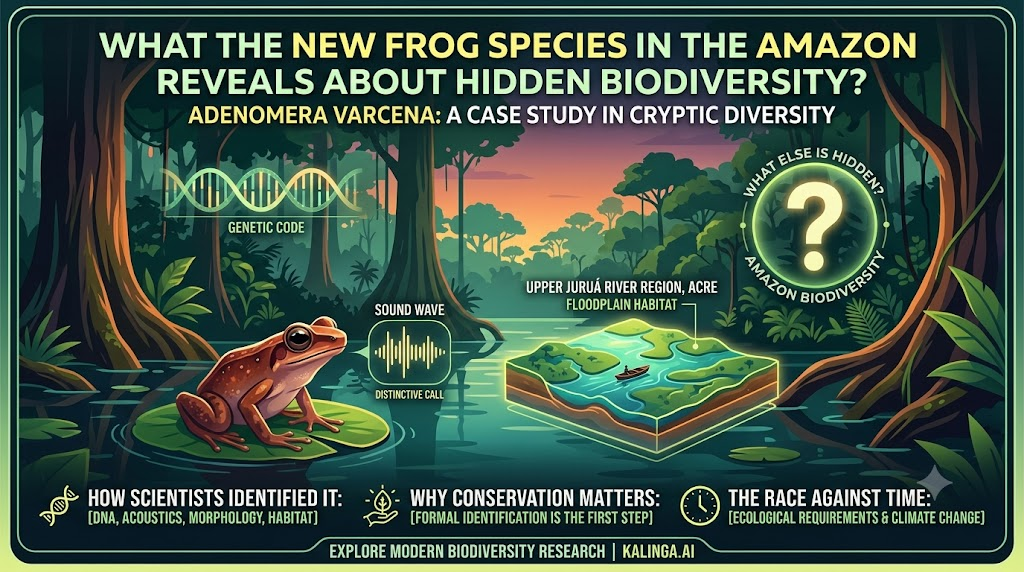
The answer is that the discovery demonstrates how much biodiversity can remain hidden even in one of the world’s most studied ecosystems. Adenomera varcena closely resembles related frogs, yet researchers found enough genetic, acoustic, morphological, and ecological differences to recognize it as a distinct species.
The new frog species in the Amazon was found in seasonally flooded forests near the Upper Juruá River in western Acre, Brazil. These forests are periodically submerged as water levels change, creating a distinctive environment that differs from permanently dry forest habitats.
The finding is particularly interesting because species in the Adenomera genus are generally associated with dryland forests. The discovery of Adenomera varcena in a floodplain environment therefore identifies a habitat association that had not previously been recognized for the genus.
That makes the frog scientifically useful in two ways. First, it expands the known diversity of Neotropical amphibians. Second, it gives researchers another example of how species can remain hidden when scientists rely heavily on outward appearance.
Definition + Expansion: What Is Cryptic Diversity?
Cryptic diversity is the presence of multiple distinct species that look very similar or nearly identical to one another.
In practical terms, two frogs can have broadly similar body shapes and coloration while belonging to different evolutionary lineages. Researchers may need DNA sequencing, vocal recordings, detailed measurements, geographic information, and ecological observations to determine whether they are actually the same species.
This is why the discovery of the new frog species in the Amazon did not happen simply because a scientist saw an unusual-looking frog. The evidence had to show that the animals represented a distinct evolutionary and biological entity.
Where Was Adenomera varcena Found?
The new species was discovered during field expeditions in the Upper Juruá River region of western Acre, Brazil. Researchers surveyed forest fragments close to the Moa and Crôa rivers near Cruzeiro do Sul.
The location matters because the frog was found in seasonally flooded forest, an ecosystem that experiences periodic inundation during the year.
Rather than remaining dry throughout the year, floodplain forests undergo changes linked to seasonal water levels. Plants and animals living there therefore experience environmental conditions that can differ substantially from those in nearby dryland forests.
Question: What makes the frog’s habitat unusual?
Adenomera varcena appears to be associated with a flooded-forest environment even though members of its genus are generally connected with dryland forests. That makes its habitat an important part of understanding the species and its possible ecological requirements.
The researchers named the species varcena in reference to Amazonian floodplain forests, connecting its scientific name to the ecosystem where it was found.
The habitat also provides an important reminder about biodiversity surveys. Finding a species is not simply about searching for animals in the most familiar parts of a rainforest. Different environments can support different communities, and species restricted to particular habitats may be especially difficult to detect.
How Did Scientists Identify the New Frog Species?
Finding a frog that appears unusual is only the beginning. To formally describe a species, scientists need evidence that separates it from already recognized relatives.
In the case of Adenomera varcena, the research team used several complementary types of evidence:
- DNA data to investigate genetic differences.
- Acoustic recordings to compare the frog’s call with related species.
- Morphology, meaning detailed examination of physical characteristics.
- Habitat information to understand where the frogs live.
- Scientific specimens preserved in collections for comparison and future research.
This multi-evidence approach is especially important for animals affected by cryptic diversity. A single visible characteristic may not be enough to establish that an animal represents a separate species.
The Frog’s Appearance Offered One Clue
One physical characteristic helped distinguish Adenomera varcena: researchers noted the absence of a dark spot on the underside of its forearm.
That difference may sound small, but subtle morphological characteristics can be useful when scientists compare closely related amphibians. Taxonomists examine such details systematically rather than relying on general impressions.
Still, physical appearance was only one part of the investigation.
Its Call Added Another Layer of Evidence
For frogs, sound can be as informative as appearance.
Adenomera varcena produces a distinctive mating call with a short sound and slow rhythm, alongside other acoustic characteristics. Researchers used these features to distinguish its call from those of closely related frogs.
Question: Why are frog calls useful for identifying species?
Frog calls can contain species-specific characteristics that help researchers distinguish animals that look very similar. Because mating calls are part of reproductive behavior, differences in acoustic signals can provide important evidence when combined with genetic and physical data.
This is particularly valuable in dense rainforest environments. A frog may be difficult to observe directly, but its call can reveal its presence and provide information about its identity.
DNA Provided Genetic Evidence
Genetic analysis was another critical component of the study.
DNA allows researchers to compare the evolutionary relationships among populations and determine whether apparently similar animals belong to the same lineage or represent distinct lineages.
For the new frog species in the Amazon, DNA evidence was combined with the frog’s call, morphology, and habitat rather than being treated as the only deciding factor.
That broader approach helps reduce the risk of identifying species based on one isolated characteristic.
New Frog Species in the Amazon: What Does Cryptic Diversity Tell Us?
The discovery of Adenomera varcena is part of a larger scientific challenge: some biodiversity is effectively hidden in plain sight.
A rainforest can appear to have a particular number of frog species based on current scientific records. But those records depend on whether researchers have encountered, studied, compared, and formally described the animals living there.
If several species look almost identical, some may historically have been grouped together. Genetic and acoustic studies can reveal that what appeared to be one widespread species may actually consist of several distinct evolutionary lineages.
Question: Does cryptic diversity mean scientists have discovered the same animals incorrectly?
Not necessarily. It means that species boundaries can be difficult to recognize, particularly when closely related organisms share similar physical characteristics. New methods and additional fieldwork can reveal distinctions that were previously difficult or impossible to detect.
The research team found evidence that numerous Adenomera lineages remain formally undescribed. That observation suggests the genus could contain substantially more documented diversity as scientists continue their investigations.
The new frog species in the Amazon therefore becomes an example of a broader phenomenon rather than an isolated curiosity.
Why Could Climate Change Affect This Amazon Frog?
Knowing where a species lives is important, but researchers also need to understand how it reproduces, feeds, moves, and responds to environmental changes.
For Adenomera varcena, much of this ecological information is still unknown.
According to Thiago R. Carvalho, one of the researchers, the lack of detailed information about the species’ ecological requirements and natural history makes it difficult to predict exactly how climate change will affect it.
The concern is connected to the frog’s apparent relationship with seasonal flooding.
Seasonal Flooding May Be Important
Floodplain ecosystems depend on changing water conditions. If climate change alters the timing, duration, or extent of seasonal flooding, the environment experienced by species living there could also change.
For Adenomera varcena, researchers suggest that changes in flood dynamics could potentially influence reproductive behavior. However, the study does not establish exactly how large that effect would be.
That distinction is important.
It would be inaccurate to say that climate change has already been shown to threaten the frog directly. The available evidence instead indicates a potential vulnerability that requires additional research.
Question: Do scientists know exactly how climate change will affect Adenomera varcena?
No. Researchers do not yet have enough information about the species’ ecology and natural history to make a precise prediction. Changes in seasonal flooding could matter, but the magnitude and direction of those effects remain uncertain.
Why Does Species Discovery Matter for Conservation?
At first glance, taxonomy,the scientific process of identifying, naming, and classifying organisms,might seem separate from conservation.
In reality, the two are closely connected.
A species cannot be properly assessed for conservation status if scientists do not know that it exists. An undescribed animal may not appear on threatened-species lists or receive attention in environmental assessments specifically because its existence has not yet been formally recognized.
Definition + Expansion: What Is Taxonomy?
Taxonomy is the scientific practice of identifying, describing, naming, and classifying organisms.
Taxonomy creates the framework scientists use to distinguish one species from another and study their evolutionary relationships. In conservation, formal species descriptions can also provide the scientific basis needed to evaluate populations, habitats, and potential threats.
The researchers involved in the study emphasize that the pace of ecosystem destruction can exceed the pace at which scientists are able to conduct taxonomic research.
That creates a difficult race against time.
A species may exist in a small or specialized habitat while remaining scientifically unknown. If its habitat disappears before researchers recognize and study it, the species could potentially decline or even disappear locally without ever being included in formal conservation assessments.
The discovery of the new frog species in the Amazon illustrates why identifying biodiversity can itself contribute to conservation planning.
How Species Discovery and Conservation Are Connected
The relationship can be understood through a simple chain:
Discover → Describe → Assess → Protect
When researchers discover an organism, they first need to establish what it is. Once a species has been formally described, scientists can investigate its distribution, population, habitat, ecological requirements, and potential threats.
Those data can then support conservation assessments and environmental decision-making.
| Stage | What scientists need to know | Why it matters |
| Discovery | Where does the organism occur? | Establishes that the organism exists |
| Identification | Is it distinct from related species? | Prevents different species from being treated as one |
| Description | What are its defining characteristics? | Creates a formal scientific record |
| Ecological study | What habitat and conditions does it require? | Helps identify environmental dependencies |
| Conservation assessment | Is the species declining or restricted? | Supports evaluation of potential risk |
| Protection | What habitats or populations need attention? | Provides information for conservation strategies |
This does not mean every newly described species is automatically threatened or receives legal protection. Conservation decisions require additional evidence about distribution, abundance, threats, and applicable laws.
But without the species description, that process can be much harder to begin.
The Amazon Still Has Biodiversity Scientists Have Not Fully Catalogued
The discovery of Adenomera varcena fits into a larger picture of ongoing biodiversity research in the Amazon.
The region is famous for its biological richness, but scientific knowledge is not complete. New species continue to be identified, while many known groups still contain lineages that require additional investigation.
Amphibians are especially interesting in this context because species can be separated by characteristics that are difficult to observe without specialized methods.
A frog’s DNA, call, morphology, and habitat can each provide different pieces of information. Combining those pieces can reveal biodiversity that would otherwise remain hidden.
Question: Does discovering more species mean the Amazon is becoming more biodiverse?
No. The discovery does not create new biodiversity; it increases scientists’ documented knowledge of biodiversity that already exists. In other words, the number of known species can rise because researchers improve their ability to detect and formally recognize organisms.
That distinction is crucial when discussing biodiversity statistics.
A rise in the number of scientifically described species does not necessarily mean ecosystems are becoming healthier. At the same time, habitat destruction can cause populations and species to decline even while scientists are still discovering previously undocumented organisms.
This creates a striking contradiction: scientists may be learning more about Amazonian biodiversity at the same time that some of that biodiversity faces environmental pressure.
What Makes the New Frog Species Especially Interesting?
Several details make Adenomera varcena scientifically notable.
1. It Lives in a Flooded-Forest Environment
The frog was found in seasonally flooded forests of western Amazonia, an environment that stands out because related Adenomera frogs are generally associated with dryland forests.
2. It Looks Similar to Related Frogs
The species demonstrates the challenge of cryptic diversity. Its differences are not necessarily obvious at a glance.
3. Its Call Helps Identify It
The frog’s mating call has characteristics that help separate it acoustically from related species.
4. DNA Strengthened the Species Identification
Genetic evidence provided another independent way to examine the relationship between Adenomera varcena and related frogs.
5. Its Discovery Has Conservation Relevance
Formal recognition means researchers can now investigate its distribution, ecology, population status, and environmental vulnerabilities as a distinct species.
What Can Students Learn From This Discovery?
The new frog species in the Amazon also offers a useful lesson in how modern science works.
Science is often portrayed as a process of finding one definitive clue. In biodiversity research, however, strong conclusions can emerge from multiple smaller pieces of evidence.
A student studying biology, environmental science, genetics, or even data science can see the same principle here: different datasets can reveal different aspects of a problem.
For this frog, researchers considered:
- Genetic information
- Acoustic information
- Physical characteristics
- Geographic location
- Habitat
- Museum and scientific collection specimens
Each source contributes something different.
This is also a useful example of interdisciplinary research. Taxonomy, genetics, ecology, field biology, climate science, and conservation can overlap when scientists try to understand a single species.
Why the Discovery Matters Beyond Frogs
It is tempting to think of a newly discovered frog as an isolated wildlife story.
But the underlying issue is much broader.
If visually similar organisms can conceal separate species, the same challenge can occur across many groups of plants and animals. Improving species identification can therefore change scientists’ understanding of how ecosystems are structured and how biodiversity evolved.
It can also affect how researchers interpret environmental change.
Imagine monitoring what appears to be one widespread species. If later research shows that it is actually several species with smaller geographic ranges, the conservation picture could look very different.
One species may turn out to be common in one region while another is restricted to a narrow habitat.
That is why the discovery of the new frog species in the Amazon is more than an addition to a species list. It demonstrates how better scientific resolution can change our understanding of an ecosystem.
Who Conducted the Research?
The study involved researchers from several Brazilian and international institutions.
The research team included Célio F. B. Haddad, a professor at São Paulo State University (UNESP), and Thiago R. Carvalho, a professor at the Federal University of Minas Gerais (UFMG).
Both researchers are associated with the Center for Research on Biodiversity Dynamics and Climate Change (CBioClima), a Research, Innovation, and Dissemination Center funded by the São Paulo Research Foundation (FAPESP).
The broader project also involved scientists from:
- Federal University of Minas Gerais (UFMG)
- São Paulo State University (UNESP)
- University of São Paulo (USP)
- Federal University of Uberlândia (UFU)
- Pontifical Catholic University of Ecuador (PUCE-Quito)
The findings were published in the journal Ichthyology & Herpetology.
The Bigger Question: How Much Amazon Biodiversity Is Still Hidden?
The most interesting part of this discovery may not be the frog itself.
It is the possibility that the Amazon still contains organisms that scientists have not formally recognized.
The researchers’ observation that additional Adenomera lineages remain undescribed suggests that the scientific inventory of Amazonian amphibians is incomplete. Similar challenges can occur when species are rare, geographically restricted, visually similar to other organisms, or difficult to observe.
At the same time, the pressure to document biodiversity is increasing because natural ecosystems are being altered or lost.
That means biodiversity research has two simultaneous goals: understand what exists and determine how environmental change may affect it.
For a species such as Adenomera varcena, the first goal has now taken an important step forward. The next questions involve its population, reproduction, ecological requirements, geographic distribution, and response to changing environmental conditions.
Those questions cannot be answered simply by discovering the frog. They require continued fieldwork and research.
FAQ: New Frog Species in the Amazon
What is the new frog species discovered in the Amazon?
The newly described species is Adenomera varcena, a frog found in seasonally flooded forests in the Upper Juruá River region of western Acre, Brazil. Researchers distinguished it from closely related frogs using DNA, morphology, habitat information, and its distinctive mating call.
Where was Adenomera varcena discovered?
Adenomera varcena was discovered in the Upper Juruá River region of western Acre, near the Moa and Crôa rivers and close to Cruzeiro do Sul. The frogs were found in seasonally flooded forest fragments.
How did scientists know the frog was a new species?
Scientists used multiple lines of evidence rather than relying only on appearance. They compared DNA, physical characteristics, mating calls, habitat, and scientific specimens to distinguish Adenomera varcena from related species.
What is cryptic diversity in frogs?
Cryptic diversity describes cases in which different species look extremely similar or nearly identical. Genetic, acoustic, morphological, and ecological analyses can reveal differences that are difficult to detect by visual observation alone.
Could climate change affect Adenomera varcena?
Potentially, but scientists do not yet know the extent of the effect. Because the frog appears associated with seasonally flooded forests, changes to the timing or pattern of seasonal flooding could influence its habitat and potentially its reproductive behavior.
Why does formally describing a new species help conservation?
Formal species descriptions create a scientific basis for studying a species as a distinct biological entity. This can support future research into its distribution, population, threats, and conservation status, while undescribed species can be missing from threatened-fauna lists and related assessments.
Key Takeaways
- Adenomera varcena is a newly described frog from the seasonally flooded forests of western Amazonia.
- Scientists used DNA, morphology, acoustic signals, habitat data, and scientific specimens to distinguish it from related frogs.
- The species provides another example of cryptic diversity, where closely related animals can look almost identical.
- Its association with flooded forest is notable because Adenomera species are generally associated with dryland forests.
- Researchers say more information is needed to understand the frog’s ecology and how environmental changes could affect it.
- Formally describing species can support conservation by making previously unrecognized biodiversity visible to scientific and environmental assessments.
- The discovery suggests that Amazonian biodiversity remains incompletely documented, particularly among difficult-to-distinguish organisms.
The new frog species in the Amazon is a reminder that biodiversity research is not finished simply because an ecosystem has been studied for decades. Sometimes, understanding what is living in a forest requires listening carefully, analyzing DNA, comparing tiny physical details, and returning to places that may initially seem familiar.
For readers interested in how science, biodiversity, and emerging technology intersect, explore more research explainers and technology stories on Kalinga.ai.