Why Is Threads Becoming More Useful for Podcasters?
Podcast discovery has a visibility problem.
There are millions of podcast episodes competing for listeners’ attention, and publishing an episode is only the beginning. Creators also need ways to announce new episodes, explain why an episode matters, introduce guests, encourage discussion, and bring followers back to older content.
Social networks can provide that promotional layer.
Threads is now expanding its podcast toolkit to make that process easier. Meta says the new features are intended to help creators promote their shows, grow audiences, and engage listeners directly on the platform.
The timing also matters because competing social platforms are paying more attention to podcast content.
X has been encouraging creators to post videos directly to its platform, with podcasts among the types of content receiving attention. Threads is taking a different approach: rather than becoming a podcast-hosting platform, it is trying to make the social conversation surrounding podcasts more useful.
Question → Direct Answer: What is Threads trying to do for podcasters?
Threads is building tools that make it easier for podcast creators to promote episodes, introduce guests, share transcripts, remind themselves to post, and understand how audiences interact with their content.
That means a podcast can remain hosted elsewhere while Threads becomes one of the places where listeners discover and discuss it.
Why Social Discovery Matters
A podcast listener does not necessarily search for a specific show every day.
People often discover podcasts because someone recommends an episode, a guest shares an appearance, a creator posts an interesting clip, or a conversation catches their attention.
That makes social platforms particularly valuable for podcast discovery.
Threads is attempting to make those discovery moments more structured instead of requiring creators to simply paste a podcast URL into a text post.
What Are Threads’ New Podcast Features?
The new Threads podcast features cover several stages of the podcast promotion process.
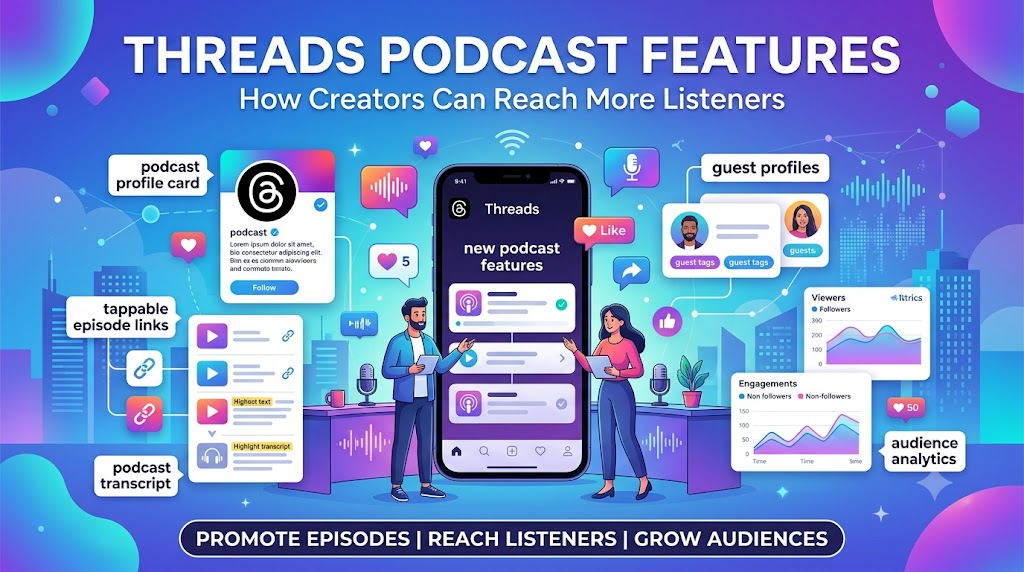
Creators can now use podcast-specific presentation elements on their profiles and posts, while listeners get tools for finding, saving, and reading podcast-related content.
The major additions include:
- Podcast profile cards
- Podcast banners
- Tappable episode-link cards
- Podcast transcripts
- Featured-guest tags
- Guest-related cards
- Post-saving functionality
- New-episode posting reminders
- Audience engagement insights
These tools address different problems.
Profile cards help people understand what a creator’s podcast is. Episode cards make links more visible. Transcripts provide another way to consume an episode. Guest tags can expose content to additional audiences, while insights help creators understand which posts are attracting attention.
Question → Direct Answer: What are the main Threads podcast features?
The main additions are podcast profile cards and banners, tappable episode links, transcripts, guest tags, reminders for new episodes, saving tools, and audience insights.
Together, these features turn Threads into more than a place to announce that a new podcast episode exists.
How Do Podcast Profile Cards and Episode Links Work?
One of the most visible changes is the introduction of podcast-focused profile elements.
Threads will display a podcast profile card and banner on a creator’s profile and in their posts. This gives podcast creators a more recognizable way to connect their social identity with their show.
For a listener discovering a creator for the first time, context matters.
A standard social-media post may tell someone that a new episode is available, but a dedicated podcast card can communicate what the show is and make the connection between the creator and the podcast clearer.
Threads is also changing how episode links appear.
When creators share links to podcast episodes, the links can appear as tappable cards within posts. That makes the episode more visually prominent and gives users a direct path toward listening.
Why Tappable Episode Cards Matter
A URL pasted into a social post can easily disappear into a stream of text.
A dedicated card is different because it provides a more recognizable destination.
The goal is straightforward: reduce friction between seeing an episode and deciding to listen.
Question → Direct Answer: Why are episode-link cards useful for podcasters?
Episode-link cards make podcast links more visible and interactive inside Threads posts. They give users a clearer way to move from social discovery to the actual episode.
For creators, that can make an episode announcement feel more like a piece of podcast content rather than a generic promotional link.
Why Is Threads Adding Podcast Transcripts?
Not every listener wants to consume an entire podcast through audio.
Some people prefer reading. Others may want to scan the important parts of an episode before deciding whether to listen. Transcripts can also make podcast discussions easier to follow inside a social platform.
Threads is therefore allowing podcast hosts to directly post transcripts for listeners to read along with an episode.
Definition + Expansion: Podcast Transcript
A podcast transcript is a written version of the spoken content in an audio episode.
On Threads, transcripts give creators another format for presenting podcast content without requiring users to immediately switch from reading to listening. A transcript can also provide more searchable and scannable text around an episode, although the supplied announcement does not establish specific SEO benefits from the feature.
This matters because social media audiences have different consumption habits.
Someone scrolling Threads might not have headphones available. Another user may simply want to understand what an episode covers before committing time to it.
A transcript gives both users another way to interact with the content.
Question → Direct Answer: Why are transcripts important for podcast promotion?
Transcripts give listeners a text-based way to engage with podcast content on Threads. They can make an episode easier to preview and follow without requiring audio playback.
For creators, this also creates another piece of content that can support a broader discussion around an episode.
Transcript Content Can Extend an Episode’s Life
A podcast episode may be 30 minutes, 60 minutes, or even several hours long.
A social post usually has a much smaller window in which to capture attention.
A transcript can bridge that gap by turning spoken content into material that users can read and discuss. Creators could use sections of a transcript as starting points for conversations, although how individual creators choose to use the feature will determine its practical value.
How Can Guest Tags Expand Podcast Reach?
Podcasts often depend heavily on guests.
An interview with an entrepreneur, researcher, athlete, creator, or industry expert can attract audiences from multiple communities. But simply mentioning someone’s name in a post does not necessarily create the strongest possible connection between the episode and that guest.
Threads is adding tools that allow podcast hosts to tag featured guests, with the platform displaying a related card.
This gives guest appearances a more structured presence within Threads content.
Question → Direct Answer: How do guest tags help podcast creators?
Guest tags connect a podcast post more directly with a featured guest and can give the guest-related content a dedicated card. This can help creators structure conversations around interviews and collaborations.
For example, a technology podcast interviewing a startup founder could share the episode on Threads while tagging the guest. The post then becomes both an episode announcement and a piece of collaborative social content.
Guest Promotion Creates Multiple Discovery Paths
A podcast episode can have several audiences.
There is the show’s existing audience, the guest’s followers, people interested in the topic, and users who encounter the post through ongoing conversations.
That makes guests potentially important distribution partners.
Threads’ guest-focused tools are designed around that reality by making guest participation more visible within podcast posts.
Can Posting Reminders Help Podcasters Stay Consistent?
Podcast creators already have a long list of tasks.
They have to plan episodes, record interviews, edit audio, create show notes, publish episodes, communicate with guests, and promote the finished content.
Social promotion can easily become an afterthought.
Threads is adding posting reminders that can notify creators when a new episode drops and remind them to post about it on the platform.
That sounds like a small feature, but consistency is important for creators building an audience.
Question → Direct Answer: What do Threads’ posting reminders do?
Threads can remind podcast creators to post on the platform when a new episode is released. The feature is intended to make podcast promotion easier to incorporate into a creator’s publishing routine.
The reminder does not create a successful promotional strategy by itself.
It simply reduces the possibility that a creator publishes an episode elsewhere and forgets to tell their Threads audience about it.
Why Consistency Matters
Imagine a podcast releasing every Wednesday.
If the creator regularly posts on Threads around each release, followers may begin to associate that day with new content. If promotion happens inconsistently, the social audience may have fewer opportunities to discover new episodes.
A reminder can help with the operational side of that routine.
The creative side—writing a useful post, starting a conversation, responding to listeners, and making the episode interesting—still belongs to the creator.
What Audience Insights Can Podcasters Track?
Posting content is only half of social-media marketing.
Creators also need to understand what happens after publishing.
Threads is adding audience insights that provide information about how users engage with creators’ posts. The announcement specifically mentions metrics showing views over time by followers, non-followers, and all viewers.
That distinction can be useful.
A post receiving views primarily from existing followers is reaching an established audience. A post attracting substantial views from non-followers may be reaching people outside the creator’s current community.
Question → Direct Answer: What insights are Threads giving podcast creators?
Threads is providing audience insights that show how posts perform over time, including views from followers, non-followers, and all viewers.
These measurements can help creators understand how their posts are being discovered and how broadly individual pieces of content are reaching.
Followers vs. Non-Followers
For podcast creators, non-follower reach can be particularly relevant to discovery.
A podcast cannot grow indefinitely by talking only to people who already know about it.
Creators need new listeners.
If a particular episode announcement attracts significant attention from non-followers, the creator can at least identify that the post reached beyond the existing community. The metric does not automatically explain why that happened, but it provides another piece of information for future content planning.
Threads vs. X for Podcast Promotion
Threads and X are both social platforms where creators can build communities around conversations, but their podcast strategies are not identical.
The supplied announcement notes that X has also been encouraging creators to post videos directly on the platform, particularly podcasts, as part of efforts around revenue and engagement.
Threads, meanwhile, is emphasizing podcast promotion and discussion without announcing podcast hosting as its goal.
| Feature | Threads | X |
| Podcast promotion | Dedicated tools being expanded | Creators encouraged to post podcast video |
| Podcast hosting focus | Not currently the focus | Video and creator content are emphasized |
| Episode links | Tappable podcast cards | Standard social sharing can be used |
| Transcripts | Direct transcript posting supported | Approach differs by creator and content format |
| Guest promotion | Guest tags and related cards | Creators can use standard tagging and posts |
| Audience insights | Views by followers and non-followers | Creator analytics provide platform-specific metrics |
| Main opportunity | Podcast discovery and discussion | Creator content, video, discussion, and monetization |
This is not necessarily a competition between identical products.
Podcasters can use multiple platforms depending on where their audiences spend time.
Question → Direct Answer: Is Threads trying to replace podcast platforms?
No. The announcement describes Threads as a platform for podcast promotion and discussion rather than a podcast-hosting service.
The actual audio episode can continue to live on a dedicated podcast platform while Threads provides another route for discovery and audience interaction.
Why Does Meta Want Threads to Become a Podcast Discovery Hub?
The bigger strategy becomes clearer when looking at Threads’ growth.
Meta said Threads reached 500 million monthly active users in June 2026. That gives the platform a large potential audience for creators, including podcasters.
A platform with hundreds of millions of active users has an obvious incentive to encourage more types of creators to use it regularly.
Podcasts are particularly useful because they generate recurring content.
A weekly or daily show can produce a steady stream of episode announcements, guest discussions, transcripts, questions, quotes, reactions, and follow-up conversations.
That aligns well with a platform built around ongoing discussion.
Question → Direct Answer: Why is podcast content valuable to Threads?
Podcasts can generate recurring conversations and content, giving Threads more opportunities to keep creators and audiences engaged on the platform.
The strategy also allows Threads to participate in podcast discovery without having to become the primary destination where podcast audio is hosted.
Threads’ Earlier Podcast Push
This is not Threads’ first attempt to support podcast creators.
Meta’s latest announcement follows podcast-related tools introduced the previous year, including better link cards and the ability to link a creator’s Threads profile with their podcast.
The 2026 update therefore represents an expansion of an existing strategy rather than a completely new direction.
The platform is gradually adding more tools around the relationship between creators, podcasts, guests, and listeners.
What Does 500 Million Users Mean for Podcast Creators?
Threads reaching 500 million monthly active users in June 2026 changes the scale of the opportunity available to creators.
It does not mean every podcast will automatically reach a large audience.
Audience size and audience engagement are different things.
A huge platform provides potential distribution, but creators still need content that gives people a reason to stop scrolling.
For podcasters, the value of Threads may therefore come from combining podcast content with social conversation.
An episode about artificial intelligence, for example, can become more than an episode link.
The creator can ask a question about the topic, tag the guest, share a transcript section, respond to comments, and direct interested users toward the complete episode.
Question → Direct Answer: Does Threads’ user growth guarantee podcast growth?
No. A large platform creates potential access to audiences, but it does not guarantee that an individual podcast will gain listeners. Discovery still depends on the content, audience interest, creator activity, and how people respond to posts.
This distinction is important for anyone treating social media as a podcast-growth strategy.
What Do Threads Podcast Features Mean for Indian Creators?
For Indian podcast creators, Threads’ expanded toolkit could be relevant because podcasting increasingly intersects with creator-led education, entertainment, technology, business, and culture.
India has a large social-media audience, and creators often distribute the same content across multiple platforms.
A podcast host might publish the full episode through a podcast service, share video clips through a video platform, post visual content through Instagram, and use Threads for conversation.
The new Threads podcast features fit into that multi-platform workflow.
How Students and Young Creators Can Use Threads
A student launching a technology podcast does not necessarily need a huge production team to use social media effectively.
They can build a simple workflow:
- Publish the podcast episode on the chosen hosting platform.
- Connect the podcast identity with their Threads presence.
- Share the episode using the new link-card format.
- Add a useful summary or discussion question.
- Tag the featured guest when appropriate.
- Share relevant transcript material.
- Save useful posts for future reference.
- Review audience insights after publishing.
- Use the results to improve future promotion.
The key is to treat Threads as part of the content workflow rather than as an afterthought.
Question → Direct Answer: Should new podcasters use Threads?
Threads can be one of several social channels used to promote a podcast, particularly for creators interested in text-based discussion and community interaction.
The platform should be considered alongside the creator’s target audience, content format, and existing distribution channels.
How Can Podcasters Use Threads More Effectively?
The new features provide tools, but tools alone do not create audience engagement.
Creators still need a reason for people to care about an episode.
Instead of posting only “New episode out now,” a podcaster could use the episode as the starting point for a conversation.
For example, a business podcast might ask:
“Will AI create more jobs than it automates over the next five years?”
The creator can then connect the discussion to the new episode.
A technology podcast could share an interesting idea from its guest. A student-focused show could post a practical lesson from an interview. A creator interviewing a startup founder could use the guest tag to connect both communities.
A Simple Podcast Promotion Framework
A useful social post can answer three questions:
- What is this episode about?
- Why should someone care?
- What should they do next?
The new Threads tools can support each stage.
The podcast card provides identity. The episode card provides the destination. The transcript provides additional context. Guest cards add another discovery path, while insights help creators evaluate the result.
This makes the platform more useful as a podcast-promotion workflow.
What Is the Future of Podcast Promotion on Social Media?
Podcast promotion is increasingly becoming a multi-format activity.
A single audio episode can generate video clips, images, quotes, transcripts, short posts, polls, guest collaborations, newsletters, and community discussions.
That means podcasting is no longer just about producing audio.
It is also about packaging ideas for different audiences and platforms.
Threads’ new features fit into that broader shift.
The platform is not trying to turn every podcast into a Threads-native audio show. Instead, it is building infrastructure around the social layer of podcasting.
Question → Direct Answer: What is changing about podcast promotion?
Podcast promotion is becoming increasingly distributed across social platforms, where creators can use different formats to attract audiences and start conversations around full episodes.
For creators, that means one episode can become the foundation for an entire week of social content.
The Social Layer Could Become More Important
Podcast discovery traditionally depended heavily on podcast directories, recommendations, search, and word of mouth.
Social networks add another mechanism: conversation-driven discovery.
Someone may encounter a post because they follow a guest rather than the podcast. Another person may discover an episode through a discussion about a topic. Someone else may read a transcript and decide to listen later.
Threads’ latest tools are designed to support these different discovery paths.
Why This Matters Beyond Podcasters
Meta’s move also illustrates a broader trend in social-media platforms.
Platforms increasingly want creators to keep their audiences engaged without forcing every piece of content into a single format.
A podcast can generate audio, text, video, images, and discussion.
By supporting those different layers, Threads can become part of a creator’s broader publishing ecosystem.
For young professionals and students interested in digital media, this is an important lesson.
The future of content creation is increasingly about distribution as much as production.
Knowing how to make a podcast is one skill. Knowing how to package, distribute, analyze, and discuss that podcast across platforms is another.
What Should Podcasters Watch Next?
Threads’ September 2026 update shows that Meta is continuing to invest in creator-focused podcast tools.
The most important development may not be any individual feature.
Instead, it is the combination.
Podcast profile cards create identity. Episode cards improve discovery. Transcripts provide another consumption format. Guest tags connect collaborators. Reminders encourage consistency. Insights provide feedback.
Together, those features create a more complete promotional workflow.
Threads is also approaching the podcast opportunity from a different direction than a traditional podcast-hosting service.
The audio can remain somewhere else.
The conversation happens on Threads.
That distinction could become increasingly important as social networks compete to become discovery and community layers for creator businesses.
FAQ: Threads Podcast Features
What are the new Threads podcast features?
Threads has introduced podcast profile cards and banners, tappable episode links, transcript posting, guest tags, guest-related cards, post-saving tools, new-episode reminders, and audience insights for creators.
Can podcasts be hosted directly on Threads?
The September 2026 announcement does not describe Threads as a podcast-hosting platform. Instead, Meta is positioning Threads as a place where creators can promote podcasts and engage listeners around episodes.
How do podcast episode links work on Threads?
Podcast episode links can appear as tappable cards in Threads posts, giving users a more direct way to discover and access an episode.
Why is Threads adding podcast transcripts?
Transcripts allow listeners to read podcast content directly on Threads. They provide an alternative to consuming an episode entirely through audio and give creators another format for discussing their shows.
How can podcast guests benefit from Threads’ new tools?
Podcast hosts can tag featured guests, with Threads displaying a related card. This can help structure promotional posts around interviews and collaborations between creators and guests.
What audience data can podcasters see on Threads?
Threads provides insights showing views over time, including views from followers, non-followers, and all viewers. These metrics can help creators understand how broadly their posts are being seen.
What Should Podcasters Take Away?
The biggest change is not that Threads suddenly became a podcast platform. It is becoming a more specialized place for podcast discovery, promotion, and conversation.
Meta’s new tools address several practical problems creators face: making episodes visible, promoting guests, offering transcripts, remembering to post, and understanding audience reach.
With Threads reaching 500 million monthly active users in June 2026, the platform has a substantial audience for creators to potentially reach. But audience size alone does not guarantee podcast growth; creators still need useful content and conversations that give people a reason to engage.
For Indian students, freshers, and young professionals interested in the creator economy, the update also highlights an increasingly valuable skill: learning how to turn one piece of content into a broader digital experience.
A podcast episode can become a conversation, a transcript, a guest collaboration, and a discovery opportunity.
And with these new Threads podcast features, Meta is giving creators more tools to make that process happen inside Threads.
Keep exploring Kalinga.ai for practical explainers on creator platforms, AI, social media, and the technologies shaping digital career.