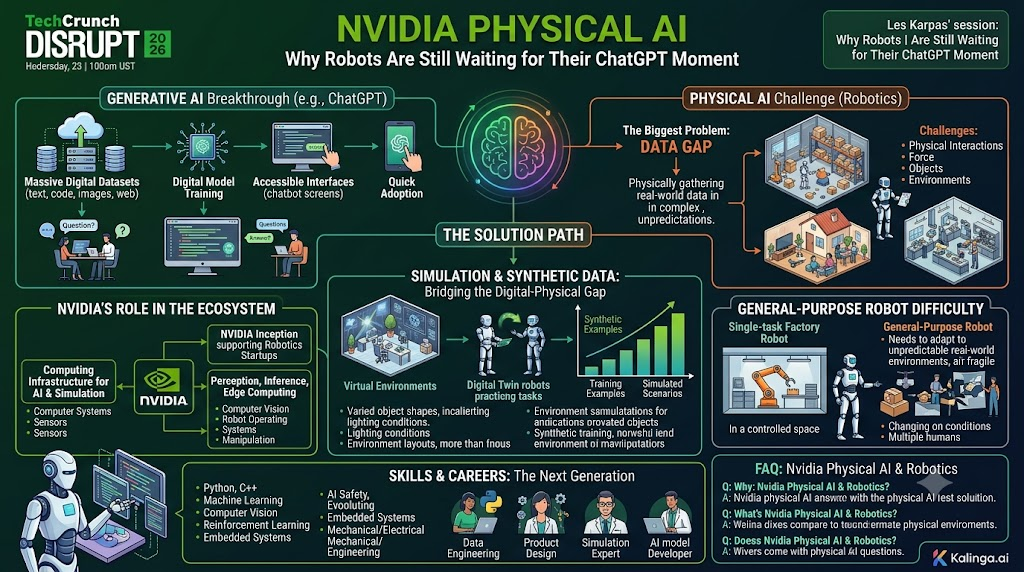
Why Is Robotics Still Waiting for Its ChatGPT Moment?
We’ve watched AI move from a specialist technology to something millions of people use every day, but robots still haven’t experienced an equivalent breakthrough.
The reason, according to Nvidia Inception’s Global Head of Physical AI Les Karpas, is closely connected to data. While language-model developers benefited from enormous amounts of digital information, robotics companies still face a major challenge in collecting enough real-world data to train robots for the huge variety of situations they may encounter.
Karpas is set to discuss that challenge at TechCrunch Disrupt 2026, where his session, “Robots Are Waiting for Their ChatGPT Moment. Here Is What Is Standing in the Way,” will examine the obstacles and opportunities facing physical AI.
The event is scheduled for October 13–15, 2026, at Moscone West in San Francisco.
The bigger story isn’t simply about one conference session. It is about a fundamental question for the robotics industry: What will it take for robots to become as useful and familiar in everyday life as AI assistants have become?
What Is Nvidia Physical AI?
Definition + Expansion: Physical AI
Physical AI refers to artificial intelligence systems that can perceive, reason about, and interact with the physical world through machines such as robots and autonomous vehicles.
Traditional generative AI primarily operates in a digital environment. A language model can write text, summarize information, generate code, or answer questions without physically moving through the world.
Physical AI has a different challenge.
A robot has to understand its surroundings and translate an AI decision into a physical action. It must account for objects, movement, space, timing, force, uncertainty, and changing environmental conditions.
That makes robotics fundamentally different from simply generating another paragraph of text.
Question → Direct Answer:
What is physical AI in robotics?
Physical AI combines AI models with robotic or autonomous systems so machines can perceive and act in the real world. It is intended to help robots perform tasks in environments that are less predictable than controlled industrial settings.
This is the area Nvidia is increasingly focused on through its physical AI efforts and its relationship with robotics startups.
Why Did ChatGPT Have a Breakthrough That Robots Haven’t?
ChatGPT’s launch in November 2022 demonstrated how quickly a digital AI interface could reach ordinary users.
People didn’t need to understand neural networks, model training, or large language models to experiment with ChatGPT. They simply typed a question and received an answer.
That created an unusually accessible interface between people and AI.
Robotics faces a much harder adoption problem because the physical world is considerably more complicated.
A chatbot can generate a response in milliseconds without worrying about whether it will knock over a glass, collide with a person, misjudge the distance to an object, or lose its balance.
A robot has to deal with those possibilities.
Question → Direct Answer:
Why hasn’t robotics had a ChatGPT moment yet?
One major obstacle is the lack of massive, diverse real-world datasets for physical AI. Robotics companies cannot simply rely on the kind of internet-scale text data that helped language-model developers train powerful AI systems.
The data problem affects nearly everything else.
A robot needs examples of how objects look, how they move, how people interact with them, and how actions produce different results in different environments.
The more general-purpose the robot is expected to become, the more varied those examples need to be.
Why Is Data the Biggest Problem for Physical AI?
Training modern AI systems requires large quantities of useful data.
Language models have access to enormous collections of digitally available information. The internet contains text, images, code, videos, and other forms of material that can be processed at scale.
Physical AI doesn’t have an equivalent universal dataset.
A robot can’t learn everything it needs to know simply by reading the internet.
It needs information about physical interactions.
For example, a robot learning to pick up an object may need to understand:
- The object’s shape
- Its size
- Its weight
- Its material
- Where it is positioned
- How much force to apply
- How the object reacts when touched
- What happens if the grip is imperfect
- How the surrounding environment changes
Collecting this information in the real world can be slow and expensive.
A robot must physically perform tasks to generate many of the experiences needed for training.
Why Self-Driving Cars Offer a Useful Comparison
The autonomous-driving industry has had an advantage that many other robotics applications don’t.
Companies such as Waymo and other autonomous-driving developers can collect enormous amounts of information through vehicles operating on real roads.
Every mile driven can potentially contribute additional data about roads, traffic, pedestrians, weather, and other driving situations.
That dataset can continue expanding as fleets operate in more locations.
General-purpose robots don’t have the same straightforward data-collection mechanism.
There is no single equivalent of “robot miles” that automatically captures every household, factory, warehouse, hospital, street, and workplace interaction.
Question → Direct Answer:
Why can’t robotics companies simply collect data like self-driving companies?
Robots operate across a much wider range of physical tasks and environments. A self-driving fleet can repeatedly gather data from road environments, while general-purpose robots may need to learn an enormous variety of interactions involving different objects, spaces, people, and tasks.
That makes the physical-AI data problem particularly difficult.
How Can Simulation Help Train Robots?
If collecting enough real-world data is difficult, researchers and companies can attempt to generate some of that experience digitally.
This is where simulation and synthetic data become important.
Simulation creates virtual environments in which robots can practice tasks without physically performing them in the real world.
A simulated robot could potentially repeat an action thousands or millions of times while encountering different conditions.
For example, a virtual training environment could vary:
- Object positions
- Lighting
- Obstacles
- Surface conditions
- Robot movements
- Object shapes
- Task sequences
- Environmental layouts
The resulting information can help researchers train and evaluate robotic systems before deploying them in physical environments.
What Is Synthetic Data?
Synthetic data is artificially generated information created to supplement or, in some cases, substitute for portions of real-world training data.
In physical AI, synthetic data can provide robots with additional examples of environments and interactions that may be expensive or difficult to collect physically.
But simulation has an obvious challenge: the simulated world has to represent the real world accurately enough to be useful.
If a robot performs perfectly inside a virtual environment but encounters unexpected physical behavior outside it, the training system has not solved the entire problem.
This is often described as the challenge of bridging the digital and physical worlds.
Can Foundation Models Make Robots More General-Purpose?
Another part of the robotics strategy involves foundation models.
A foundation model is a large AI model trained on broad data that can potentially be adapted for multiple tasks rather than being designed exclusively for one narrow application.
The robotics industry is exploring similar ideas.
Instead of training a completely separate model for every robot and every task, companies are attempting to build models that can operate across different robotic platforms and environments.
Question → Direct Answer:
Why are robotics companies interested in foundation models?
Foundation models could potentially provide a common AI layer that can be adapted across different robots and tasks, reducing the need to develop entirely separate AI systems for every physical application.
This could be particularly important for general-purpose robotics.
Imagine a future robot that can move from one task to another without requiring an entirely new AI system every time its environment changes.
That is a much more ambitious goal than building a machine optimized for one repetitive factory task.
What Role Does Nvidia Play in Physical AI?
Nvidia has become deeply involved in the infrastructure supporting modern AI, and the company is also positioning itself around robotics and physical AI.
At Nvidia Inception, Les Karpas works with a broad startup ecosystem spanning areas such as:
- Robotics
- Automotive
- Manufacturing
- Mobility
- Smart cities
- Physical AI
That gives Karpas exposure to companies attempting to solve different parts of the robotics problem.
Question → Direct Answer:
Why is Nvidia interested in robotics?
Nvidia sees robotics and physical AI as an important area for AI development and works with startups across robotics, automotive, manufacturing, mobility, and related fields.
The company’s interest also reflects a broader shift in AI computing.
AI isn’t limited to data centers and software applications.
As models begin operating machines, autonomous vehicles, and other physical systems, those systems require computing infrastructure capable of handling perception, simulation, inference, and increasingly complex AI workloads.
Why Does Nvidia Need a Robotics Startup Ecosystem?
Robotics is too broad for one company to solve every problem.
A warehouse robot may need different hardware and software from an autonomous vehicle. A household robot may face completely different challenges from a manufacturing system.
That creates an ecosystem of startups working on different parts of the technology stack.
Some companies focus on robot hardware.
Others work on:
- Computer vision
- Simulation
- Robot operating systems
- AI models
- Sensors
- Autonomous navigation
- Manipulation
- Data collection
- Industrial automation
Nvidia’s relationship with this ecosystem gives it a perspective that extends beyond a single robotic product.
The company’s Inception program connects Nvidia with startups across multiple industries, including companies attempting to solve the physical-AI data challenge.
What Makes General-Purpose Robots So Difficult?
A robot that performs one predictable task can be relatively straightforward compared with a machine expected to handle many different situations.
Consider a factory robot designed to repeatedly move an identical component between two fixed locations.
Its environment can be carefully controlled.
Now imagine asking the same robot to work in a home.
Suddenly, the environment becomes unpredictable.
There may be:
- Different furniture
- Children or pets
- Objects in unexpected locations
- Changing lighting
- Fragile items
- Narrow spaces
- Moving people
- Different floor surfaces
- Unfamiliar objects
The robot needs to adapt.
Question → Direct Answer:
Why are general-purpose robots difficult to build?
General-purpose robots must operate across diverse and unpredictable physical environments, requiring them to perceive changing conditions, make decisions, and execute actions safely and accurately.
This is why physical AI cannot be treated as simply putting a chatbot inside a robot.
The language model may provide reasoning capabilities, but the complete robotic system still needs perception, movement, sensors, control systems, hardware, and safety mechanisms.
What Will Les Karpas Discuss at TechCrunch Disrupt 2026?
Les Karpas will address these robotics challenges during the Real World AI Stage at TechCrunch Disrupt 2026.
His session is titled:
“Robots Are Waiting for Their ChatGPT Moment. Here Is What Is Standing in the Way.”
The session is expected to focus on the limitations and opportunities surrounding AI and robotics, particularly the challenges involved in bringing physical AI into everyday life.
Karpas’s professional background also spans several industries and disciplines.
According to the event announcement, his experience includes roles connected to companies and organizations such as Stanley Black & Decker, Intellectual Ventures, Herman Miller, iRobot, and Cirque du Soleil.
His career has included work as an architect, manufacturing engineer, startup CEO, venture studio executive, and corporate venture capitalist.
That cross-disciplinary background is relevant because robotics itself sits at the intersection of multiple fields.
The Real World AI Stage
The session is part of TechCrunch Disrupt’s Real World AI programming.
Other companies and founders featured in the broader lineup include representatives from Shield AI, Colossal Biosciences, FieldAI, and Foxglove, according to the event announcement.
The focus is broader than consumer robots.
It reflects the increasing interest in AI systems that operate in physical environments.
Nvidia Physical AI vs. Generative AI: What’s Different?
It is useful to compare physical AI with the generative AI systems that became widely popular after ChatGPT.
| Area | Generative AI | Physical AI |
| Primary environment | Digital | Physical |
| Main inputs | Text, images, audio, data | Sensors, cameras, physical data |
| Main outputs | Text, images, code, audio | Physical actions |
| Data challenge | Large digital datasets | Diverse real-world experience |
| Training methods | Digital model training | Real-world data + simulation |
| Failure impact | Often digital | Can affect physical objects and people |
| Hardware dependency | Primarily computing devices | Robots, sensors, actuators, compute |
| Example | AI writing assistant | Autonomous robot |
The difference is especially important when considering safety.
A language model generating an incorrect sentence is undesirable, but a physical system making an incorrect movement could create an entirely different consequence.
That means robotics developers need to think about reliability and safety alongside model performance.
What Could Finally Give Robots Their ChatGPT Moment?
There probably isn’t one single technology that will suddenly make robots mainstream.
Instead, several pieces may need to improve simultaneously.
The robotics ecosystem is exploring a combination of:
- Better foundation models
- More physical-world training data
- Synthetic data
- Advanced simulation
- Improved sensors
- More capable hardware
- Better robot control systems
- More efficient AI computing
- Improved safety mechanisms
- Scalable deployment
The data problem sits near the center of many of these efforts.
More capable models need useful data. Better simulation can generate more training experiences. Better hardware can make robots capable of performing more complex tasks.
These improvements can reinforce each other.
Question → Direct Answer:
What could help robotics reach a ChatGPT-like breakthrough?
A combination of scalable physical-world data, simulation, synthetic data, foundation models, capable hardware, and reliable control systems could help make robots more adaptable and useful across everyday environments.
The timing of such a breakthrough remains uncertain.
What is clear is that the industry is actively trying to solve the bottlenecks preventing robots from becoming broadly useful.
What Does Physical AI Mean for AI Careers?
For students and freshers, physical AI creates an interesting intersection between software and hardware.
AI careers are no longer limited to building chatbots or training language models.
Robotics requires people who understand how AI interacts with physical systems.
That creates opportunities across several technical areas.
Skills Worth Learning
Students interested in robotics and physical AI can explore:
- Python and C++
- Machine learning
- Computer vision
- Robotics fundamentals
- Sensor technologies
- Simulation
- Reinforcement learning
- AI model deployment
- Edge computing
- Embedded systems
- Robot operating systems
- Data engineering
- AI safety
- Autonomous systems
A strong robotics career can also require knowledge beyond coding.
Mechanical engineering, electrical engineering, manufacturing, control systems, industrial design, and product development can all contribute to physical AI systems.
Why Cross-Disciplinary Skills Matter
Les Karpas’s own career illustrates how robotics draws from multiple disciplines.
His professional experience spans architecture, manufacturing engineering, entrepreneurship, venture development, and corporate venture capital.
That is a useful reminder for students: the robotics industry isn’t built only by people who train AI models.
People are needed to design machines, manufacture components, build software, collect data, develop simulations, create business models, and deploy systems safely.
Why Is Simulation an Important Career Skill?
Simulation is becoming particularly relevant because physical AI cannot always rely exclusively on real-world experimentation.
A virtual environment can allow developers to test robotic behavior before deploying it physically.
That can help reduce some of the cost and complexity associated with repeated physical testing.
For students, learning simulation therefore offers a path into robotics without requiring immediate access to expensive hardware.
A learner can begin by understanding virtual environments, robotic movement, computer vision, physics engines, and reinforcement-learning concepts.
The transition from simulation to real hardware then becomes another stage of the learning process.
What Is the Future of AI-Powered Robots?
The long-term vision for physical AI extends well beyond humanoid robots.
Robotic systems could eventually be used across:
- Manufacturing
- Warehousing
- Agriculture
- Healthcare
- Logistics
- Construction
- Transportation
- Smart cities
- Domestic environments
But each application introduces different requirements.
A warehouse robot may prioritize navigation and package handling. An agricultural robot may need to understand crops and uneven outdoor environments. A household robot may need to operate safely around people and unpredictable objects.
That is why a general-purpose physical AI system is such a difficult engineering challenge.
Question → Direct Answer:
Will physical AI replace all human workers?
The supplied announcement does not establish such an outcome. The current focus is on the technical challenges of making robots more capable and useful in real-world environments, particularly the data and training problems involved in physical AI.
The more immediate story is about augmentation, automation, and new forms of machine capability.
What Can Indian Students Learn From the Robotics Race?
For students in India, the physical-AI trend connects several areas that are already important in the country’s technology ecosystem.
AI, semiconductor computing, manufacturing, automation, embedded systems, and robotics are increasingly interconnected.
That means students don’t necessarily need to choose between “AI” and “hardware” as completely separate career paths.
There is growing value in understanding the interface between them.
For example, someone studying computer science could learn computer vision and robotics simulation. An electronics student could explore edge AI and autonomous systems. A mechanical engineering student could add machine learning and robot-control skills.
The strongest learning path depends on the individual’s background, but the overall direction is increasingly multidisciplinary.
What Should We Watch at TechCrunch Disrupt 2026?
Karpas’s upcoming session provides an opportunity to hear directly from someone working with startups across the physical-AI ecosystem.
The central question is straightforward:
What is preventing robots from becoming as accessible and useful as today’s AI assistants?
The answer involves much more than model size.
It involves data, simulation, hardware, software, safety, deployment, and the ability to generalize from one physical environment to another.
TechCrunch Disrupt 2026 is scheduled for October 13–15 in San Francisco, with the event announcement stating that 10,000+ tech leaders, founders, and investors are expected to attend.
For people following robotics, AI, startups, and emerging technology careers, the physical-AI discussion offers a useful view of where the next wave of innovation may be focused.
The Bigger Picture: AI Is Leaving the Screen
The first major wave of generative AI put powerful models directly in front of everyday users.
The next challenge is making AI useful outside the screen.
That means teaching machines to understand environments, interact with objects, navigate uncertainty, and perform tasks safely.
This is where Nvidia physical AI efforts and the broader robotics ecosystem intersect.
The industry has already demonstrated that AI can generate language, images, software, and other digital outputs at remarkable scale.
Physical AI asks a harder question:
Can AI turn intelligence into reliable action in the real world?
Solving that problem will require more than one breakthrough.
It will require advances across models, data, simulation, computing, robotics hardware, and engineering.
And unlike the ChatGPT moment, the breakthrough may not arrive as one application that suddenly becomes everyone’s interface to AI.
It could emerge gradually as robots become capable of performing more useful tasks, in more environments, with fewer human instructions.
That may ultimately be the real robotics breakthrough: not simply a smarter robot, but a robot that can reliably understand what people want and act on it in the physical world.
FAQ: Nvidia Physical AI and Robotics
What is Nvidia physical AI?
Nvidia physical AI refers to the company’s focus on AI systems designed to operate in and interact with the physical world, including robotics, autonomous systems, manufacturing, mobility, and related applications.
Why haven’t robots had a ChatGPT moment?
A major challenge is data. Unlike language models that can learn from enormous quantities of digital information, robots require diverse physical-world data involving objects, environments, movements, and interactions.
Why is physical AI harder than generative AI?
Physical AI has to connect AI decisions with real-world actions. Robots must perceive their surroundings, account for physical conditions, control hardware, and operate reliably in environments that can change unexpectedly.
How can simulation help robotics?
Simulation allows robots and AI models to practice tasks in virtual environments. Developers can generate synthetic experiences and test different conditions without requiring every training example to happen physically.
What is Les Karpas discussing at TechCrunch Disrupt 2026?
Les Karpas, Nvidia Inception’s Global Head of Physical AI, is scheduled to discuss why robotics has not yet experienced a ChatGPT-like breakthrough and the technical challenges that stand in the way.
When is TechCrunch Disrupt 2026?
TechCrunch Disrupt 2026 is scheduled for October 13–15, 2026, at Moscone West in San Francisco. The event’s Real World AI Stage will feature discussions about robotics and other physical applications of AI.
What Should Students Take Away?
The robotics industry is trying to solve a problem that generative AI largely avoided: how to teach AI to operate reliably in the messy, unpredictable physical world.
Data, simulation, foundation models, sensors, computing, and robotics hardware will all play a role. For students and young professionals, that creates opportunities for people who can combine AI knowledge with engineering and real-world system skills.
The next big AI breakthrough may not live inside a chat window. It may move, see, grasp, navigate, and work alongside people.
Keep exploring Kalinga.ai for practical explainers on AI, robotics, emerging technologies, and the skills shaping the next generation of tech careers.